
The Trouvelot Astronomical Drawings: all 15 plates
The fifteen chromolithographs of É. L. Trouvelot’s set, in order, with the date of each observation as printed on the plate.
Étienne Léopold Trouvelot (1827–1895) was a French artist and astronomer who spent most of his working life in Massachusetts. In 1872 he began drawing the sky at Harvard College Observatory, and in 1875 he was invited to use the great 26-inch telescope of the U.S. Naval Observatory in Washington.
He worked in pastel, at the eyepiece, before photography could show this much detail. In 1881 and 1882 Charles Scribner’s Sons published fifteen of his drawings as large chromolithographs, about 28 by 38 inches, printed by Armstrong & Company at the Riverside Press in Cambridge, with a separate Manual describing each plate. Each plate prints the date of the observation it records. In 1882 he went back to France to work at the new observatory at Meudon.
He is also remembered for something else: the spongy moth, which escaped from his silk-moth experiments in Medford around 1868–69 and became one of America’s worst forest pests. Our Journal tells that story.
The plates
In the order of the set, with the observation as printed on each plate and the Manual’s note on how it was seen.
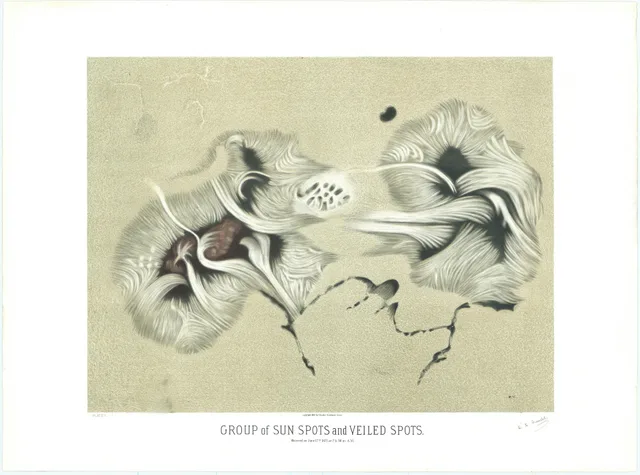
Group of Sun Spots and Veiled Spots
17 June 1875, 7.30 a.m.
Two large sunspots, each a dark core under a fringe of pale, straw-like filaments, joined by a dark crack, with two faint veiled spots nearby.
Through a telescope. The Manual says the group first appeared as three small dots on 15 June and had grown by the next morning.
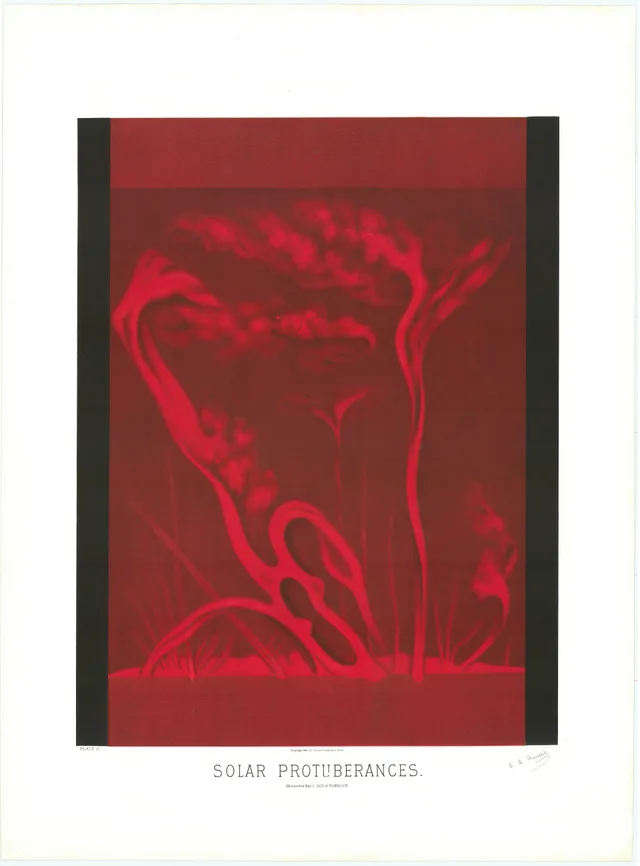
Solar Protuberances
5 May 1873, 9.40 a.m.
Tall, flame-like jets and drifting clouds of glowing red gas rising from the edge of the Sun.
Through a telescope fitted with a spectroscope.
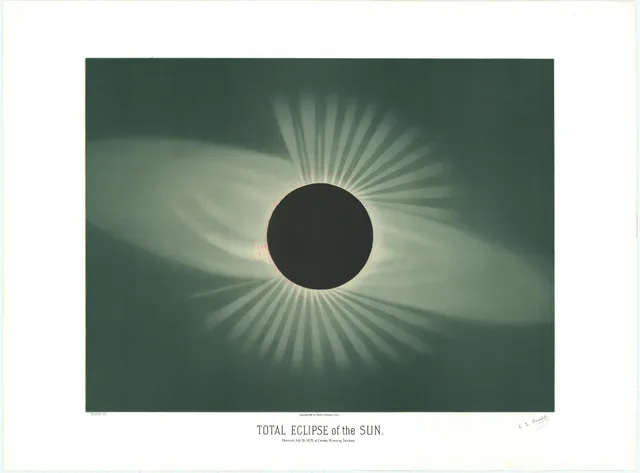
Total Eclipse of the Sun
29 July 1878, at Creston, Wyoming Territory
The black disc of the Moon ringed by the pale green-white streamers of the corona, with two long wings stretching east and west.
For the U.S. Naval Observatory, with a 6⅓-inch refracting telescope, a few seconds before totality ended.
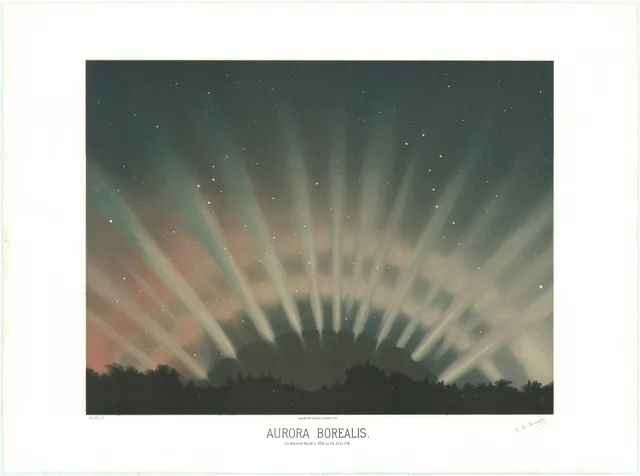
Aurora Borealis
1 March 1872, 9.25 p.m.
Arches of pale green light, pink at the western end, sending bright streamers up over a dark landscape.
With the naked eye. The Pole Star is near the centre, the Great Bear on the right and Cassiopeia on the left.
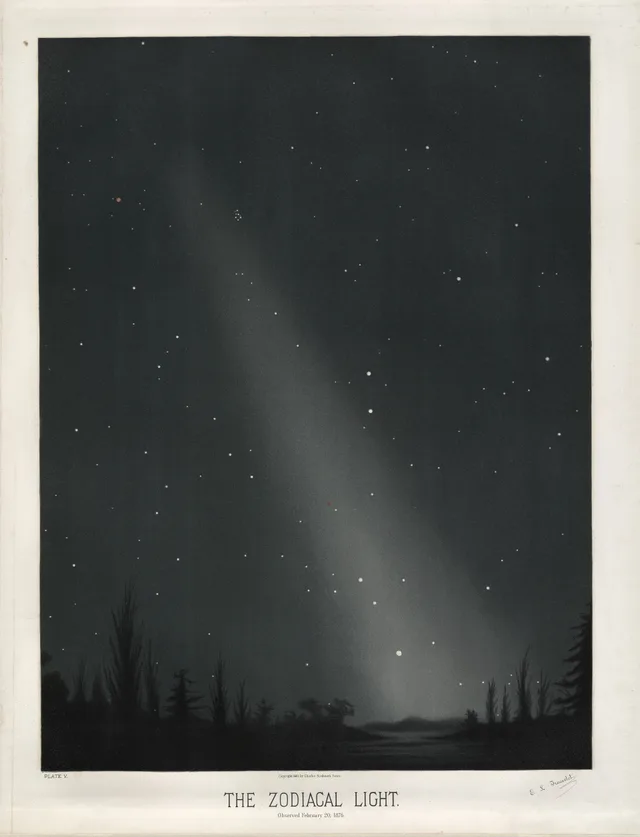
The Zodiacal Light
20 February 1876, in the evening, in the west
A faint, slanting cone of pale light rising from a dark wooded horizon into a starry sky.
With the naked eye. Venus and Mars both shine inside the cone of light.
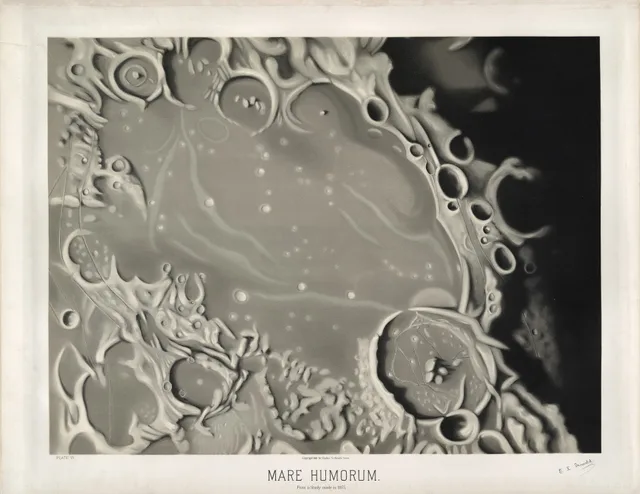
Mare Humorum
From a study made in 1875
The Moon’s “Sea of Moisture”, a grey plain ringed by broken crater walls and mountains.
Through a telescope, drawn upside down as a refracting telescope shows it.
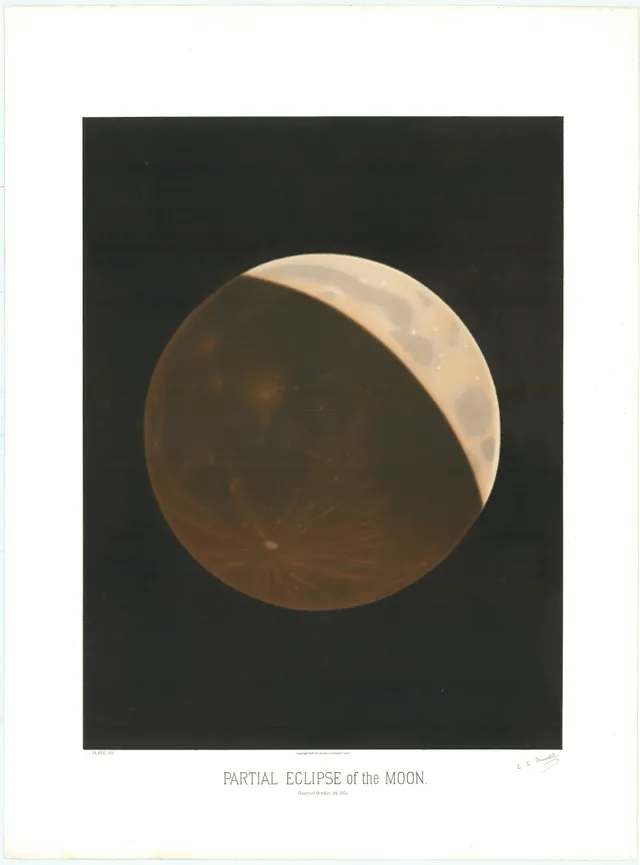
Partial Eclipse of the Moon
24 October 1874
The full Moon, most of its face in the Earth’s copper-brown shadow, with a bright crescent still in sunlight.
With the naked eye.
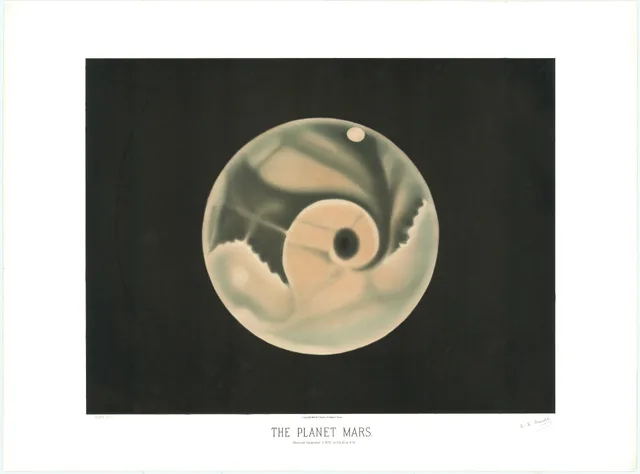
The Planet Mars
3 September 1877, 11.55 p.m.
The disc of Mars in salmon pink with grey-green markings and a small white polar cap.
Through a telescope, during the close approach of Mars in 1877.
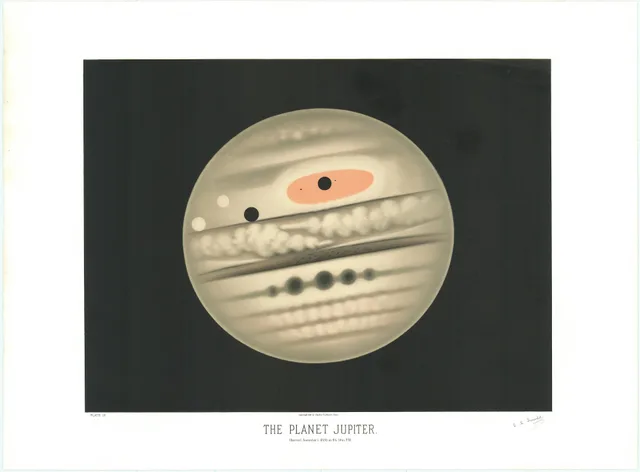
The Planet Jupiter
1 November 1880, 9.30 p.m.
Jupiter’s banded disc in creams and greys, with the pink Great Red Spot and the black shadows of its moons.
Through a telescope.
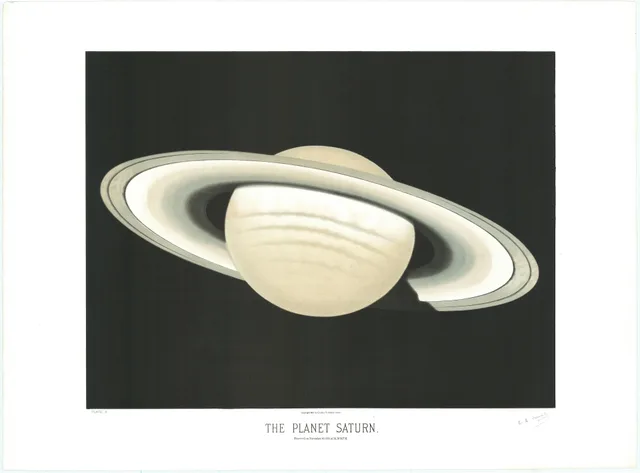
The Planet Saturn
30 November 1874, 5.50 p.m.
Saturn tilted on black, its cream globe banded and wrapped in grey and white rings, with the planet’s shadow across them.
Through a telescope. (Several online copies give the time as 5.30; the plate and the Manual both say 5.50.)
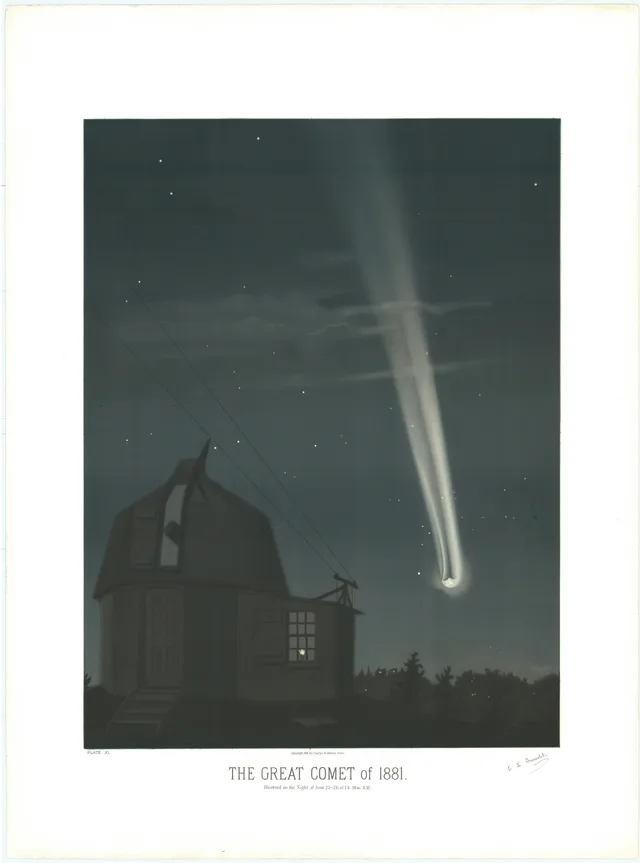
The Great Comet of 1881
Night of 25–26 June 1881, 1.30 a.m.
A bright comet with a long, split, curving tail streaming up a deep blue night sky above a small domed observatory.
Drawn as the naked eye saw it, with detail added from the telescope. Today the comet is known as Tebbutt’s comet, C/1881 K1.
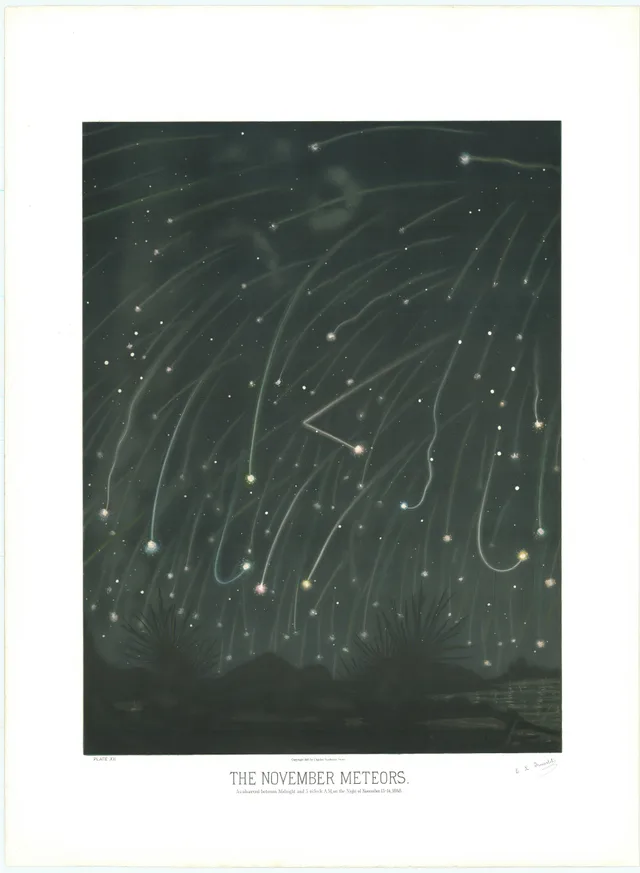
The November Meteors
Night of 13–14 November 1868, from midnight to 5 a.m.
Dozens of shooting stars streaking down a dark sky in curved, wavy and broken trails, some tinted red, green and blue.
From “a northern window of my house”. The Manual calls it an ideal view, combining meteors seen at different moments that night.
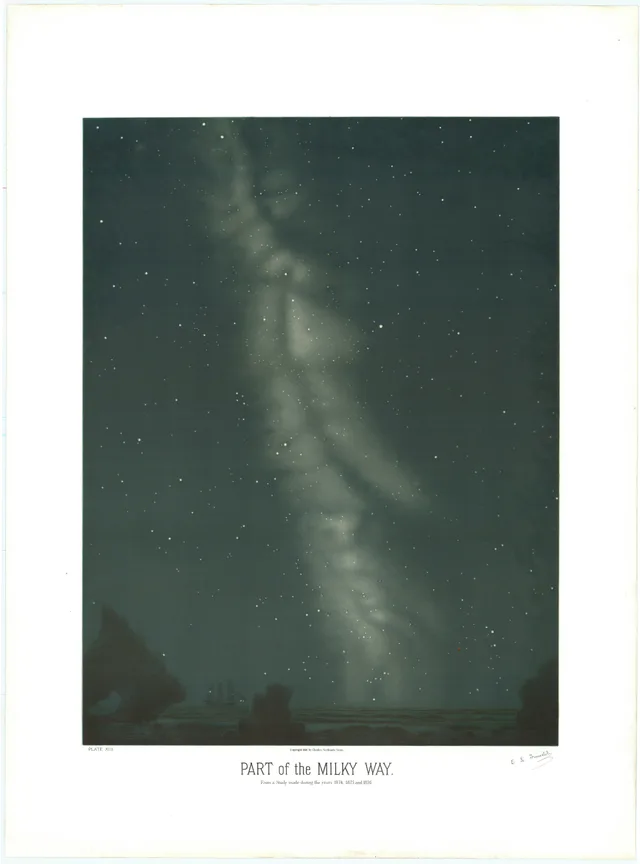
Part of the Milky Way
From a study made in 1874, 1875 and 1876
The Milky Way as a branching river of misty starlight crossing a dark blue-green sky.
With the naked eye, from Cassiopeia through Cygnus and Aquila to Scorpius.
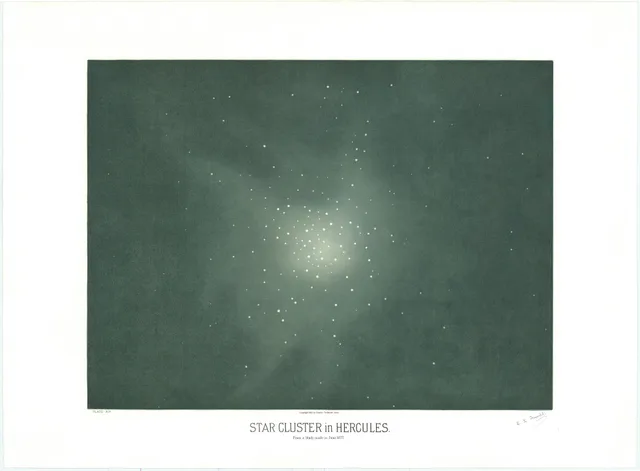
Star Cluster in Hercules
From a study made in June 1877
A glowing ball of tightly packed stars with faint curving wings of light.
Through telescopes of several sizes. The cluster is the one now called Messier 13.
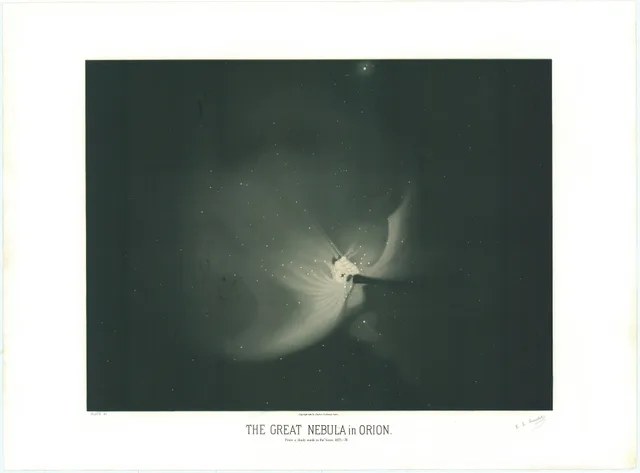
The Great Nebula in Orion
From a study made in 1875–76
The cloud-like core of the Orion Nebula with its four-star Trapezium, sweeping wisps and dark rifts.
Through a telescope. The Manual says he studied this nebula with the refractors at Harvard and at the Naval Observatory in Washington, but not which one this drawing comes from.
All 15 plates, for citing
| Plate | Title | Observed |
|---|---|---|
| I | Group of Sun Spots and Veiled Spots | 17 June 1875, 7.30 a.m. |
| II | Solar Protuberances | 5 May 1873, 9.40 a.m. |
| III | Total Eclipse of the Sun | 29 July 1878, at Creston, Wyoming Territory |
| IV | Aurora Borealis | 1 March 1872, 9.25 p.m. |
| V | The Zodiacal Light | 20 February 1876, in the evening, in the west |
| VI | Mare Humorum | From a study made in 1875 |
| VII | Partial Eclipse of the Moon | 24 October 1874 |
| VIII | The Planet Mars | 3 September 1877, 11.55 p.m. |
| IX | The Planet Jupiter | 1 November 1880, 9.30 p.m. |
| X | The Planet Saturn | 30 November 1874, 5.50 p.m. |
| XI | The Great Comet of 1881 | Night of 25–26 June 1881, 1.30 a.m. |
| XII | The November Meteors | Night of 13–14 November 1868, from midnight to 5 a.m. |
| XIII | Part of the Milky Way | From a study made in 1874, 1875 and 1876 |
| XIV | Star Cluster in Hercules | From a study made in June 1877 |
| XV | The Great Nebula in Orion | From a study made in 1875–76 |
See the set free, and sources
- New York Public Library, Digital Collections: all 15 plates
- Internet Archive: the 15 plates
- Project Gutenberg: the Manual (1882), full text
- Internet Archive: the Manual, University of California copy
The dates follow the plates themselves. A few online copies differ: some give Saturn’s time as 5.30 p.m. (the plate says 5.50), the meteors as ending at 3 a.m. (5 a.m.) and the Orion study as 1873–76 (1875–76). The plates are in the public domain. The restorations shown here are Madten’s, at web resolution, and are free to view. To cite this page: Madten, “The Trouvelot Astronomical Drawings: All 15 Plates,” https://www.madten.com/reference/trouvelot-astronomical-drawings, 2026-11-09.