
William Morris and Morris & Co.: every pattern we hold
Wallpapers, cottons, silks, carpets and embroidery by William Morris, John Henry Dearle and May Morris, each with its date, how it was made and the museum that holds it.
William Morris (1834–1896) designed patterns for the things people live with: wallpaper, curtains, cushions and carpets. He began because he could not find a wallpaper he liked well enough for his own home. His first, Trellis, came from the roses growing over trellises in the garden at Red House, the house in Kent that his friend Philip Webb designed for him.
The firm started in 1861 as Morris, Marshall, Faulkner & Co., a group of friends making furnishings by hand. In 1875 Morris took sole charge and renamed it Morris & Co. It sold wallpapers, printed and woven cloth, carpets and embroidery. After Morris died in 1896, his assistant John Henry Dearle carried on as art director.
Everything was made the slow way. Wallpapers were printed by hand from carved wooden blocks. Cloth was coloured with plant dyes, indigo for blue, madder for red and weld for yellow, which Morris set out to relearn in the 1870s. A good pattern stayed in the catalogue for decades, so many of the pieces below were printed long after they were designed.
Why do they still look current? Morris drew plants he knew, from his gardens and from country walks, and flattened them into repeats that read clearly from across a room and still reward a close look. Several are in production today: Morris & Co. is now part of Sanderson, which still owns the original blocks for Fruit.
This page lists every Morris & Co. piece we have restored: 45 museum pieces of 37 designs, some in more than one colourway. Each picture comes from an open-access museum photograph, and the table at the bottom gives the museum record for each one.
The designers
William Morris
Founded the firm in 1861 with friends as Morris, Marshall, Faulkner & Co., took sole charge in 1875 and renamed it Morris & Co. Also a poet, novelist and campaigner. He drew most of the patterns on this page.
38 pieces on this pageJohn Henry Dearle
Joined the firm’s Oxford Street showroom as an assistant in 1878 and trained as Morris’s tapestry apprentice. Chief designer by 1890 and art director after Morris died. Many of his patterns were sold under Morris’s name.
7 pieces on this pageMay Morris
William Morris’s younger daughter. From 1885 she ran the firm’s embroidery department, and her designs were often credited to her father.
1 piece on this pageWallpapers
23 piecesPrinted by hand from carved wooden blocks, each colour from its own blocks. Most were printed for the firm by Jeffrey & Co. of Islington, and the Met’s sheets are printed in distemper, a water-based paint. A large pattern needed many blocks: St James’s took 68.
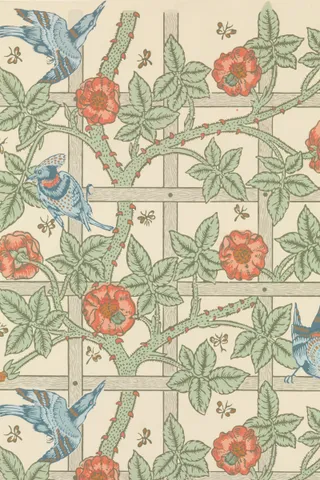
Trellis
Morris’s first wallpaper, drawn from the roses trained over trellises in his garden at Red House. His friend Philip Webb, the architect of the house, drew the birds.
Wallpaper, block-printed in distemper colours by Jeffrey & Co.. The Metropolitan Museum of Art.
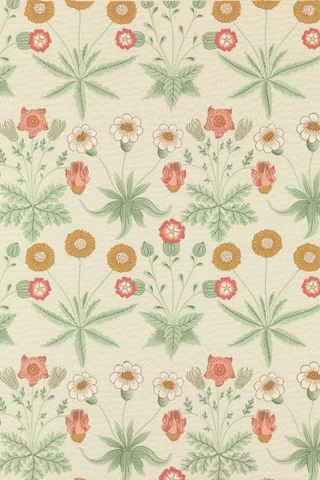
Daisy
Cream
The first Morris wallpaper to go into production. The little front-facing plants come from a wall hanging painted in a fifteenth-century manuscript of Froissart’s Chronicles.
Wallpaper, block-printed in distemper colours by Jeffrey & Co.. The Metropolitan Museum of Art.
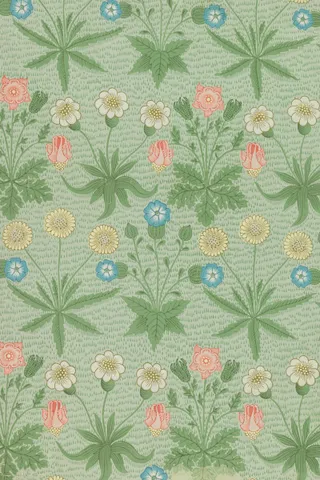
Daisy
Green
The same Daisy on a light green ground, the flowers in white, pink, pale yellow and sky blue. Short dashes of darker green stand in for grass.
Wallpaper, block-printed. Cooper Hewitt, Smithsonian Design Museum.
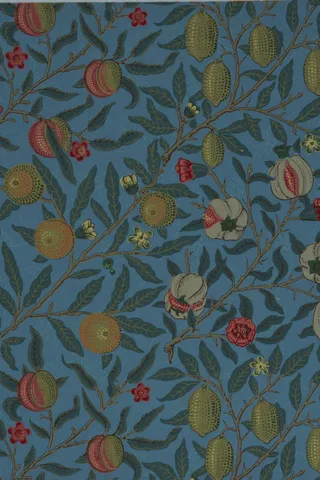
Fruit (or Pomegranate)
Blue
Pomegranates split to show their seeds, with lemons and peaches, on branches that cross the sheet on the diagonal. It became one of Morris’s most lasting papers, and the original printing blocks still survive.
Wallpaper, block-printed; printed by Jeffrey & Co.. Cooper Hewitt, Smithsonian Design Museum.
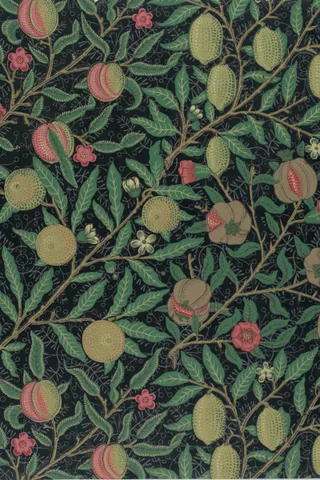
Fruit (or Pomegranate)
Black
The same branches printed on a near-black ground. The fruit is the same; the dark makes the pinks and greens glow.
Wallpaper, block-printed; printed by Jeffrey & Co.. Cooper Hewitt, Smithsonian Design Museum.
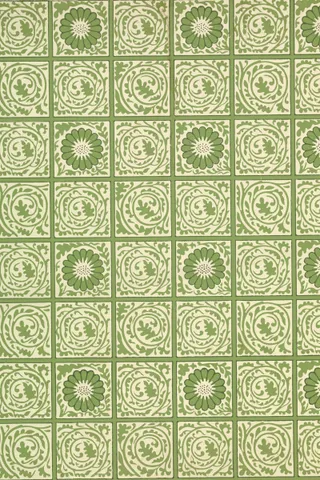
Diaper
“Diaper” is the old word for a small repeat of squares. This one alternates a daisy-like flower with leafy scrolls. It began in two colourways, yellow and olive, and seven more were added in the 1870s.
Wallpaper, block-printed. Cooper Hewitt, Smithsonian Design Museum.
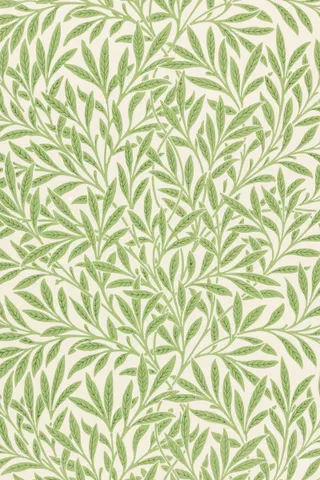
Willow
Green on cream
Morris’s first willow paper. The willow was one of his favourite motifs, and here small leaves turn every way on fine stems, so there is no obvious direction to the pattern.
Wallpaper, block-printed; printed by Jeffrey & Co.. Cooper Hewitt, Smithsonian Design Museum.
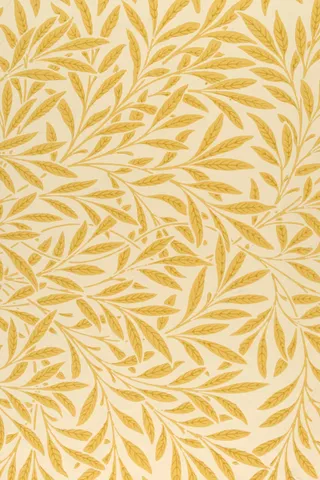
Willow
Gold
The same Willow printed in yellow and ochre on white, so the leaves read warm gold rather than green.
Wallpaper, block-printed. Cooper Hewitt, Smithsonian Design Museum.
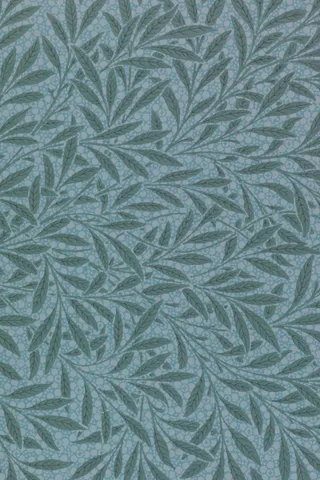
Willow
Blue
Dark blue-green leaves over a lighter blue ground that is itself dotted with tiny flowers: two patterns, one on top of the other.
Wallpaper, block-printed. Cooper Hewitt, Smithsonian Design Museum.
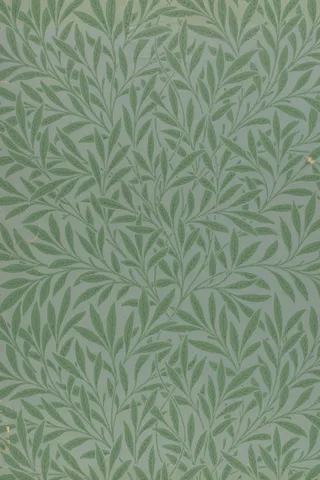
Willow
Sage
Darker green leaves on a muted sage ground, the quietest of the four willows here.
Wallpaper, block-printed. Cooper Hewitt, Smithsonian Design Museum.
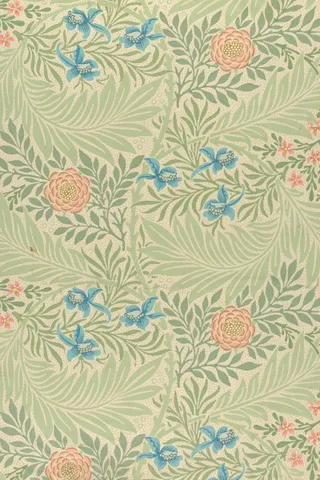
Larkspur
Larkspur was first issued as a one-colour paper. This printing has blue larkspur, peach double flowers and small pink blooms on long pale fronds.
Wallpaper, block-printed. Cooper Hewitt, Smithsonian Design Museum.
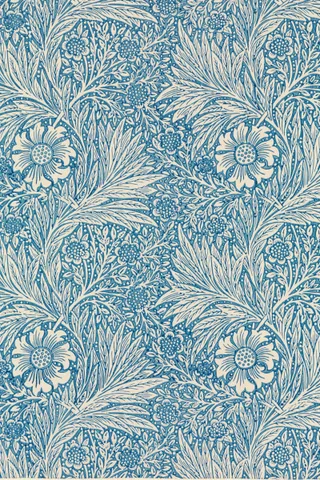
Marigold
Printed in a single blue on white. Flowers, veins and feathery leaves are drawn as pale lines in a dense blue field, with almost no plain ground left.
Wallpaper, block-printed in distemper colours by Jeffrey & Co.. The Metropolitan Museum of Art.
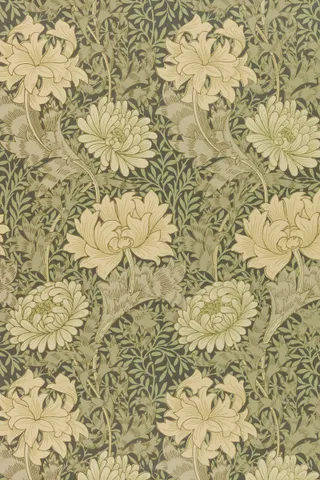
Chrysanthemum
Large cream chrysanthemums rise through olive leaves over a dark ground packed with small foliage.
Wallpaper, block-printed. Cooper Hewitt, Smithsonian Design Museum.
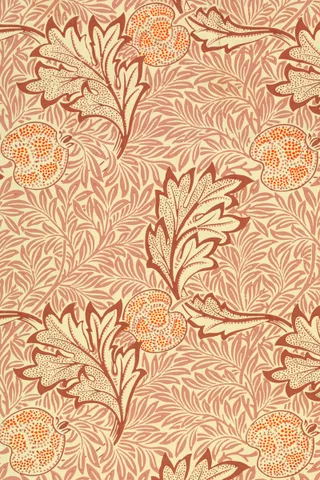
Apple
Apples drawn in orange dots, with two sizes of leaf: big ones outlined in dark red, and a fine pink leaf ground behind them.
Wallpaper, block-printed; printed by Jeffrey & Co.. Cooper Hewitt, Smithsonian Design Museum.
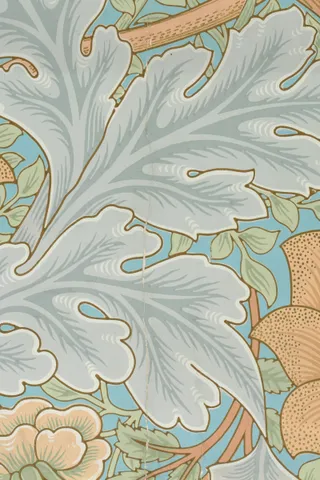
St James’s
Made for the Grand Staircase of St James’s Palace. One repeat spans two widths of paper and took 68 blocks to print. The blocks burned in a fire at Jeffrey & Co. on 22 November 1881 and had to be cut again. This sheet shows a single giant acanthus leaf.
Wallpaper, block-printed. Cooper Hewitt, Smithsonian Design Museum.
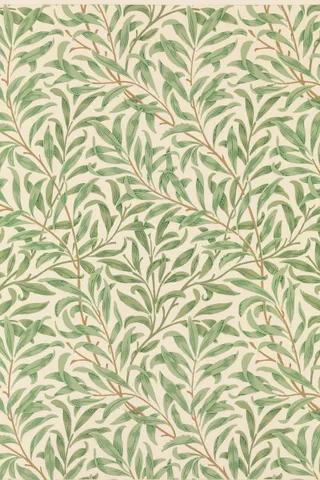
Willow Bough
Drawn from willow branches seen on a country walk. His daughter May later described the walk with her father that gave him the idea. Thirteen years after Willow, the leaves are larger and the branches sway.
Wallpaper, block-printed in distemper colours by Jeffrey & Co.. The Metropolitan Museum of Art.
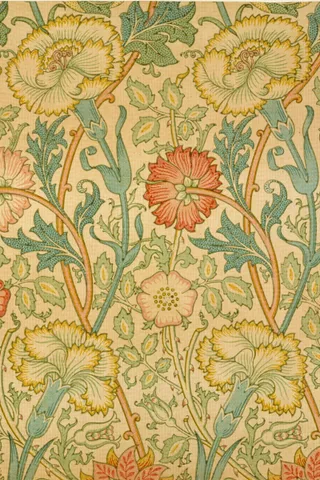
Pink and Rose
Tall stems of pinks, the cottage-garden carnations, twine with wild roses over a honey-coloured ground.
Wallpaper, block-printed in distemper colours by Jeffrey & Co.. The Metropolitan Museum of Art.
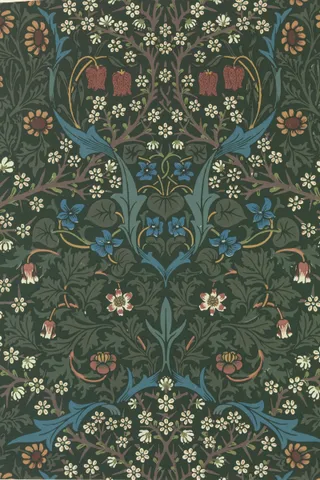
Blackthorn
Long sold as a Morris. The Met credits Dearle, adding “approved by William Morris”. White blackthorn blossom frames violets and red snakeshead fritillaries on deep green.
Wallpaper, block-printed in distemper colours by Jeffrey & Co.. The Metropolitan Museum of Art.
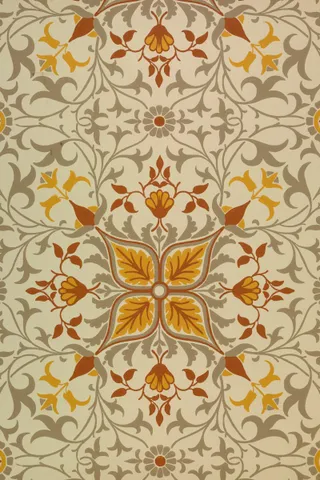
Net Ceiling
A paper for ceilings, from the year before Morris died. It is symmetrical both ways, so it looks right from wherever you stand in the room.
Ceiling paper, block-printed. Cooper Hewitt, Smithsonian Design Museum.
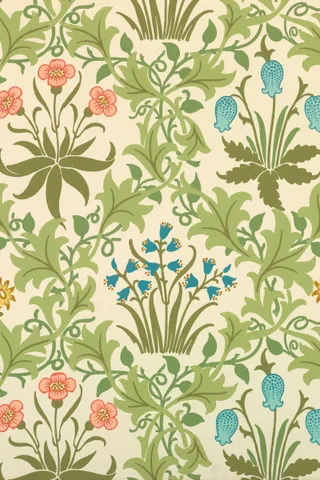
Celandine
Twining vines make diamond-shaped bowers, and each one holds a clump of flowers. The Cooper Hewitt names lily of the valley and bluebells among them.
Wallpaper, block-printed. Cooper Hewitt, Smithsonian Design Museum.
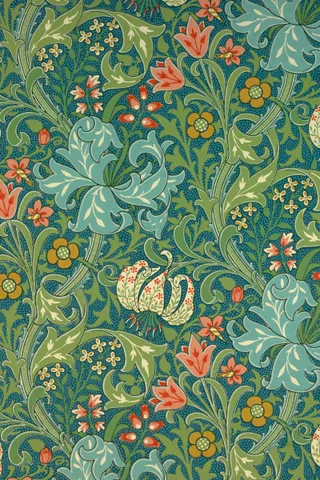
Golden Lily
Drawn after Morris’s death, and long sold as one of his. Dearle’s design drawing at the Huntington dates to about 1897; most records date the paper 1899.
Wallpaper, block-printed; printed by Jeffrey & Co.. Cooper Hewitt, Smithsonian Design Museum.
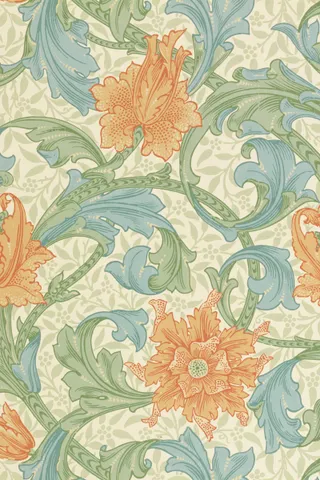
Single Stem
Scrolling acanthus leaves and big orange flowers over a fine ground of small leaves, drawn nearly ten years after Morris died.
Wallpaper, block-printed on continuous paper; printed by Jeffrey & Co.. Cooper Hewitt, Smithsonian Design Museum.
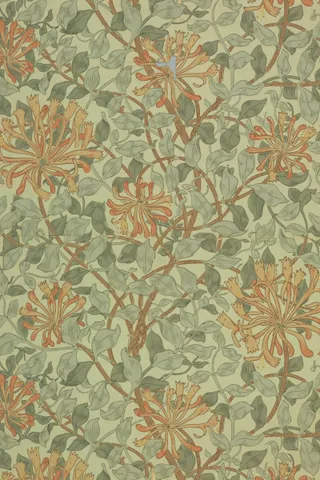
Honeysuckle
Wallpaper
May Morris drew this paper in 1883, two years before she took charge of the firm’s embroidery. It is a different design from her father’s Honeysuckle cloth of 1876, below.
Wallpaper, block-printed. Cooper Hewitt, Smithsonian Design Museum.
Printed cottons and linens
8 piecesIn the mid-1870s Morris spent fortnights at Thomas Wardle’s dyeworks in Leek, Staffordshire, learning the old vegetable dyes. His biographer wrote that his hands were “habitually and unwashably blue”. In 1881 he moved his works to Merton Abbey on the River Wandle. There he finally made indigo discharge work: the cloth is dyed blue all over, then bleach is printed on to take the blue out wherever another colour will go.
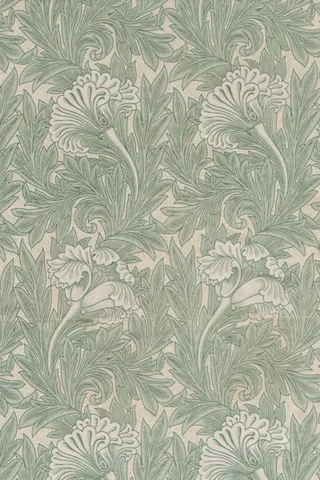
Tulip
Frilled white tulips among dense, saw-edged leaves. This example was printed by machine roller in a single pale green.
Furnishing cotton, roller-printed. The Cleveland Museum of Art.
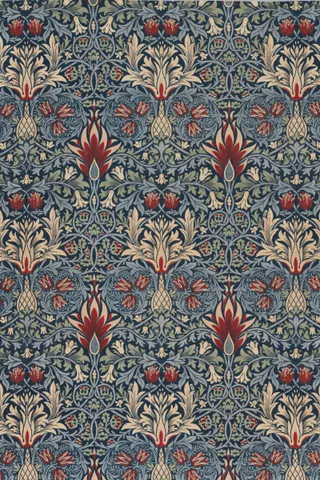
Snakeshead
Named for the snakeshead fritillary, a wildflower Morris remembered growing in the meadows near Oxford. Its strong red and dark colours were in fashion only briefly.
Furnishing cotton, printed (early 20th-century printing). The Cleveland Museum of Art.
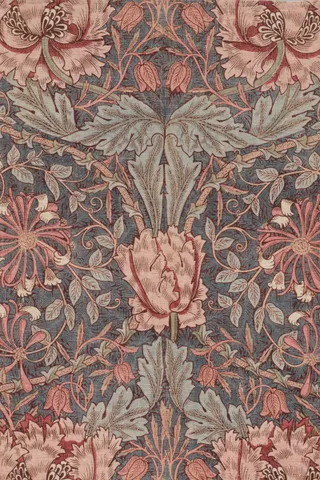
Honeysuckle
Printed linen
May Morris called it “the very symbol of a garden tangle”. The mirrored repeat is almost as wide as the loom.
Furnishing linen, printed (early 20th-century printing). The Cleveland Museum of Art.
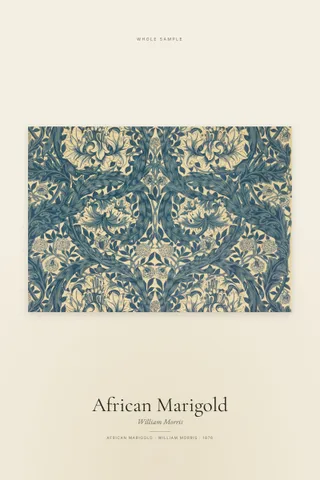
African Marigold
Leafy branches loop into great circles around open flowers, printed in one blue on off-white. A different drawing from the Marigold wallpaper above.
Furnishing cotton, printed. Cooper Hewitt, Smithsonian Design Museum.
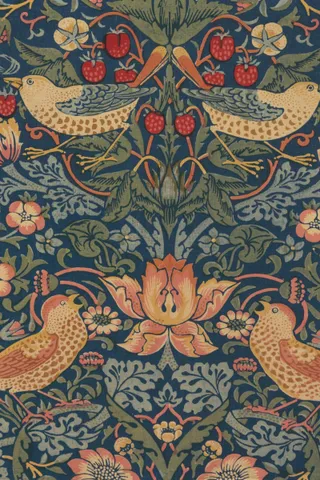
Strawberry Thief
Thrushes kept stealing the strawberries in the kitchen garden at Kelmscott Manor, so Morris put them on a cloth. In May 1883 he wrote that he was “anxiously superintending the first printing”. It was one of the firm’s most expensive cottons, and a favourite anyway.
Furnishing cotton, indigo-discharged and block-printed. Cooper Hewitt, Smithsonian Design Museum.
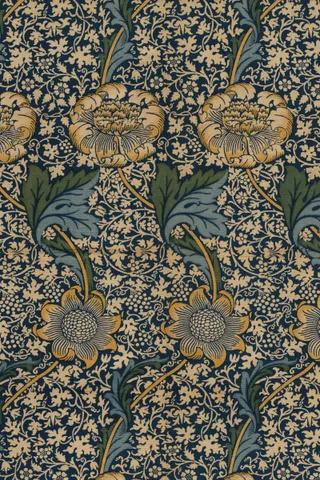
Kennet
Printed cotton
Named after the River Kennet, which flows into the Thames. Its long diagonal stems owe a debt to old Italian cut velvets Morris studied at the South Kensington Museum, now the V&A.
Furnishing cotton, printed (Merton Abbey, about 1920). The Cleveland Museum of Art.
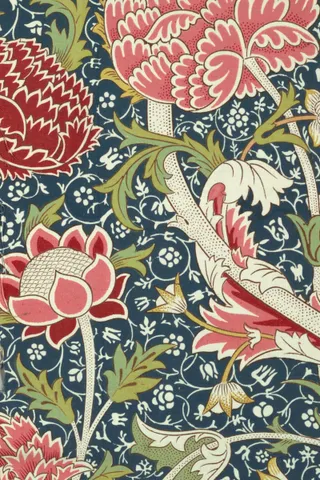
Cray
Named after the River Cray. One repeat needed 34 printing blocks, more than any other Morris design.
Furnishing cotton, block-printed. Cooper Hewitt, Smithsonian Design Museum.
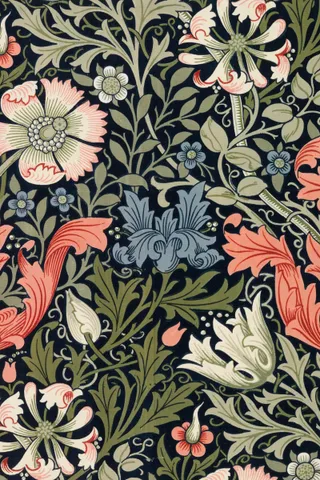
Compton
Made for Compton Hall, Laurence Hodson’s house near Wolverhampton, as both a paper and a cloth. For years it was called Morris’s last design, by May Morris among others. The textile historian Linda Parry showed it was Dearle’s.
Furnishing cotton, printed. Cooper Hewitt, Smithsonian Design Museum.
Woven silks and wools
9 piecesWoven on Jacquard hand-looms, first at the firm’s workshop in Queen Square, London, and later at Merton Abbey. The pattern is in the weave itself, so the colours sit in the thread rather than on the surface.
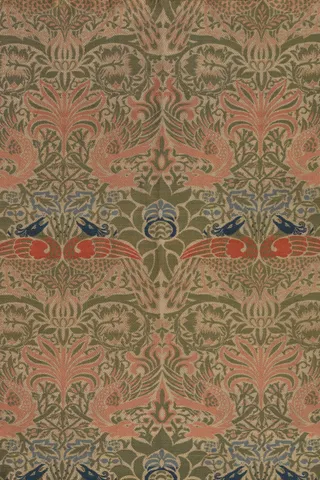
Peacock and Dragon
Olive
Woven thick in wool to hang like a medieval tapestry. That year Morris saw a room from Damascus in a London dealer’s shop, “all vermilion and gold and ultramarine”.
Woven furnishing, wool, weft-faced compound twill (Merton Abbey). The Cleveland Museum of Art.
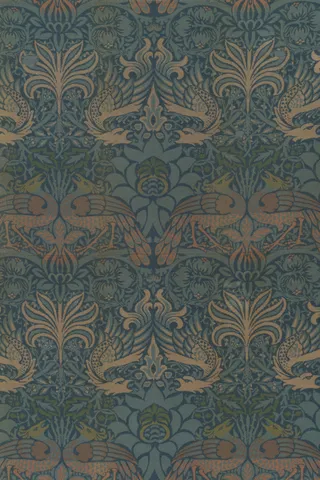
Peacock and Dragon
Blue
The firm later described the design as “a favourite with its author” that needed a large room to show it off. Here the birds are buff and copper on blue.
Woven furnishing, wool twill, two panels lined with linen. The Art Institute of Chicago.
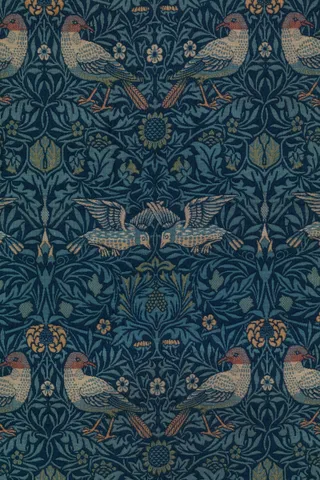
Bird
Designed for the drawing room of Kelmscott House, Morris’s home in Hammersmith. Pairs of birds sit face to face, and others fly, among blue leaves.
Woven furnishing, wool double cloth. The Metropolitan Museum of Art.
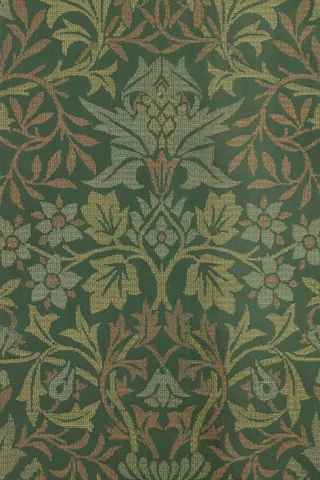
Flower Garden
In March 1879 Morris wrote that a new piece on the loom “looks beautiful, like a flower garden”. He said he chose its colours to suggest inlaid metal.
Woven furnishing, silk. The Metropolitan Museum of Art.
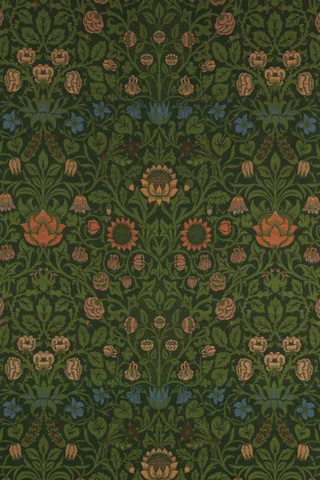
Violet and Columbine
Green
Rows of coral flowers, sunflower heads, blue columbines and violets on dark green. Morris pictured cloths like this hanging in heavy folds, like a garden wall.
Woven furnishing, wool. The Metropolitan Museum of Art.
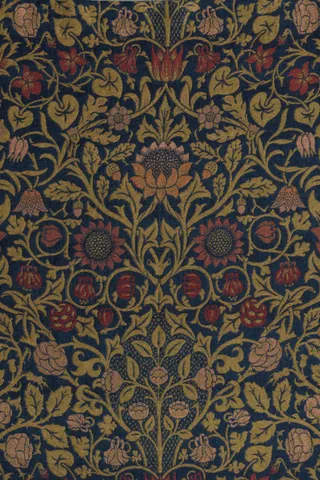
Violet and Columbine
Navy
The same design with olive-gold leaves on navy. Morris used natural dyes for cloths like this, though they were scarce and costly.
Woven furnishing, Jacquard double cloth, wool and mohair (Merton Abbey). The Cleveland Museum of Art.
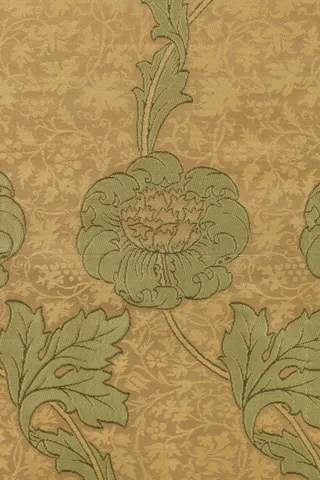
Kennet
Woven silk
The design was registered on 18 October 1883. In woven silk the small vine ground turns into a gold-on-gold sheen behind the sage-green flowers.
Woven furnishing, silk. The Metropolitan Museum of Art.
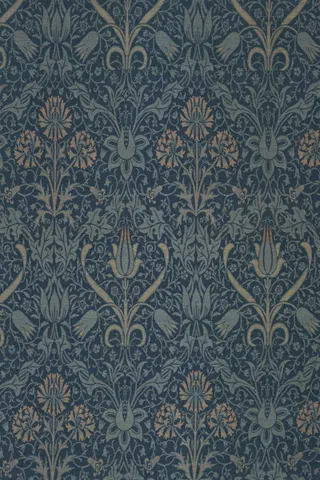
Tulip and Net
Usually credited to Morris; the V&A names Dearle as well. From 1888 Dearle designed the firm’s new textiles. Blue tulips stand in a pointed net of stems on indigo.
Woven furnishing, wool. Cooper Hewitt, Smithsonian Design Museum.
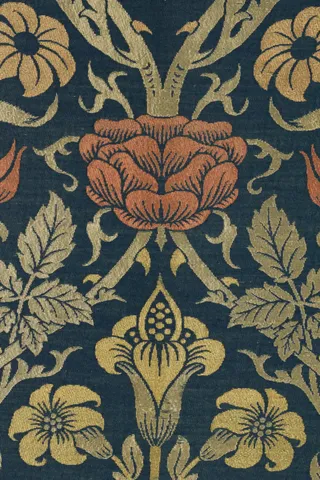
Rose and Lily
Modelled directly on an early seventeenth-century Italian fabric in the V&A. Morris had advised that museum on what to buy, and passed his study of old textiles on to Dearle.
Woven furnishing, silk and wool. The Metropolitan Museum of Art.
Carpets and embroidery
5 piecesThe carpets were knotted by hand; the Swan House carpet was made at Merton Abbey in 1887. From 1885 the firm’s embroidery department was run by Morris’s daughter May, and the two cushion covers here were stitched from Morris designs by Annie May Hegeman.
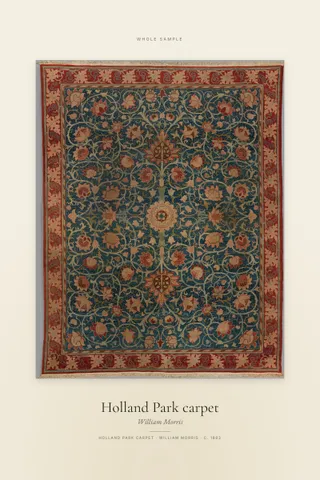
Holland Park carpet
The design takes its name from 1 Holland Park, the London house of Alexander Ionides, for which the firm made carpets. This one is more than five metres long.
Carpet, hand-knotted wool, 25 Turkish knots to the square inch. The Metropolitan Museum of Art.
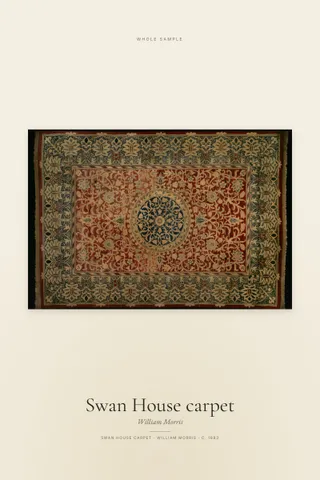
Swan House carpet
Bought at Marshall Field’s in Chicago on 16 April 1887 for the hall of John J. Glessner’s new house on Prairie Avenue. The family kept it until 1974.
Carpet, hand-knotted cotton and wool (Merton Abbey). The Art Institute of Chicago.
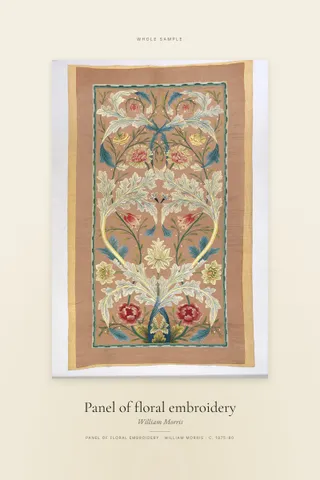
Panel of floral embroidery
Designed by Morris and probably stitched by Catherine Holiday. Silvery acanthus climbs a sand-pink silk ground, with crimson roses near the foot.
Embroidered panel, silk on silk, linen backing. The Metropolitan Museum of Art.
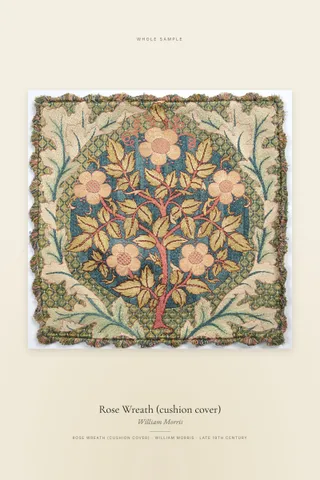
Rose Wreath
Cushion cover
A small rose tree in a blue roundel inside a green lattice, with a looped fringe. A Morris design, stitched by Annie May Hegeman, who gave it to the museum.
Cushion cover, cotton and mercerized-cotton embroidery; stitched by Annie May Hegeman. Cooper Hewitt, Smithsonian Design Museum.
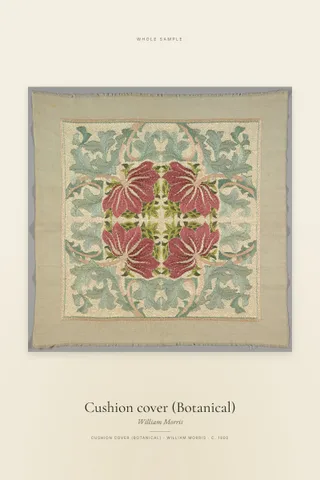
Cushion cover
Four rose-red flowers meet at the centre inside a frame of sea-green acanthus and pink ribbons. The museum records a Morris design, stitched by Annie May Hegeman and sold through Morris & Co.
Cushion cover, mercerized-cotton embroidery on cotton; stitched by Annie May Hegeman, sold by Morris & Co.. Cooper Hewitt, Smithsonian Design Museum.
All 45 pieces, for citing
Dates are the date of the design, as the museum records give it. Where the records disagree, the range covers both; the notes under Sources say why.
| Pattern | Designer | Date | Made as | Museum record |
|---|---|---|---|---|
| Trellis | William Morris, birds by Philip Webb | 1862 (issued 1864) | Wallpaper, block-printed in distemper colours by Jeffrey & Co. | The Metropolitan Museum of Art, 23.163.4h |
| Daisy (Cream) | William Morris | 1864 | Wallpaper, block-printed in distemper colours by Jeffrey & Co. | The Metropolitan Museum of Art, 23.163.4b |
| Daisy (Green) | William Morris | 1864 | Wallpaper, block-printed | Cooper Hewitt, Smithsonian Design Museum, 1980-73-3 |
| Fruit (or Pomegranate) (Blue) | William Morris | c. 1862–66 | Wallpaper, block-printed; printed by Jeffrey & Co. | Cooper Hewitt, Smithsonian Design Museum, 1935-23-14 |
| Fruit (or Pomegranate) (Black) | William Morris | c. 1862–66 | Wallpaper, block-printed; printed by Jeffrey & Co. | Cooper Hewitt, Smithsonian Design Museum, 1935-23-15 |
| Diaper | William Morris | c. 1868–70 | Wallpaper, block-printed | Cooper Hewitt, Smithsonian Design Museum, 1941-74-2 |
| Willow (Green on cream) | William Morris | 1874 | Wallpaper, block-printed; printed by Jeffrey & Co. | Cooper Hewitt, Smithsonian Design Museum, 1935-23-11 |
| Willow (Gold) | William Morris | 1874 | Wallpaper, block-printed | Cooper Hewitt, Smithsonian Design Museum, 1941-74-1 |
| Willow (Blue) | William Morris | 1874 | Wallpaper, block-printed | Cooper Hewitt, Smithsonian Design Museum, 1941-74-1 |
| Willow (Sage) | William Morris | 1874 | Wallpaper, block-printed | Cooper Hewitt, Smithsonian Design Museum, 1980-73-15 |
| Larkspur | William Morris | 1874 | Wallpaper, block-printed | Cooper Hewitt, Smithsonian Design Museum, 1980-73-11 |
| Marigold | William Morris | 1875 | Wallpaper, block-printed in distemper colours by Jeffrey & Co. | The Metropolitan Museum of Art, 23.163.4c |
| Chrysanthemum | William Morris | 1877 | Wallpaper, block-printed | Cooper Hewitt, Smithsonian Design Museum, 1978-159-1 |
| Apple | William Morris | 1877 | Wallpaper, block-printed; printed by Jeffrey & Co. | Cooper Hewitt, Smithsonian Design Museum, 1941-74-8 |
| St James’s | William Morris | 1881 | Wallpaper, block-printed | Cooper Hewitt, Smithsonian Design Museum, 1941-74-18 |
| Willow Bough | William Morris | 1887 | Wallpaper, block-printed in distemper colours by Jeffrey & Co. | The Metropolitan Museum of Art, 23.163.4k |
| Pink and Rose | William Morris | c. 1890 | Wallpaper, block-printed in distemper colours by Jeffrey & Co. | The Metropolitan Museum of Art, 23.163.4a |
| Blackthorn | John Henry Dearle | 1892 | Wallpaper, block-printed in distemper colours by Jeffrey & Co. | The Metropolitan Museum of Art, 23.163.4d |
| Net Ceiling | William Morris | 1895 | Ceiling paper, block-printed | Cooper Hewitt, Smithsonian Design Museum, 1977-28-18 |
| Celandine | John Henry Dearle | Late 19th century | Wallpaper, block-printed | Cooper Hewitt, Smithsonian Design Museum, 1977-31-2-a/g |
| Golden Lily | John Henry Dearle | c. 1897–99 | Wallpaper, block-printed; printed by Jeffrey & Co. | Cooper Hewitt, Smithsonian Design Museum, 1935-23-2 |
| Single Stem | John Henry Dearle | c. 1905 | Wallpaper, block-printed on continuous paper; printed by Jeffrey & Co. | Cooper Hewitt, Smithsonian Design Museum, 1935-23-1 |
| Honeysuckle (Wallpaper) | May Morris | 1883 | Wallpaper, block-printed | Cooper Hewitt, Smithsonian Design Museum, 1980-73-1 |
| Tulip | William Morris | 1875 | Furnishing cotton, roller-printed | The Cleveland Museum of Art, 1937.579 |
| Snakeshead | William Morris | 1876 | Furnishing cotton, printed (early 20th-century printing) | The Cleveland Museum of Art, 1937.695 |
| Honeysuckle (Printed linen) | William Morris | 1876 | Furnishing linen, printed (early 20th-century printing) | The Cleveland Museum of Art, 1937.697 |
| African Marigold | William Morris | 1876 | Furnishing cotton, printed | Cooper Hewitt, Smithsonian Design Museum, 1936-5-1-a,b |
| Strawberry Thief | William Morris | 1883 | Furnishing cotton, indigo-discharged and block-printed | Cooper Hewitt, Smithsonian Design Museum, 1935-20-1-a |
| Kennet (Printed cotton) | William Morris | 1883 | Furnishing cotton, printed (Merton Abbey, about 1920) | The Cleveland Museum of Art, 1937.698 |
| Cray | William Morris | 1884 | Furnishing cotton, block-printed | Cooper Hewitt, Smithsonian Design Museum, 1951-103-19-a,c |
| Compton | John Henry Dearle | 1896 | Furnishing cotton, printed | Cooper Hewitt, Smithsonian Design Museum, 1951-103-18-a,b |
| Peacock and Dragon (Olive) | William Morris | 1878 | Woven furnishing, wool, weft-faced compound twill (Merton Abbey) | The Cleveland Museum of Art, 1953.330 |
| Peacock and Dragon (Blue) | William Morris | 1878 | Woven furnishing, wool twill, two panels lined with linen | The Art Institute of Chicago, 1985.74 |
| Bird | William Morris | 1878 | Woven furnishing, wool double cloth | The Metropolitan Museum of Art, 23.163.15 |
| Flower Garden | William Morris | 1879 | Woven furnishing, silk | The Metropolitan Museum of Art, 23.163.13 |
| Violet and Columbine (Green) | William Morris | 1883 | Woven furnishing, wool | The Metropolitan Museum of Art, 23.163.16 |
| Violet and Columbine (Navy) | William Morris | 1883 | Woven furnishing, Jacquard double cloth, wool and mohair (Merton Abbey) | The Cleveland Museum of Art, 1953.329 |
| Kennet (Woven silk) | William Morris | 1883 | Woven furnishing, silk | The Metropolitan Museum of Art, 23.163.12 |
| Tulip and Net | William Morris and John Henry Dearle | 1888–89 | Woven furnishing, wool | Cooper Hewitt, Smithsonian Design Museum, 1985-87-2-a,b |
| Rose and Lily | John Henry Dearle | 1893 | Woven furnishing, silk and wool | The Metropolitan Museum of Art, 23.163.14 |
| Holland Park carpet | William Morris | Late 19th century | Carpet, hand-knotted wool, 25 Turkish knots to the square inch | The Metropolitan Museum of Art, 27.139.3 |
| Swan House carpet | William Morris | Design c. 1883, made 1887 | Carpet, hand-knotted cotton and wool (Merton Abbey) | The Art Institute of Chicago, 1974.524 |
| Panel of floral embroidery | William Morris | c. 1875–80 | Embroidered panel, silk on silk, linen backing | The Metropolitan Museum of Art, 1972.65 |
| Rose Wreath (Cushion cover) | William Morris | Late 19th century | Cushion cover, cotton and mercerized-cotton embroidery; stitched by Annie May Hegeman | Cooper Hewitt, Smithsonian Design Museum, 1944-71-6 |
| Cushion cover | William Morris | c. 1900 | Cushion cover, mercerized-cotton embroidery on cotton; stitched by Annie May Hegeman, sold by Morris & Co. | Cooper Hewitt, Smithsonian Design Museum, 1936-5-3 |
Sources
Every picture comes from the open-access collections of the Metropolitan Museum of Art, the Cooper Hewitt, Smithsonian Design Museum, the Cleveland Museum of Art and the Art Institute of Chicago; the museum record for each is linked in the table above. The stories in the notes come from these:
- Victoria and Albert Museum: William Morris and wallpaper design
- V&A: Strawberry Thief furnishing fabric, 1883 (T.586-1919)
- V&A: Trellis wallpaper, with Philip Webb’s birds
- V&A: Fruit wallpaper (dating, and the surviving blocks)
- V&A: Daisy wallpaper (the Froissart source)
- V&A: Willow Bough wallpaper
- V&A: Cray furnishing fabric
- V&A: Peacock and Dragon curtains from Clouds
- V&A: Flower Garden woven silk
- V&A: Compton wallpaper (the Dearle attribution)
- V&A: Rose and Lily woven fabric
- V&A: Honeysuckle wallpaper by May Morris
- Art Institute of Chicago: Cray (34 blocks)
- Huntington Library: Dearle’s Golden Lily design drawing
- J. W. Mackail, The Life of William Morris, vol. 1 (1899), Internet Archive
Where the records disagree. Fruit: the Cooper Hewitt dates the design 1862; the V&A dates it 1865–66, citing notes that it was drawn no earlier than 1865. Golden Lily: Dearle’s drawing at the Huntington is dated about 1897; the Cooper Hewitt dates this paper 1899. Snakeshead: the V&A dates the design 1876 and the Cleveland Museum’s label 1877; Cleveland catalogues this early twentieth-century printing as made “in imitation of” Morris. Celandine: the V&A gives the late nineteenth century; the Cooper Hewitt record gives 1872–82. Tulip and Net: the V&A credits William Morris and John Henry Dearle together.
The designs are in the public domain. The restorations shown here are Madten’s, at web resolution, and are free to view. To cite this page: Madten, “William Morris and Morris & Co.: Every Pattern We Hold,” https://www.madten.com/reference/william-morris-patterns, 2026-11-10.