
Hiroshige's One Hundred Famous Views of Edo, explained
Hiroshige's last series shows the city now called Tokyo in 118 upright prints. What it is, why the count runs past 100, what Van Gogh copied, and ten to know.
Contents9 sections
- What is One Hundred Famous Views of Edo?
- Who published it, and when?
- Why are there 119 prints when the title says 100?
- How is the series organised?
- Why do the prints look like that?
- What did Van Gogh copy?
- Which ten prints should you know?
- Where can you see the originals?
- Which should you buy, and how should you hang them?
One Hundred Famous Views of Edo is a set of colour woodblock prints by Utagawa Hiroshige. It shows the best-known places in Edo, the city now called Tokyo: its bridges, temples, gardens, theatres and river, in every season and weather. Hiroshige made it at the end of his life, and the publisher issued the sheets from 1856 to 1858. It was his last series. Vincent van Gogh copied two of the views in oil. This piece explains what the series is, why it has more than a hundred prints, and which ten to know first.
What is One Hundred Famous Views of Edo?
It is a picture guide to a city, issued as single prints. The Japanese title is Meisho Edo hyakkei. Each sheet shows one famous place, named in the red strip at the top right, with a smaller coloured panel beside it giving the exact spot. Hiroshige's signature sits in a second strip lower down.
The sheets are a standard size that printers called ōban. The Brooklyn Museum's copy of the rain print measures 36.1 by 23.1 cm, a little larger than a sheet of office paper. They were printed by hand from carved wooden blocks, one block for each colour. Our piece on Japanese woodblock printing follows that process stage by stage.
Hiroshige was the right man for it. The Art Institute of Chicago credits him with 8,000 prints, says much of his work is landscape, and says he withdrew into Buddhist monkhood in 1856 to complete this series. He was born in Edo and died there. The Met's records give both as his birthplace and deathplace.
Who published it, and when?
A man called Uoya Eikichi, between 1856 and 1858. The Brooklyn Museum notes that Uoya means "fishmonger", apparently his former trade, and that his shop was at Ueno Hirokōji. The Van Gogh Museum reads the same publisher's name as Sakanaya Eikichi, so you will meet both spellings.
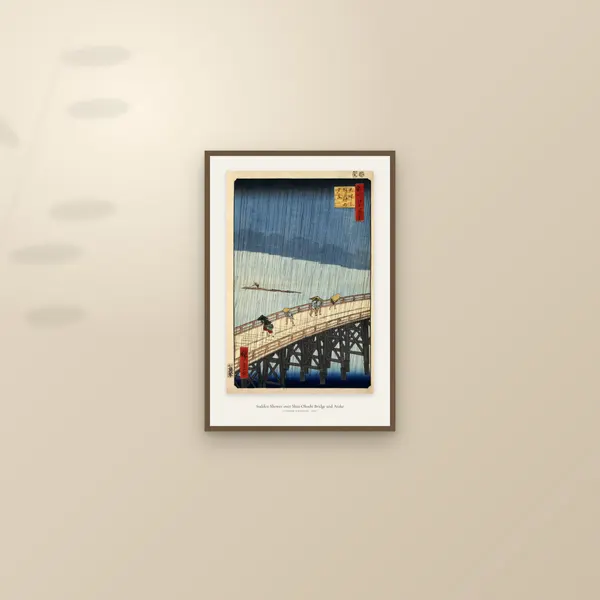
Edo had just been through a disaster. The Cleveland Museum of Art points out that the rain print came out two years after the great earthquake and fire of 1855, and that the bridge in it had only just been rebuilt. The Brooklyn Museum dates the series from 1856, the year after the earthquake.
Each print can be dated to the month. Before a design could be sold it needed a censor's approval, and the Brooklyn Museum explains that the production date sits in a small seal in the margin of each sheet. That is why museum records for this series can read "ninth month of 1857".
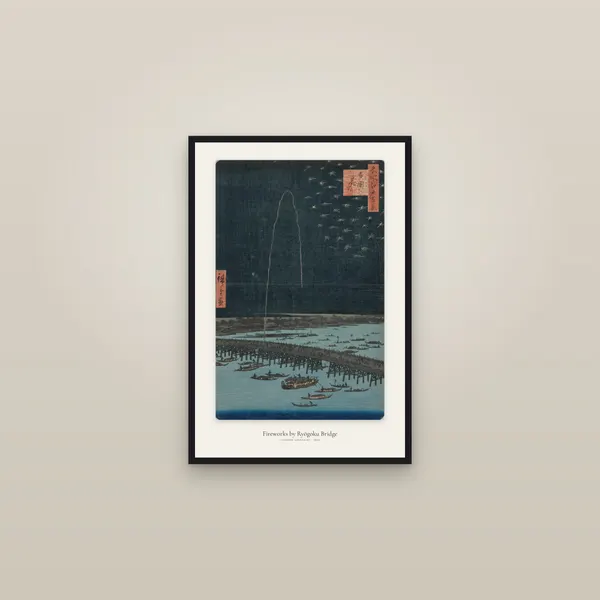
Hiroshige did not see the end of it. He died in the ninth month of 1858, according to the same Brooklyn record. Fireworks by Ryōgoku Bridge carries a seal of the eighth month of 1858, one month earlier.
Why are there 119 prints when the title says 100?
The sources cited here give no reason. The Brooklyn Museum says the series proved immensely popular and was published from 1856 to 1858. By its close it had passed the round number.
Three numbers are in use, and each counts something different.
| Count | What it counts | Who uses it |
|---|---|---|
| 118 | The views in the series when its table of contents was printed, in the tenth month of 1858 | The Brooklyn Museum, for its complete set |
| 119 | Those 118, plus Paulownia Trees at Akasaka in the Evening Rain, by Hiroshige II, dated 1859 | Lists that include the later print, such as our own reference page |
| 120 | Those 119, plus the decorated table of contents itself | Anyone counting sheets, not views |
The 119th print has a story. Hiroshige II was the older man's son-in-law and successor. The Metropolitan Museum of Art says his Akasaka view was finished seven months after Hiroshige's death, as a replacement for Hiroshige's own picture of the same place, whose blocks may have been damaged or lost. The Art Institute of Chicago gives the same explanation and the same year, 1859.
There is a second wrinkle inside the 118. The Brooklyn Museum notes that three designs, numbers 12, 41 and 114, were approved the month after Hiroshige died. That timing supports the theory that Hiroshige II drew those as well.
The table of contents was designed by a different artist, Baisotei Gengyo, who was best known for book jackets. Above the title it prints Hiroshige's name and, in Brooklyn's translation, an advertisement that the series was his "grand farewell performance". He had been dead a month.
Every print, in order, with its Japanese title and seal date, is on our reference page: all 119 Edo views by number and season.
How is the series organised?
By season, not by map. The prints did not come out in number order: number 118 is dated 1857 and number 98 is dated 1858. The table of contents then sorted them into the four seasons, which the Brooklyn Museum calls a way of grouping deeply rooted in Japanese art and literature.
| Season | Print numbers | What you see most |
|---|---|---|
| Spring | 1–42 | Plum and cherry blossom, river crossings, temple gardens |
| Summer | 43–72 | Rain, irises, wisteria, carp streamers, boats |
| Autumn | 73–98 | Maples, moon viewing, festival nights, fireworks |
| Winter | 99–118 | Snow on roofs and bridges, and one night of foxes |
The numbers are Brooklyn's reading of the contents sheet. Within each season the order is roughly by district, but not in any way you could predict.
Why do the prints look like that?
Because Hiroshige turned the paper upright and put something enormous at the front. His famous road series, the Tōkaidō, is printed wide. Here the sheet stands tall.
The Brooklyn Museum's 1987 press release describes the method in one line: a close-up of the main subject is placed against distant background scenes. A plum branch fills the foreground and the garden sits behind it. A carp streamer as tall as the sheet hangs over a town the size of a thumbnail. An eagle's wings are cut off by the top edge.
The Van Gogh Museum lists what European painters took from prints like these: objects in the foreground enlarged, the middle ground left empty, the horizon often left out and things cropped abruptly at the edge. It showed them that a picture did not have to be arranged from near to far, "like in a peep show".
What did Van Gogh copy?
Two prints, in oil, in Paris in the autumn of 1887. Both paintings are in the Van Gogh Museum in Amsterdam.
| Van Gogh's painting | Hiroshige's print | Date and size |
|---|---|---|
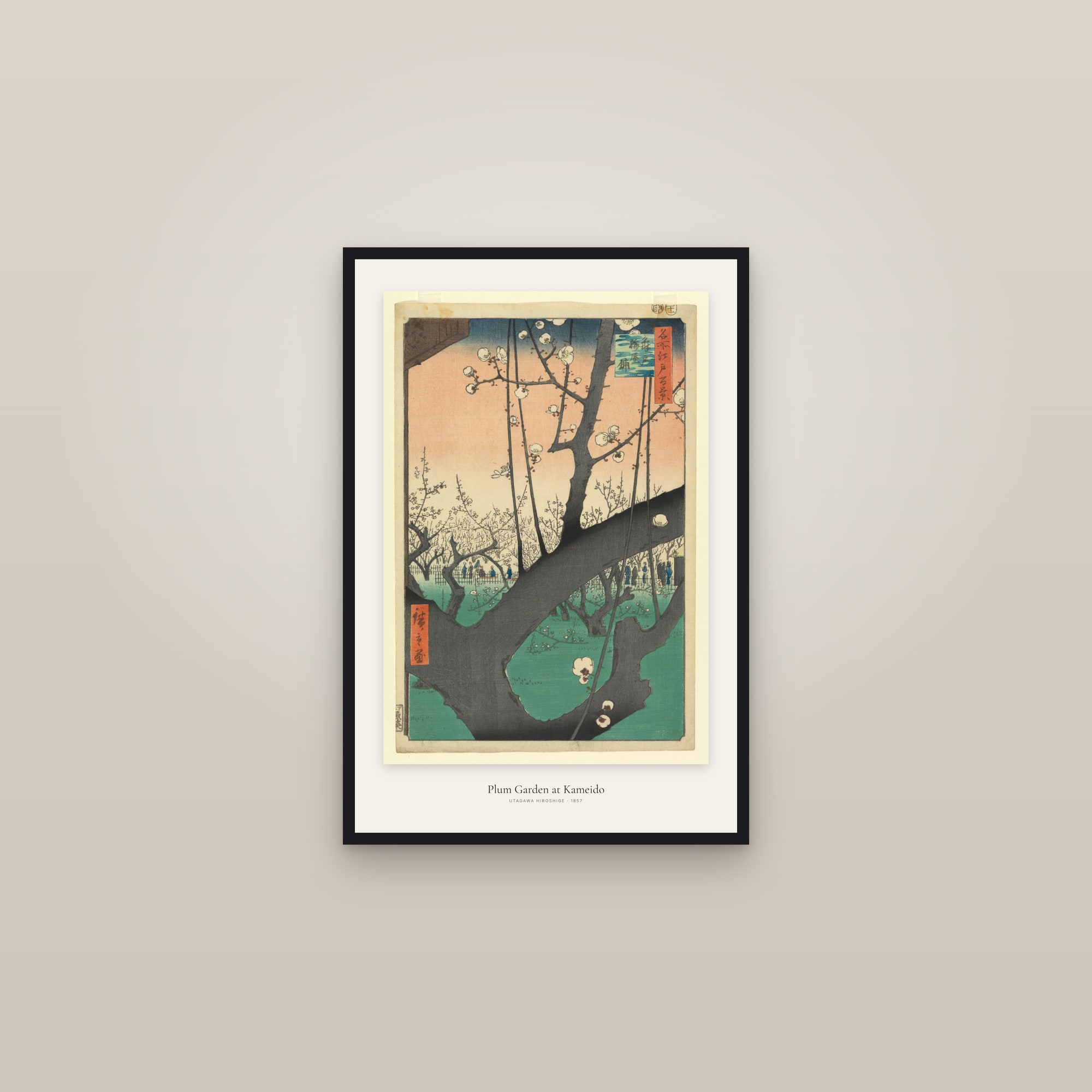
| Flowering Plum Orchard (after Hiroshige) | Plum Garden at Kameido, number 30 | October–November 1887, 55.6 × 46.8 cm |
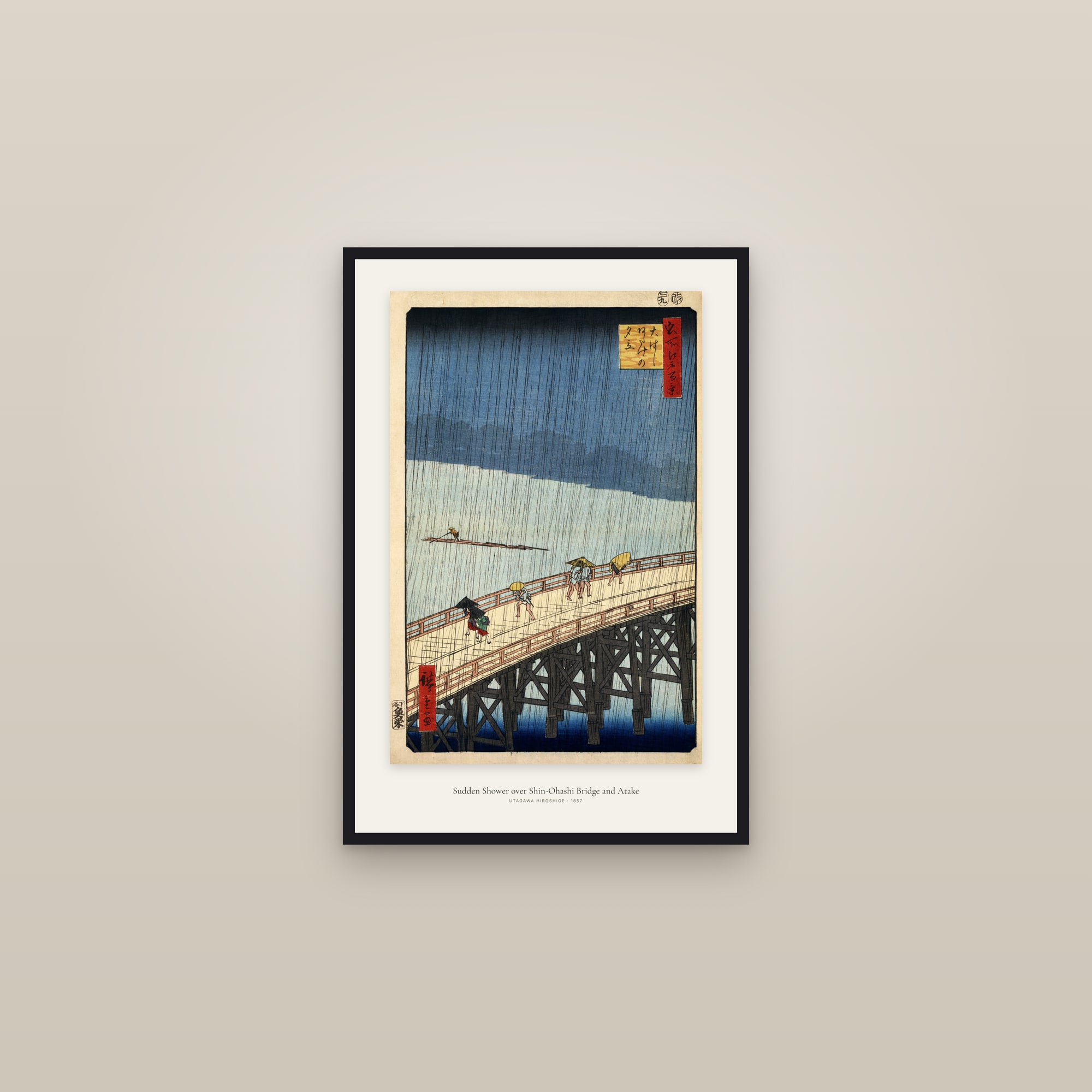
| Bridge in the Rain (after Hiroshige) | Sudden Shower over Shin-Ōhashi Bridge and Atake, number 58 | October–November 1887, 73.3 × 53.8 cm |
He worked from prints he owned. The museum's story of his collection says he bought his first stack of Japanese woodcuts in Antwerp and pinned them to the wall of his room, then built up a large collection with his brother Theo in Paris. His own sheet of the Plum Garden is in the museum too, and its record lists a pin hole made by Van Gogh.
He kept the compositions and changed the colour. In the plum painting, the museum says, he replaced the black and grey of Hiroshige's trunk with red and blue. For the bridge he used a standard canvas, which was the wrong shape for the print. He kept the print's proportions and filled the leftover border with Japanese characters copied from other prints. They are there for effect, not meaning.
The museum counts three paintings after Japanese prints in all. The third is after a different artist, Keisai Eisen, and we print it as Courtesan (after Eisen).
Which ten prints should you know?
These ten cover all four seasons and the series' main tricks. The years are the ones on our product pages. Museum records can differ by a year: the Brooklyn Museum reads the seal on the Moon Pine as the seventh month of 1856.
| No. | Season | Year | |
|---|---|---|---|
| 30 | Plum Garden at Kameido | Spring | 1857 |
| 48 | Suidō Bridge and the Surugadai Quarter | Summer | 1857 |
| 58 | Sudden Shower over Shin-Ōhashi Bridge and Atake | Summer | 1857 |
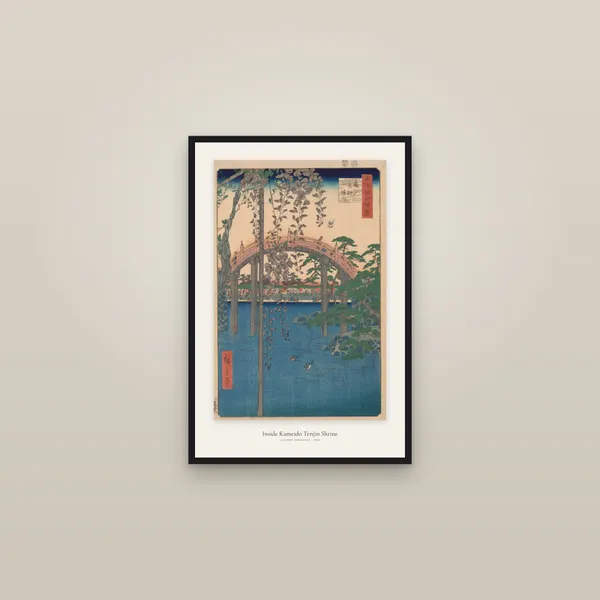
| 65 | Inside Kameido Tenjin Shrine | Summer | 1856 |
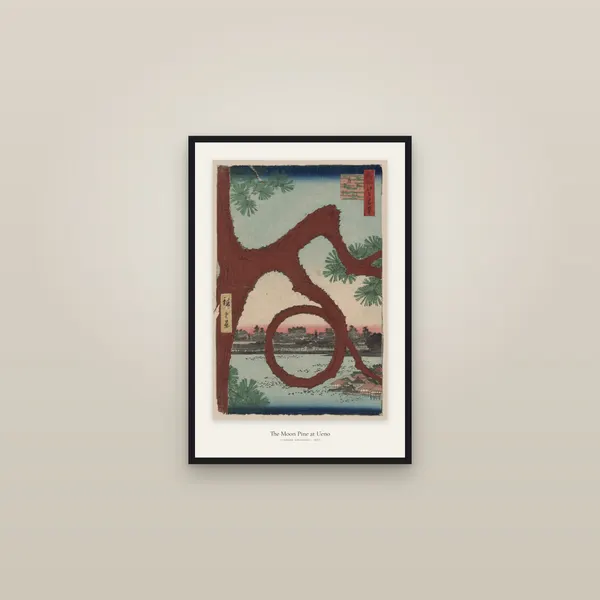
| 89 | The Moon Pine at Ueno | Autumn | 1857 |
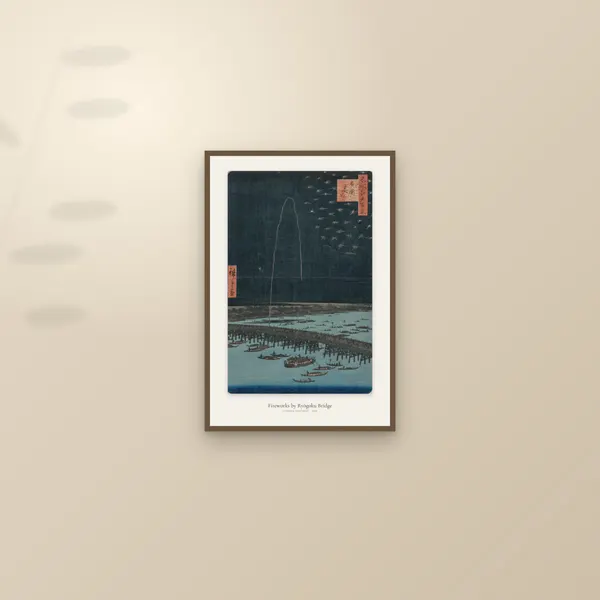
| 98 | Fireworks by Ryōgoku Bridge | Autumn | 1858 |
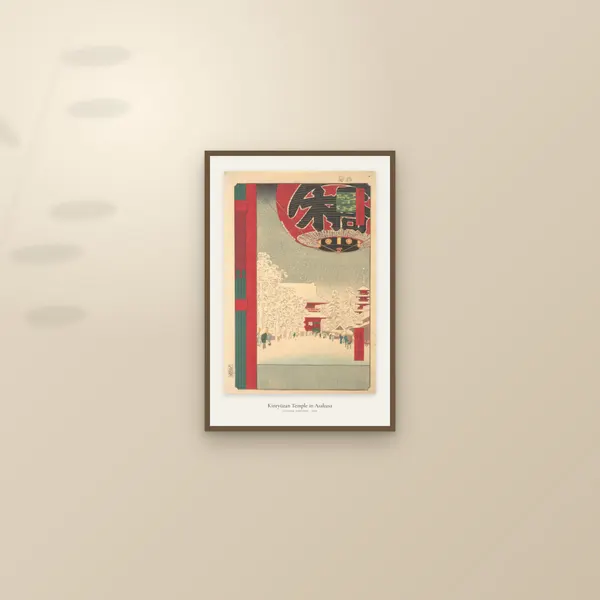
| 99 | Kinryūzan Temple in Asakusa | Winter | 1856 |
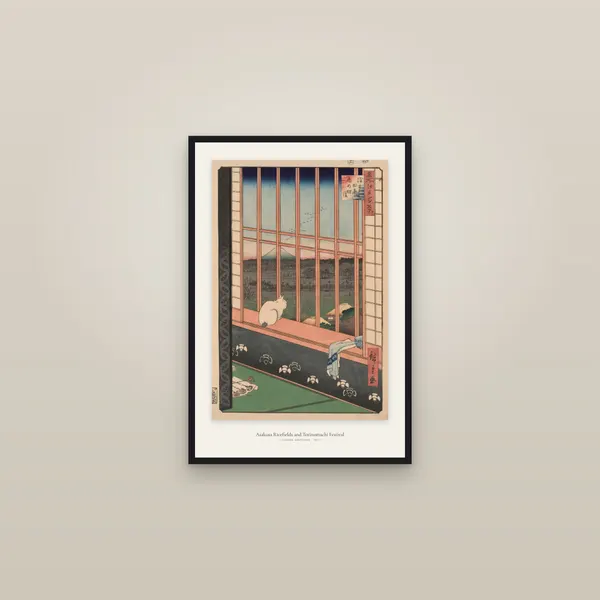
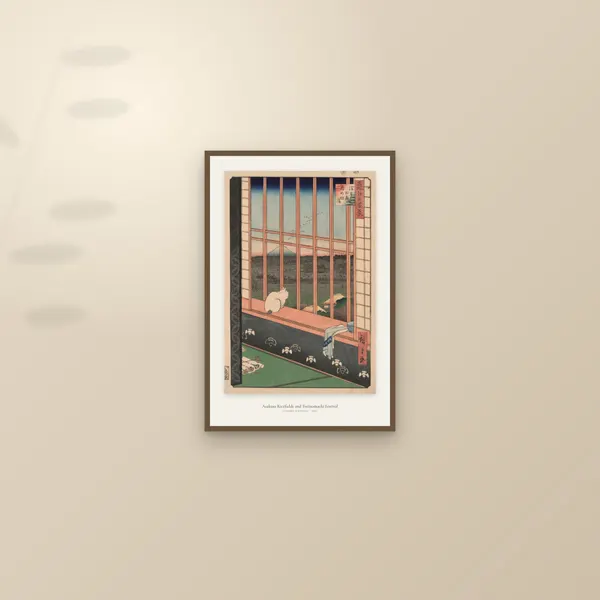
| 101 | Asakusa Ricefields and Torinomachi Festival | Winter | 1857 |
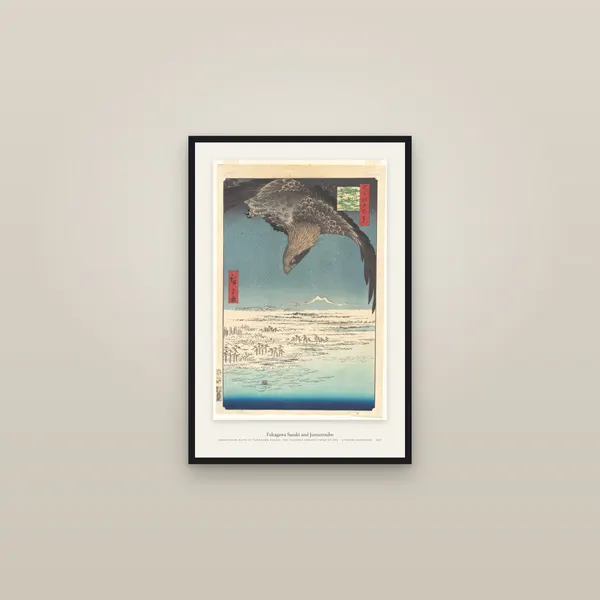
| 107 | Fukagawa Susaki and Jūmantsubo | Winter | 1857 |
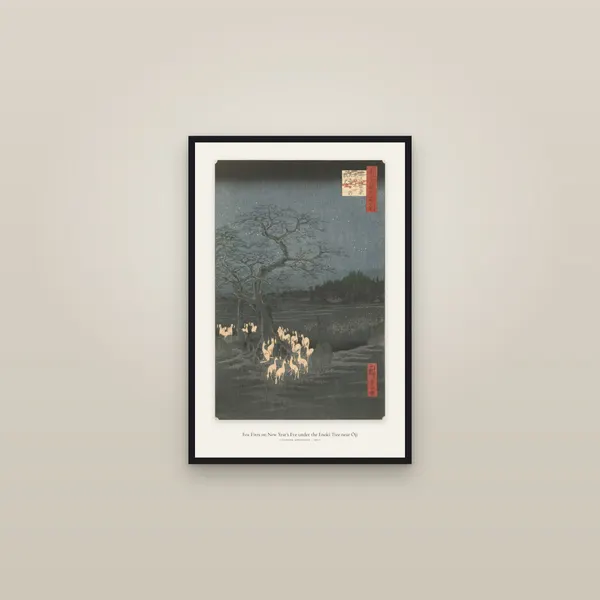
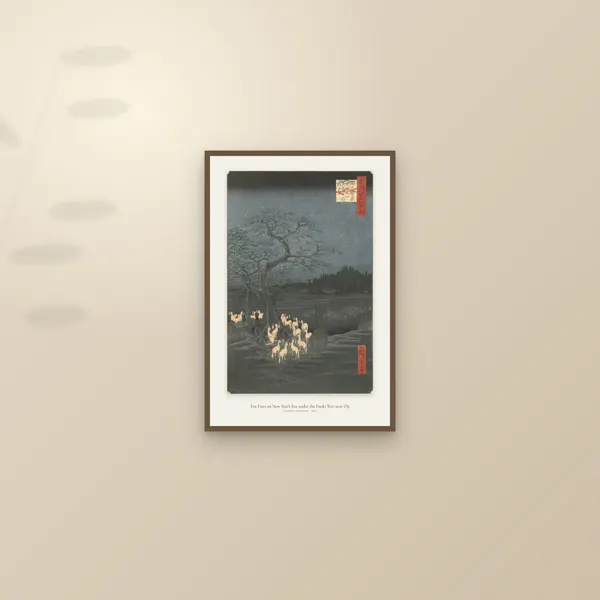
| 118 | Fox Fires on New Year's Eve under the Enoki Tree near Ōji | Winter | 1857 |
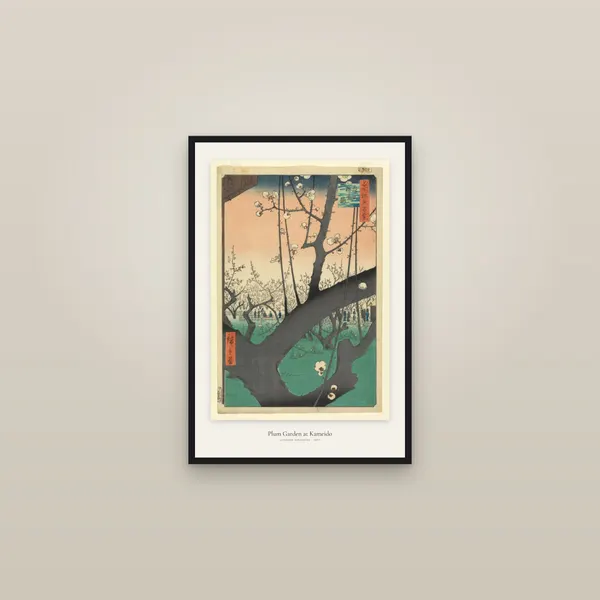
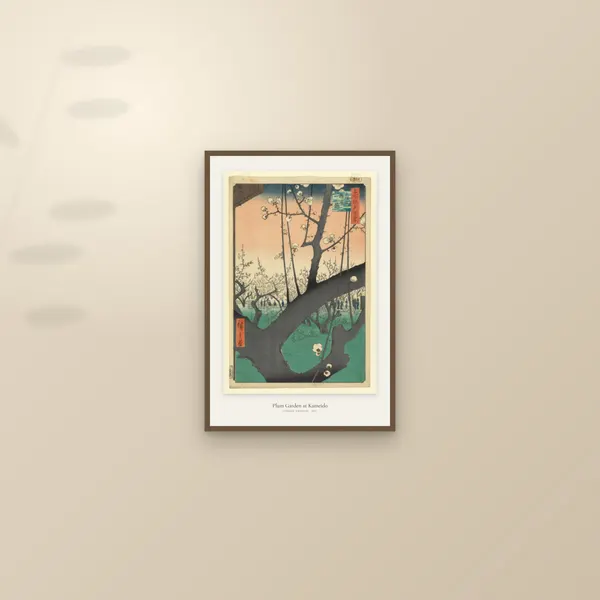
30. Plum Garden at Kameido. You look through the branches of one tree at a garden full of others. The tree was a celebrity. The Brooklyn Museum identifies it as the Sleeping Dragon Plum, the most famous tree in Edo, known for the whiteness of its blossom and a scent said to have drawn in a passing shogun. This is the print Van Gogh copied first. The red sky is strong, so give it a pale wall: a bedroom or a reading corner, in dark wood.
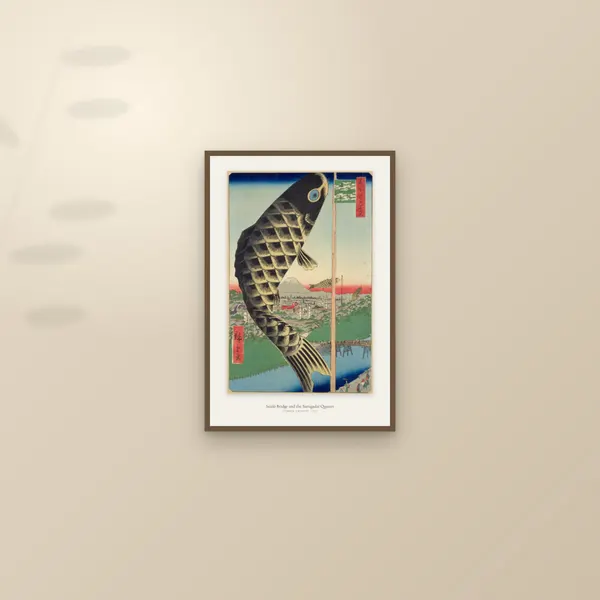
48. Suidō Bridge and the Surugadai Quarter. A black and cream carp streamer fills the sheet from top to bottom, its blue eye near the upper edge. Behind its tail are a green town, more carp on poles, a bridge and a white Mount Fuji. Families flew carp banners from their roofs for Boys' Day, on the fifth day of the fifth month, as the Met explains in its note on the festival. It is the most cheerful print in the set and the easiest to place: a hallway, a family room, a child's room.
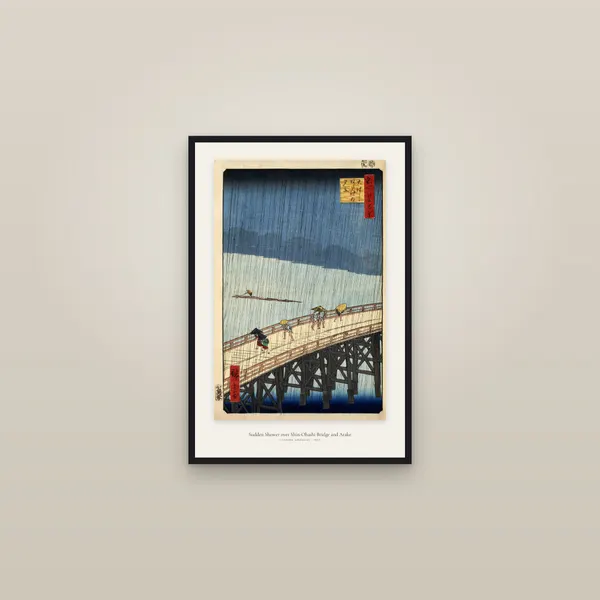
58. Sudden Shower over Shin-Ōhashi Bridge and Atake. Rain falls in fine dark lines across the whole sheet. On the bridge, people run in both directions under whatever they have. On the river, a single raftsman carries on. The Brooklyn Museum calls it the undisputed masterpiece of the series and describes the weather as an evening summer storm that darkens, pours and clears. Grey and blue, it suits a hallway, a bathroom or a study better than a sunny room.
65. Inside Kameido Tenjin Shrine. Purple wisteria hangs down the front of the picture. Through it you see a steep arched bridge over a blue pond, with a crowd on the far bank and swallows low over the water. The Brooklyn Museum says the bridge alone would have told any Edo viewer where this was. Mauve, pink and deep blue: a bedroom or a living room.
89. The Moon Pine at Ueno. A red-brown pine branch loops into a circle, and a row of houses across a pond shows through the hole. Edo people named their odd trees, the Brooklyn Museum explains, and this one was the Moon Pine. The same record reports that the famous branch blew off in a storm in the early Meiji period. The loop is a frame inside the frame, so the print holds a small wall by itself: an entry, a landing, the space above a side table.
98. Fireworks by Ryōgoku Bridge. More than half the sheet is night sky. One rocket's trail climbs in a thin wavering line and falls back, and a burst of sparks hangs at the upper right. Below, a long bridge crosses a river full of small boats. Evenings on the Sumida were a summer habit, and the best seat was a nearby restaurant or a hired boat, according to the Brooklyn Museum. Hiroshige died the month after this print was approved. Dark blue with fine pale marks, it works in a living room or study, framed in black.
99. Kinryūzan Temple in Asakusa. A huge red lantern hangs into the picture from above, beside a red and green gate post. Past them, snow falls on a path, a red gate and a pagoda, and a few visitors walk under hats and umbrellas. The temple is Sensōji. The Met notes that red on white is a festive pairing, down to the red label carrying Hiroshige's signature. It opens the winter group. Hang it in an entrance hall, where its own gateway makes sense.
101. Asakusa Ricefields and Torinomachi Festival. A white cat sits on a windowsill with its back to us, looking through wooden bars at fields, a small Mount Fuji and a line of geese. Far off, a dark procession crosses the fields to a festival. The Met identifies the room as an upstairs room in a brothel beside the ricefields that surrounded the Yoshiwara pleasure quarter, and the small objects on the floor as rake-shaped hairpins, probably bought at the festival. Nobody is in the room but the cat. It suits a study or a reading corner.
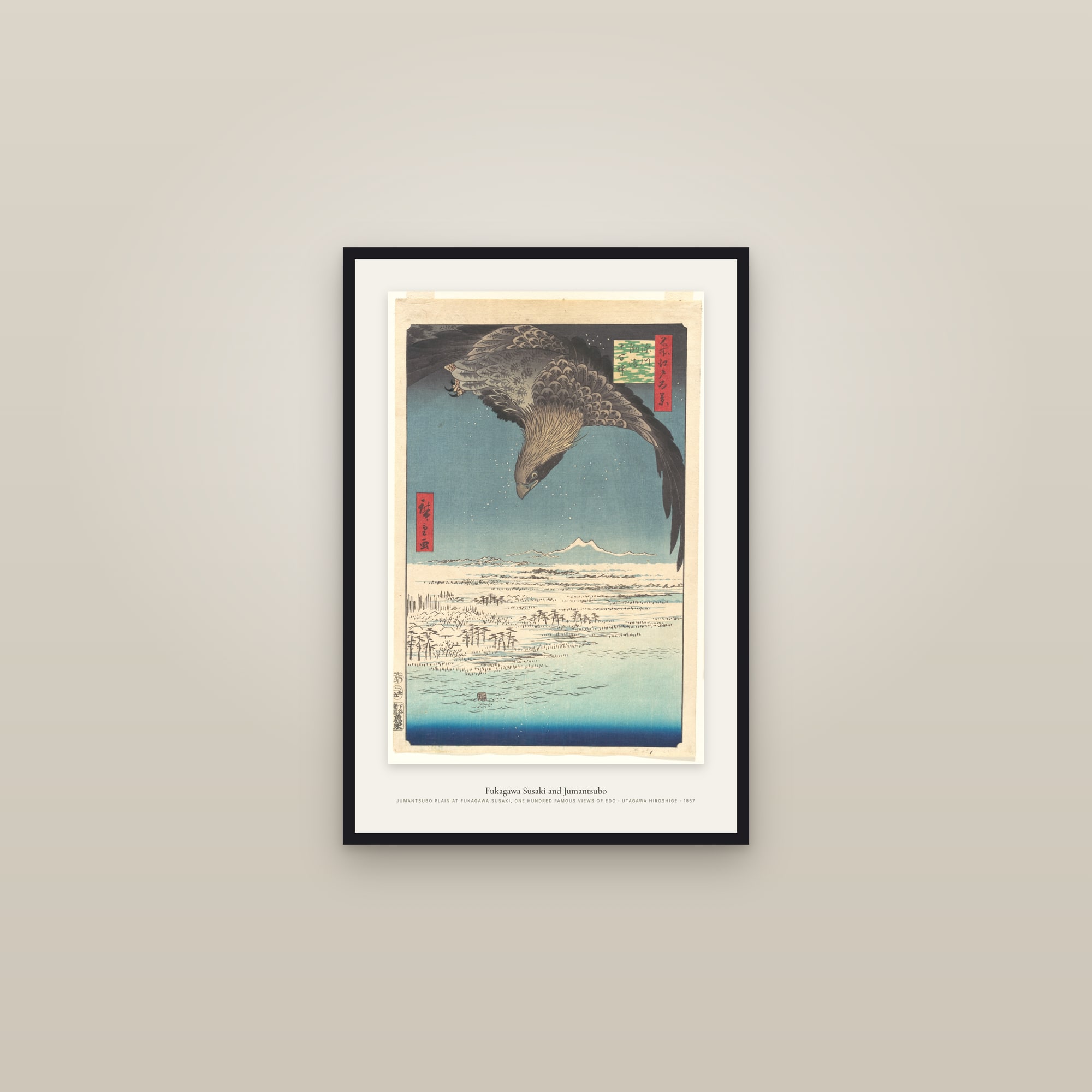
107. Fukagawa Susaki and Jūmantsubo. An eagle fills the top of the sheet, head down. Below it lies a flat white marsh, with a snowy peak far away. Look near the bottom and you will find a single wooden bucket floating at the water's edge. The Brooklyn Museum reads that bucket as the human presence in a picture with no people. Jūmantsubo was named for its size, a hundred thousand tsubo, about eighty acres. Spare and cold, it is good in a study or a pale hallway.
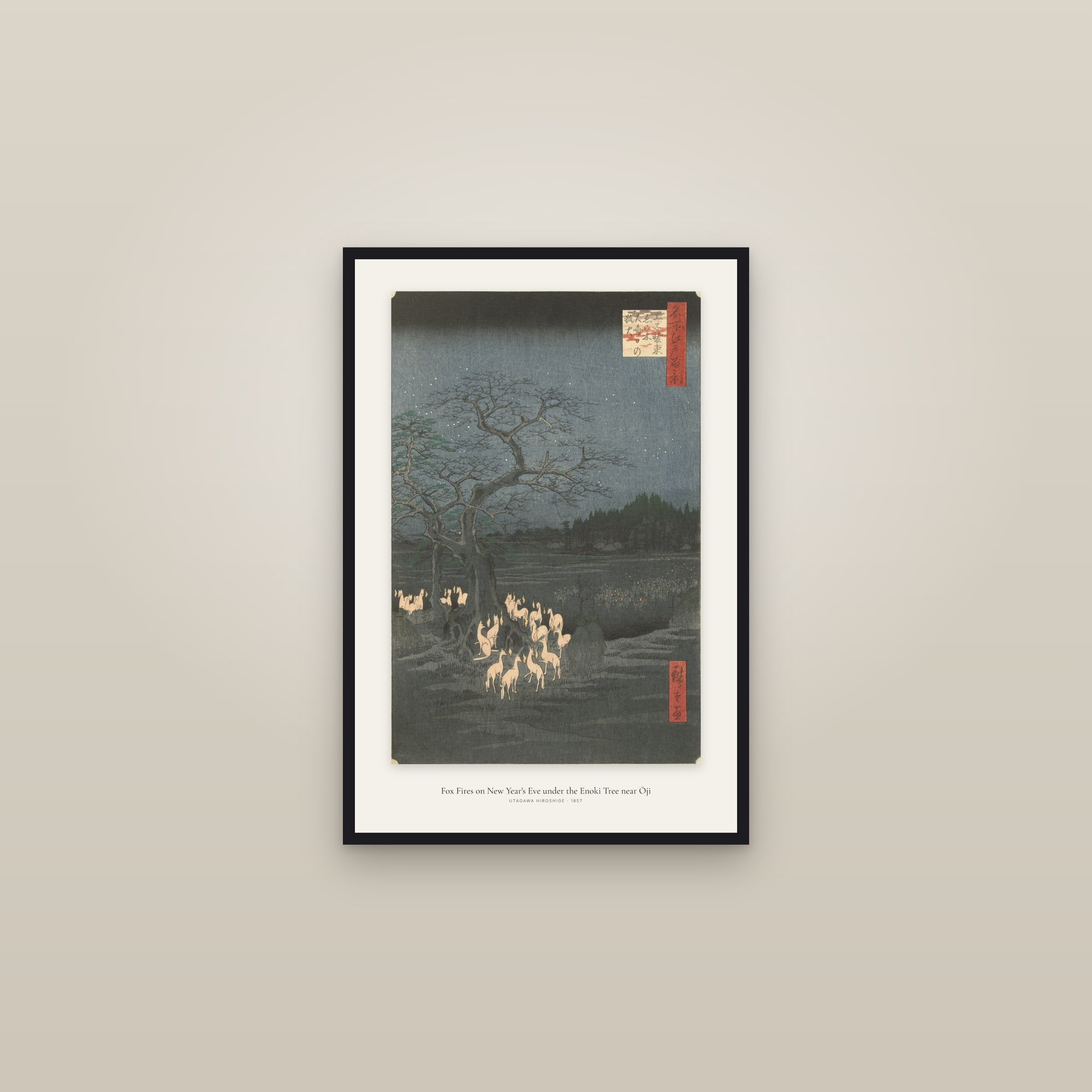
118. Fox Fires on New Year's Eve under the Enoki Tree near Ōji. Under a bare tree at night stands a crowd of pale foxes, each with a small flame. The legend, as the Brooklyn Museum tells it, was that every fox in the region met at this tree on New Year's Eve before visiting the nearby Inari shrine, and that farmers read the coming harvest from their fires. Brooklyn calls it the only print in the series that involves fantasy, and one of the three most often named as favourites, with numbers 58 and 107. It is the last of the 118. Blue-grey and quiet, it suits a living room or study in a black frame.
Where can you see the originals?
The best place is Brooklyn. The Brooklyn Museum's set, a gift of Anna Ferris in 1930, is described in its own 1987 press release as one of three complete sets known, remarkable for its condition. That year the museum showed all 118 together for the first time, alongside a book of the whole set with commentary by Henry D. Smith II and Amy G. Poster. It showed the set again from 5 April to 4 August 2024.
Single prints are in many museums. The Metropolitan Museum of Art, the Art Institute of Chicago and the Cleveland Museum of Art all hold sheets from the series, and the Van Gogh Museum has the painter's own.
There is a catch. The Brooklyn and Met records cited here are all marked not on view. Check the object's page before you travel for one print.
Which should you buy, and how should you hang them?
Start with the season you like, then pick the print. We print all 118 of Hiroshige's views from museum and library scans, on 250 gsm archival paper, unframed or in a black or dark wood frame. The full run is in One Hundred Famous Views of Edo.
Each view comes as a gallery print, which shows the whole sheet with its margins, title strip and seals on a pale ground. Most also come edge to edge, very slightly cropped, on paper or canvas. Each print's page lists its versions and sizes, because the scans differ in sharpness.
Three ways to hang them:
- One print, upright. These are tall pictures. They fit the narrow walls that wide art cannot: beside a door, at the end of a hallway, between two windows.
- A pair. The classic pair is the two Van Gogh chose: the Plum Garden, red, and the Sudden Shower, blue. Same size, same frame, a hand's width apart.
- A row of three or four by season. Try plum, carp, pine and foxes for spring to winter. Keep the sizes equal and the frames the same. Our guide to one big piece or a set of three covers the spacing.
For frames, black suits the night scenes and the snow. Dark wood suits the warmer prints: the plum, the carp, the wisteria.
If you want more of Hiroshige, his road series is in Fifty-three Stations of the Tōkaidō and everything else in Hiroshige prints. If you came here from the Great Wave, that belongs to Hokusai's Thirty-six Views of Mount Fuji, and we have a separate piece on which Great Wave to buy.





Questions people ask
What is One Hundred Famous Views of Edo?
It is the last great print series by the Japanese artist Utagawa Hiroshige: upright colour woodblock prints of well-known places in Edo, the city now called Tokyo, published by Uoya Eikichi in 1856–58 and arranged by the four seasons.
How many prints are in One Hundred Famous Views of Edo?
118 views in the series as it stood when the table of contents was printed in the tenth month of 1858. A replacement view of Akasaka by Hiroshige II, dated 1859, makes 119. Counting the table of contents as well gives 120 sheets.
Which prints did Van Gogh copy?
Two from this series, both in Paris in October to November 1887: Flowering Plum Orchard (after Hiroshige), from Plum Garden at Kameido, and Bridge in the Rain (after Hiroshige), from Sudden Shower over Shin-Ōhashi Bridge and Atake. Both are in the Van Gogh Museum, Amsterdam.
Did Hiroshige design all of the prints himself?
Nearly all. He died in the ninth month of 1858. The Brooklyn Museum notes that three designs, numbers 12, 41 and 114, were approved the month after his death, which supports the theory that his successor Hiroshige II drew them. Hiroshige II also made the 1859 replacement view of Akasaka.
Where can I see the original prints?
The Brooklyn Museum in New York owns a complete set and showed it in 2024. The Metropolitan Museum of Art, the Art Institute of Chicago and the Cleveland Museum of Art hold individual prints. The records cited here are marked not on view, so check the museum's page before you go.
Why are the prints upright when most Japanese landscapes are wide?
The upright sheet lets Hiroshige put a large object right at the front, cut by the frame, and drop the view far behind it. The Brooklyn Museum describes the method as a close-up of the main subject set against distant background scenes.
Sources
- Brooklyn Museum: Table of Contents, from One Hundred Famous Views of Edo, 30.1478.119 (publisher Uoya Eikichi, 1856–58, 118 prints, the four seasons and their print numbers, Hiroshige's death in the ninth month of 1858, prints 12, 41 and 114, Baisotei Gengyo, the farewell advertisement, the fishmonger name)
- Brooklyn Museum, press release of 1 October 1987, Curator's Choice: Hiroshige, One Hundred Famous Views of Edo (first showing of the complete set of 118, one of three complete sets known, the close-up composition, the Henry D. Smith II and Amy G. Poster book)
- Brooklyn Museum: Plum Estate, Kameido, No. 30 (the Sleeping Dragon Plum, its white blossom, the shogun Yoshimune, seal of the eleventh month of 1857, the 2024 exhibition dates)
- Brooklyn Museum: Sudden Shower over Shin-Ohashi Bridge and Atake, No. 58 (the evening summer storm, the raftsman, the Van Gogh copy, sheet size)
- Brooklyn Museum: New Year's Eve Foxfires at the Changing Tree, Oji, No. 118 (the legend, the only fantasy subject, the three favourites, seal of the ninth month of 1857)
- Brooklyn Museum: Fukagawa Susaki and Jumantsubo, No. 107 (the eagle, the floating bucket, Jūmantsubo's name and area, Mount Tsukuba)
- Brooklyn Museum: Moon Pine, Ueno, No. 89 (named trees in Edo, the far shore, the branch lost in a storm)
- Brooklyn Museum: Fireworks at Ryogoku, No. 98 (evenings on the Sumida, the boats, seal of the eighth month of 1858)
- Brooklyn Museum: Inside Kameido Tenjin Shrine, No. 65 (the drum bridge, the shrine's dedication, the wisteria)
- The Metropolitan Museum of Art: Pilgrimage to the Torinomachi Festival across the Ricefields of Asakusa, dated 1857, 11th month (the cat, the upstairs room, the festival crowd, the rake-shaped hairpins)
- The Metropolitan Museum of Art: Kinryūsan Temple at Asakusa, JP2519 (Sensōji, the red and white colour scheme, the signature label)
- The Metropolitan Museum of Art: Eaves Decorated with Irises for the Tango Festival, 36.100.98 (Boys' Day on the fifth day of the fifth month, carp banners flown from roofs)
- The Metropolitan Museum of Art: Utagawa Hiroshige II, Paulownia Trees at Akasaka in the Evening Rain, JP236 (1859, made seven months after Hiroshige's death as a replacement, Hiroshige II as son-in-law and successor)
- Art Institute of Chicago: Hiroshige II, Night Rain at the Paulownia Grove at Akasaka, 1859 (issued with the rest of the series in 1859; the lost-blocks theory)
- Art Institute of Chicago: Utagawa Hiroshige, artist page (about 8,000 prints, Buddhist monkhood in 1856, the series dated 1856–58, death in 1858)
- The Cleveland Museum of Art: Sudden Shower over Shin-Ōhashi Bridge and Atake, 1921.318 (the earthquake and fire of 1855, the newly rebuilt bridge, Edo as present-day Tokyo)
- Van Gogh Museum: Flowering Plum Orchard (after Hiroshige), s0115V1962 (Paris, October–November 1887, three copies after prints he owned, the changed colours, the orange borders)
- Van Gogh Museum: Bridge in the Rain (after Hiroshige), s0114V1962 (Paris, October–November 1887, the standard canvas, the border of copied characters)
- Van Gogh Museum: Hiroshige, The Residence with Plum Trees at Kameido, n0077V1962 (Van Gogh's own impression, the pin holes, publisher read as Sakanaya Eikichi)
- Van Gogh Museum: Inspiration from Japan (the prints pinned to his wall in Antwerp, collecting with Theo in Paris, the enlarged foreground and cropped edges)
Start hereThe most famous paintings in the world and where to see them