The most famous paintings in the world and where to see them
Twenty-five paintings almost everyone can picture, ranked by fame, with the museum each one hangs in, why it got famous, and whether you can print it.
Contents26 sections
- Mona Lisa, Leonardo da Vinci, c. 1503–1519
- The Starry Night, Vincent van Gogh, 1889
- The Last Supper, Leonardo da Vinci, 1495–1498
- The Scream, Edvard Munch, 1893
- Girl with a Pearl Earring, Johannes Vermeer, c. 1665
- Guernica, Pablo Picasso, 1937
- The Creation of Adam, Michelangelo, c. 1512
- The Birth of Venus, Sandro Botticelli, c. 1485
- The Kiss, Gustav Klimt, 1908–1909
- The Night Watch, Rembrandt van Rijn, 1642
- Under the Wave off Kanagawa (The Great Wave), Katsushika Hokusai, c. 1830–1832
- The Persistence of Memory, Salvador Dalí, 1931
- Sunflowers, Vincent van Gogh, 1888
- Water Lilies, Claude Monet, 1916
- Las Meninas, Diego Velázquez, 1656
- Nighthawks, Edward Hopper, 1942
- Arrangement in Grey and Black No. 1 (Whistler's Mother), James McNeill Whistler, 1871
- Impression, Sunrise, Claude Monet, 1872
- Wanderer above the Sea of Fog, Caspar David Friedrich, c. 1817
- Liberty Leading the People, Eugène Delacroix, 1830
- A Sunday on La Grande Jatte, Georges Seurat, 1884–1886
- The Arnolfini Portrait, Jan van Eyck, 1434
- The Garden of Earthly Delights, Hieronymus Bosch, 1490–1500
- Café Terrace at Night, Vincent van Gogh, 1888
- Bal du moulin de la Galette, Pierre-Auguste Renoir, 1876
- What the list tells you
Fame is not the same as quality, value or importance, and this list is ranked by fame alone: how many people, shown the picture with no caption, could name it or at least say "I know that one". That is a judgement, not a measurement, so here is how it was made. A painting ranks higher if it is on the postcard rack of a major museum, if it has been parodied (the surest sign that everyone knows the original), and if it is reproduced on things that are not art: mugs, phone cases, cereal boxes. It ranks lower if people know the image but not its name, which is why Las Meninas sits below The Kiss despite being the better painting.
Twenty-two of the twenty-five are in the public domain and we print them from museum scans; the product link follows each entry. Three are still in copyright (Guernica, The Persistence of Memory, Nighthawks). They are on the list because they belong there, and we say plainly that we do not sell them.
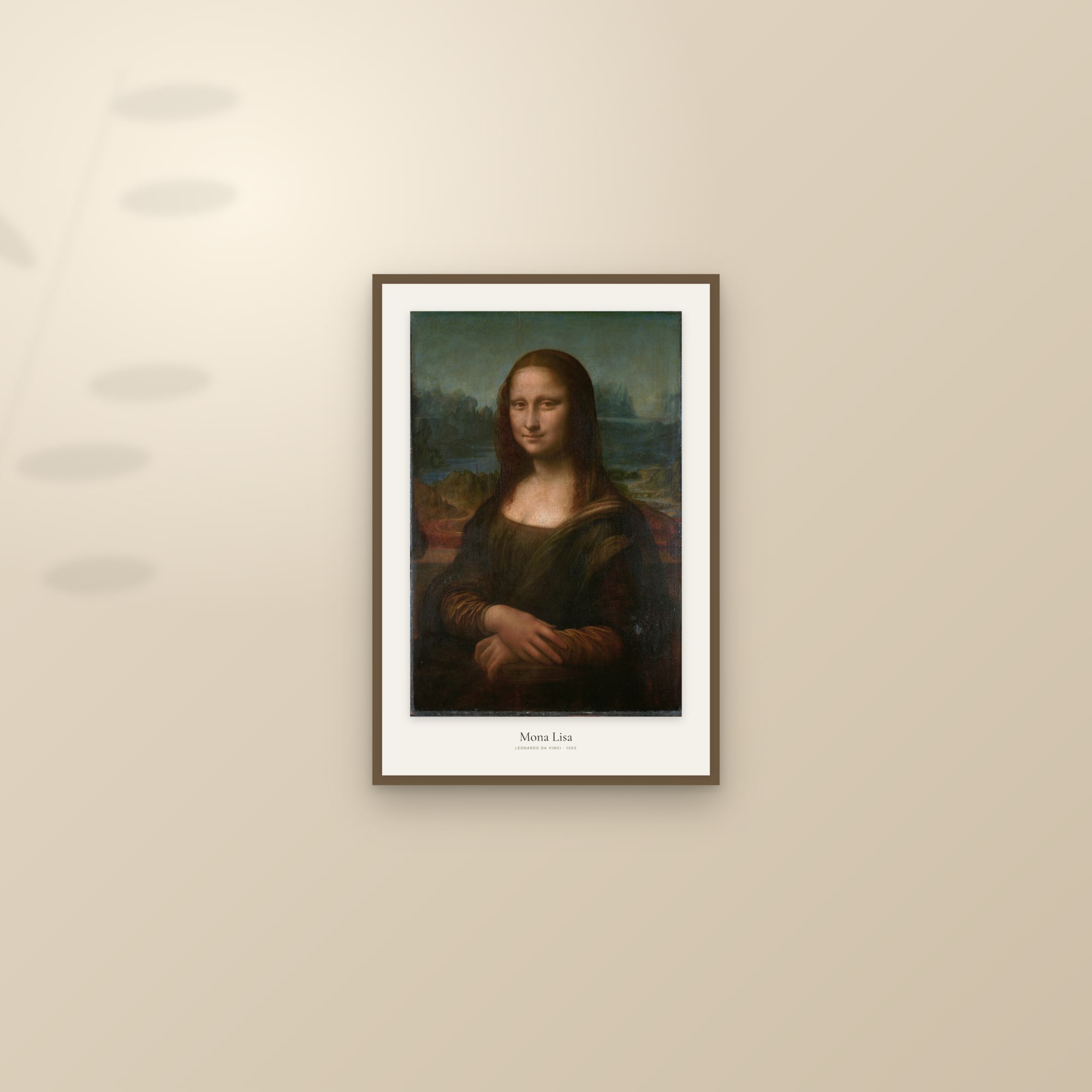
Mona Lisa, Leonardo da Vinci, c. 1503–1519
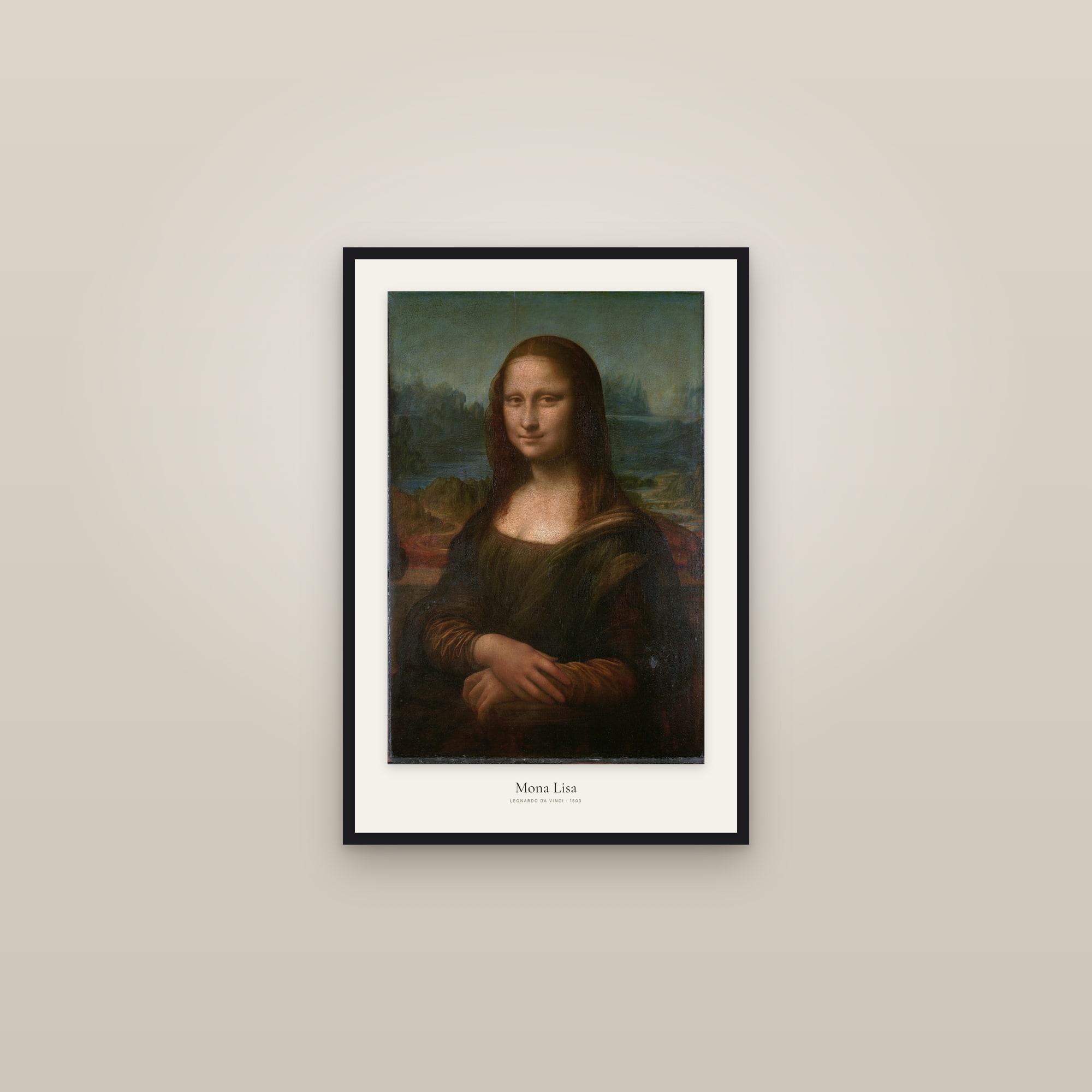
Where Musée du Louvre, Paris (Denon wing, room 711). The Louvre's record says Leonardo began the portrait of Lisa Gherardini around 1503, never considered it finished, and kept it until his death in 1519; Francis I of France most likely acquired it in 1518.
Why it is famous partly the painting and partly the crime. The smoky modelling (sfumato) and the half-smile were admired for four centuries, but what made the picture a household name was its theft on 21 August 1911 by Vincenzo Peruggia, a glazier who had worked at the museum, and the two years of headlines before it was recovered in Florence in 1913. What people get wrong: its size. It is 79 by 53 cm, a panel you could carry under one arm, which is how it left the building.
Print yes, from the Louvre scan. Mona Lisa.
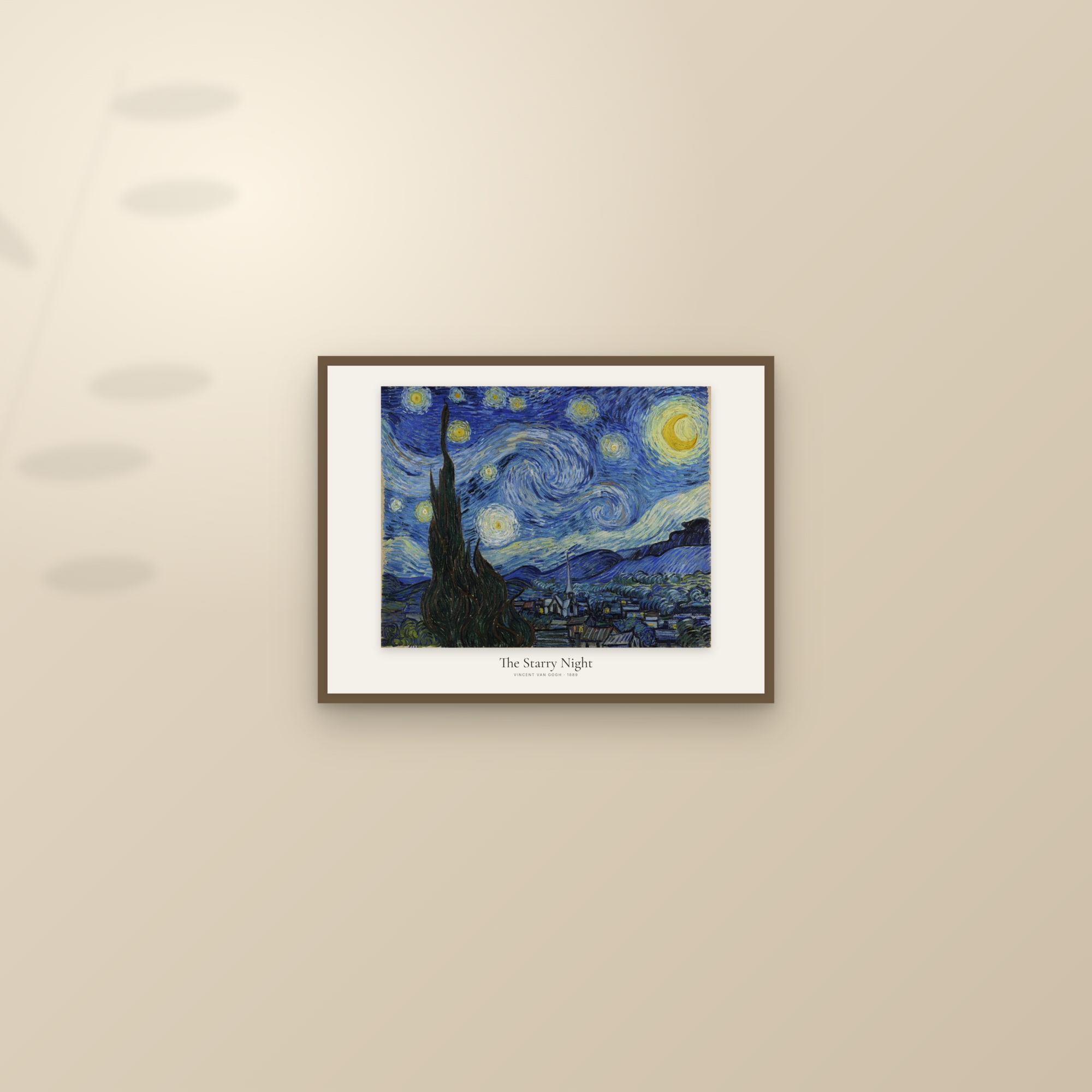
The Starry Night, Vincent van Gogh, 1889
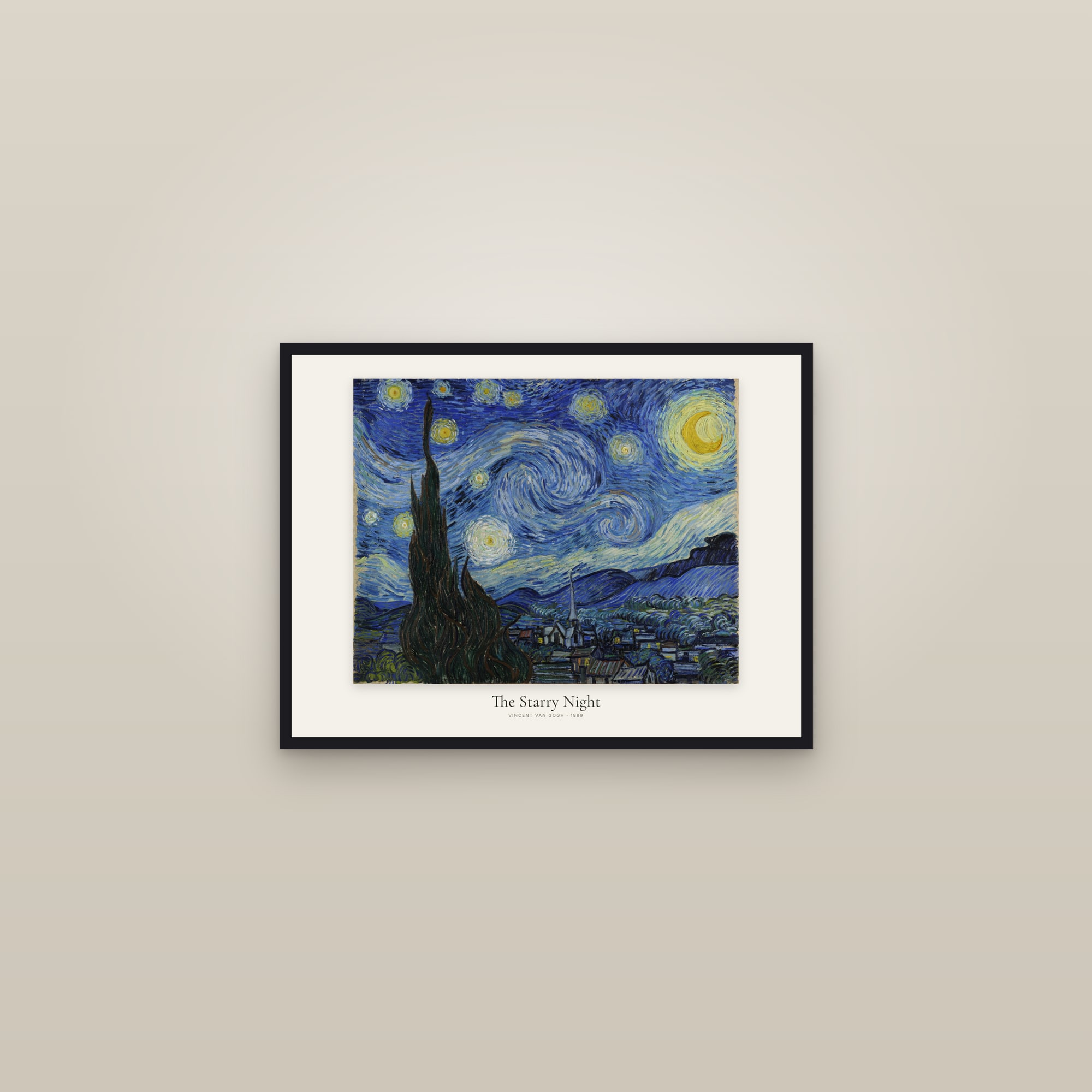
Where The Museum of Modern Art, New York, which acquired it in 1941. Painted in June 1889 at the asylum of Saint-Paul-de-Mausole in Saint-Rémy, from the view from the window of his room.
Why it is famous it is the painting people mean when they say Van Gogh. The swirling sky became shorthand for the romantic idea of the tormented artist, and the image reproduces well at any size, which matters more than critics admit. What people get wrong: they confuse it with Starry Night Over the Rhône, painted in Arles a year earlier and now in the Musée d'Orsay. That one has the river and the gaslights; this one has the cypress.
Print yes. The Starry Night.
The Last Supper, Leonardo da Vinci, 1495–1498
Where the refectory of Santa Maria delle Grazie, Milan. It is a wall painting, not a canvas, so it has never travelled. Visits are limited to fifteen minutes in groups of forty, by reservation.
Why it is famous the composition, with the apostles in four groups of three reacting to the words "one of you will betray me", is the most copied arrangement of figures in Western art. What people get wrong: they think it is a fresco. The museum's record says Leonardo chose not to use true fresco but a method that let him paint on dry plaster, so that he could work slowly, and the paint began to flake within his lifetime. What you see today is a careful ruin, restored at length in the late twentieth century, and the museum's own site describes the work as fragile and kept under constant environmental control.
Print yes, at its wide native proportions. The Last Supper.
The Scream, Edvard Munch, 1893
Where the National Museum of Norway, Oslo, holds the 1893 painted version (tempera and crayon on cardboard, 91 by 73.5 cm). Munch made several: two pastels (1893 and 1895), a lithograph (1895) and a later painted version at the Munch Museum.
Why it is famous it is the one image of anxiety everyone recognises, and the 1895 pastel's sale for $119.9 million at Sotheby's in 2012 (about $176 m in today's money) renewed the fame for a generation. What people get wrong: the figure is not screaming. Munch's own text, quoted in the museum's record, has him sensing "an infinite scream passing through nature": the scream is in the landscape, not the figure. The museum's record also notes a faint pencil line at the top left, "can only have been painted by a madman", which a 2020 study concluded Munch wrote himself.
Print yes, the 1893 Oslo painting. The Scream.
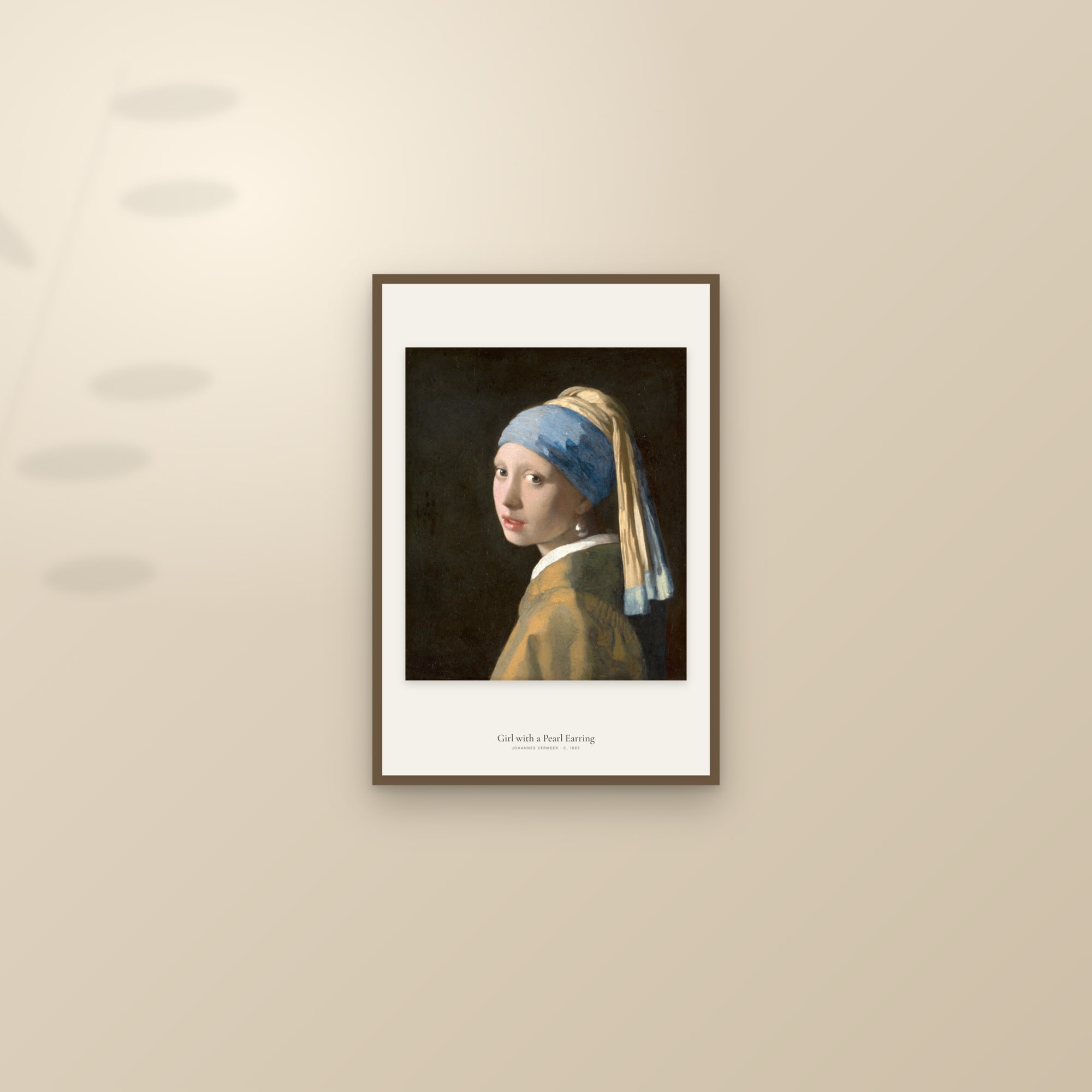
Girl with a Pearl Earring, Johannes Vermeer, c. 1665
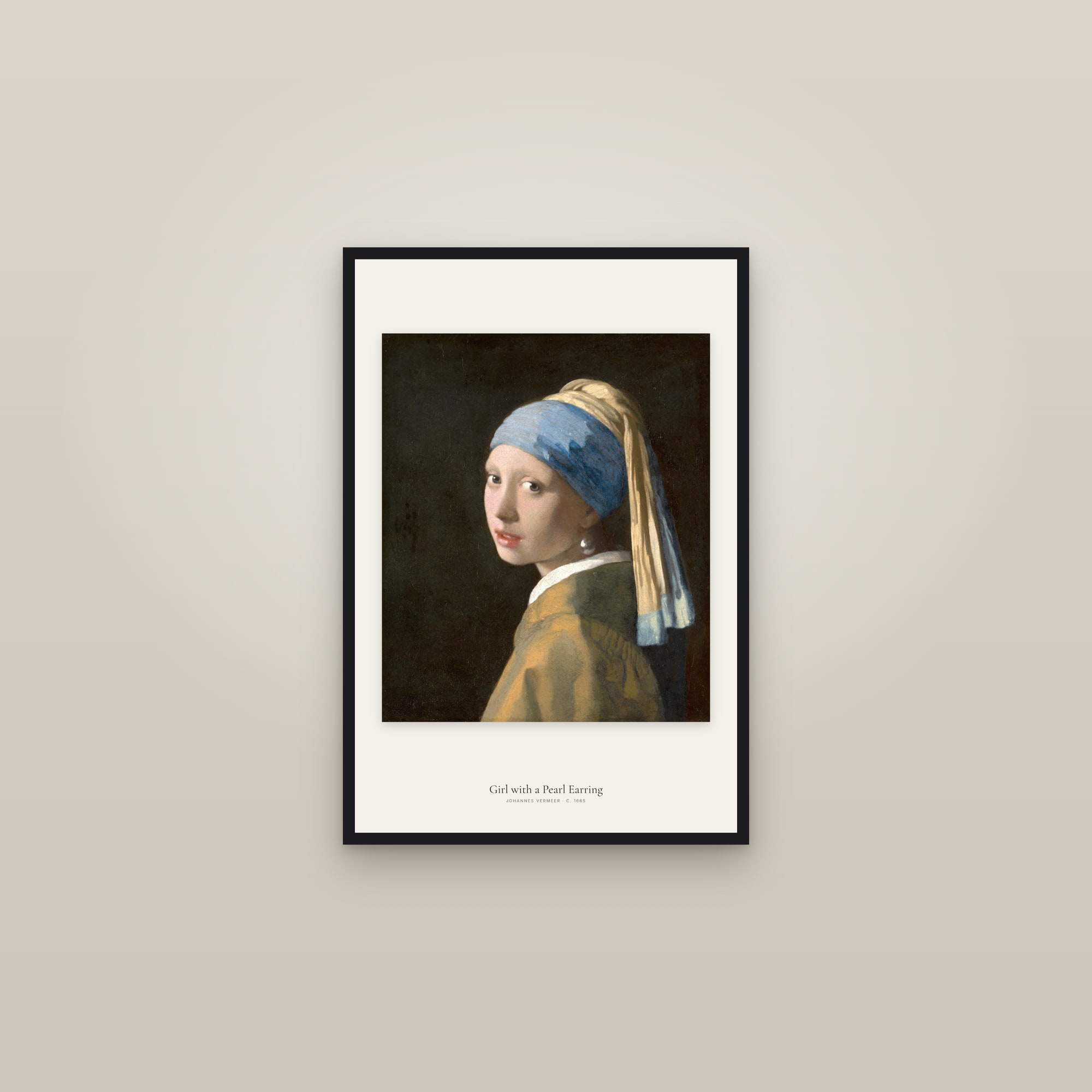
Where Mauritshuis, The Hague (inv. 670).
Why it is famous the turned head and the lit pearl have made it the Mona Lisa of the north, and a novel and a film in the 2000s put it on the bedside table of people who never visit museums. What people get wrong: it is not a portrait of anyone. It is a tronie, a study of a head in exotic dress, which is why no one has ever identified the sitter and why the search for her is beside the point.
Print yes. Girl with a Pearl Earring.
Guernica, Pablo Picasso, 1937
Where Museo Reina Sofía, Madrid (room 205.10). Painted in Paris between 1 May and 4 June 1937 for the Spanish Republic's pavilion at the Paris world's fair; 349 by 777 cm. It stayed at MoMA in New York, at Picasso's request, until democracy returned to Spain, and arrived in Madrid in 1981.
Why it is famous it is the twentieth century's picture of war, painted in black, white and grey weeks after the bombing of the Basque town. What people get wrong: that it shows the bombing. It shows no aircraft and no town; it shows a horse, a bull, a lamp and screaming figures in a room.
Print no. Picasso died in 1973, so the painting is in copyright until the 2040s. We do not sell it.
The Creation of Adam, Michelangelo, c. 1512
Where the ceiling of the Sistine Chapel, Vatican Museums. The Vatican's own chronology: contract signed 8 May 1508, first half finished by August 1510, the whole ceiling complete by the end of October 1512.
Why it is famous two fingers that do not quite touch. The gap is the most quoted detail in painting, parodied in every medium. What people get wrong: that it is a painting you can stand in front of. It is one panel of nine Genesis scenes, twenty metres up, seen from a crowded floor with your neck bent.
Print yes, cropped to the panel. The Creation of Adam.
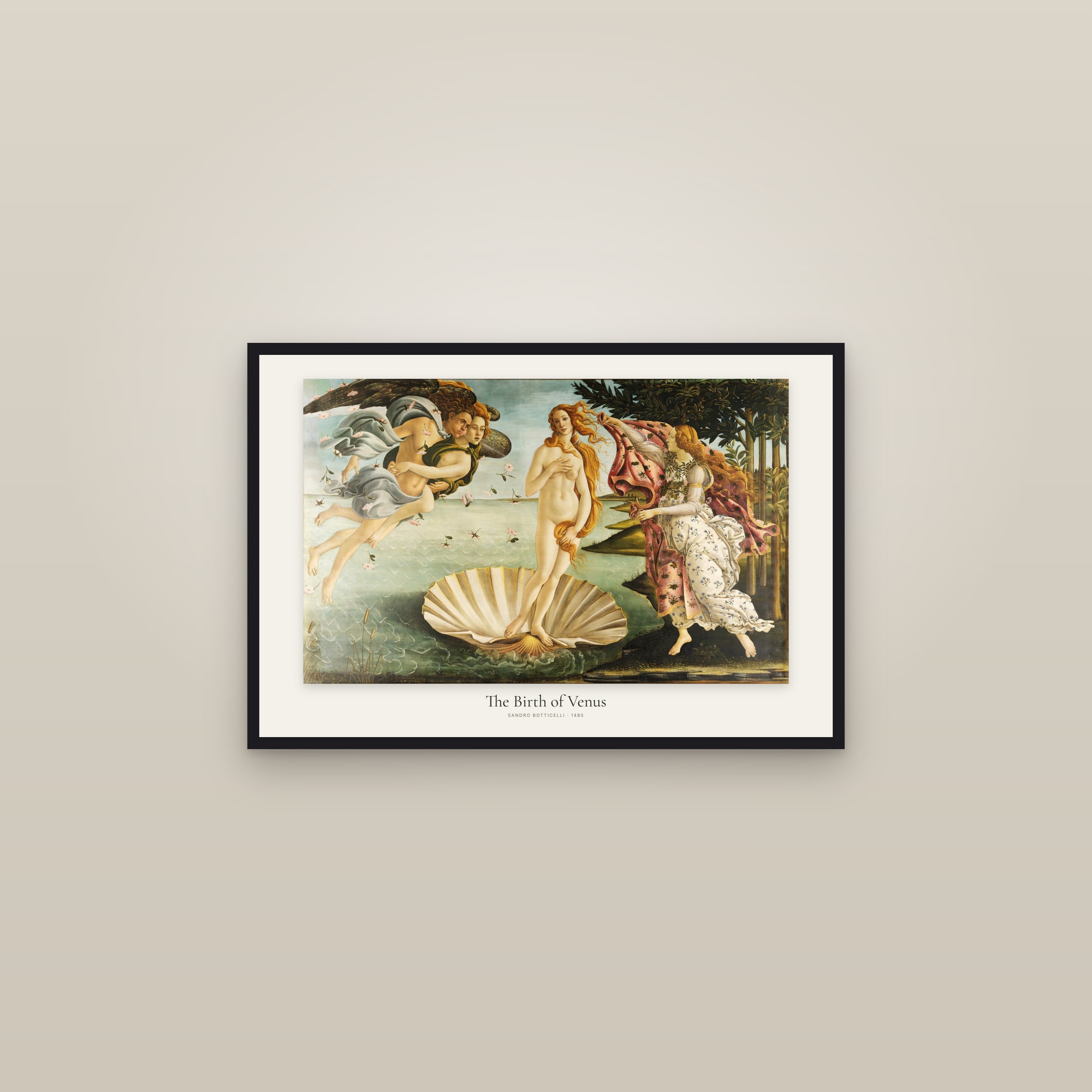
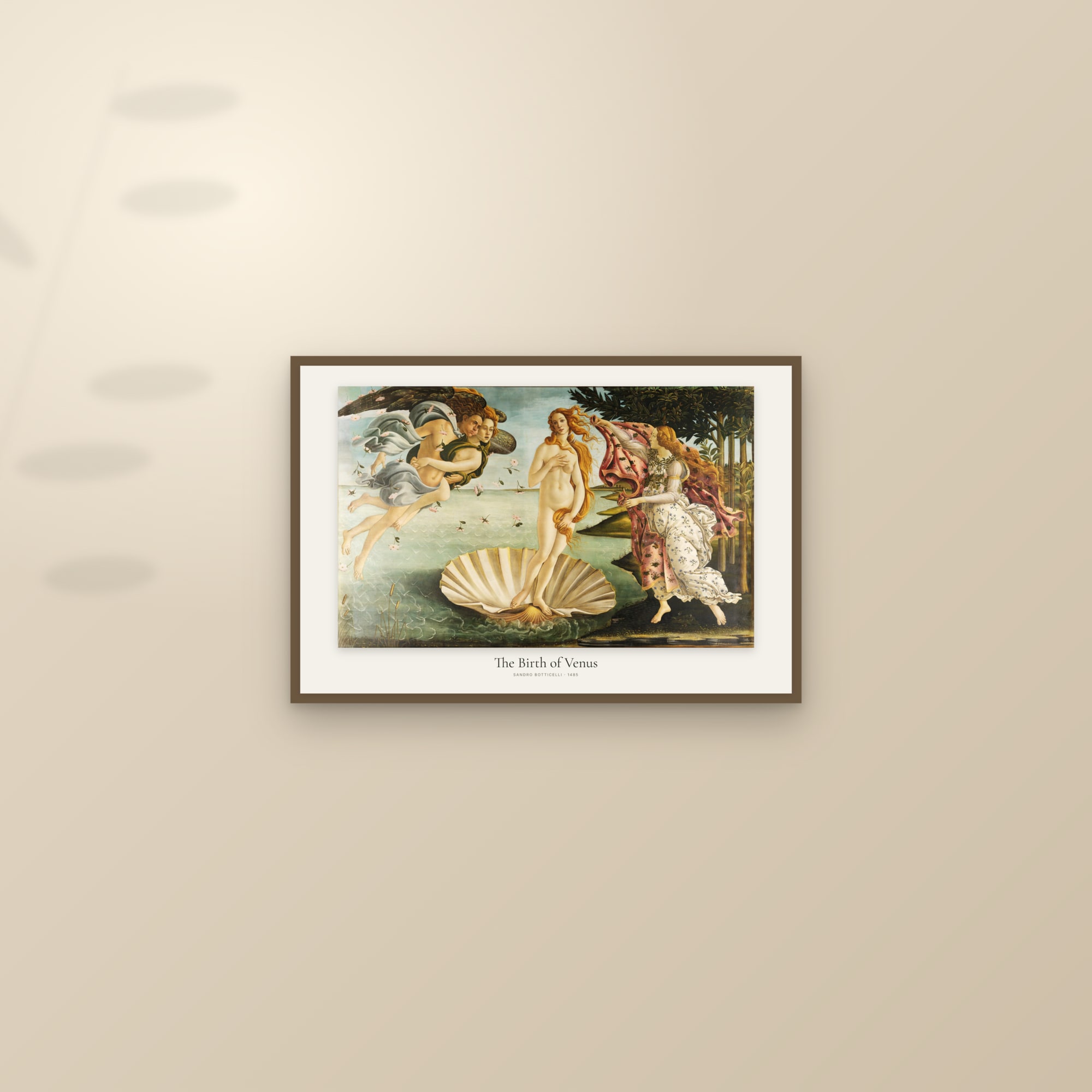
The Birth of Venus, Sandro Botticelli, c. 1485
Where Uffizi Galleries, Florence (room A12). Tempera on canvas, 172.5 by 278.5 cm, almost certainly a Medici commission; the first record is Vasari's, who saw it at the Medici villa of Castello in 1550.
Why it is famous it is the Renaissance's nude, and the one that made the shell, the blowing winds and the flying hair into a visual language. What people get wrong: Botticelli was nearly forgotten for three centuries. The picture's fame is a nineteenth-century rediscovery, not a continuous one.
Print yes, wide format. The Birth of Venus.
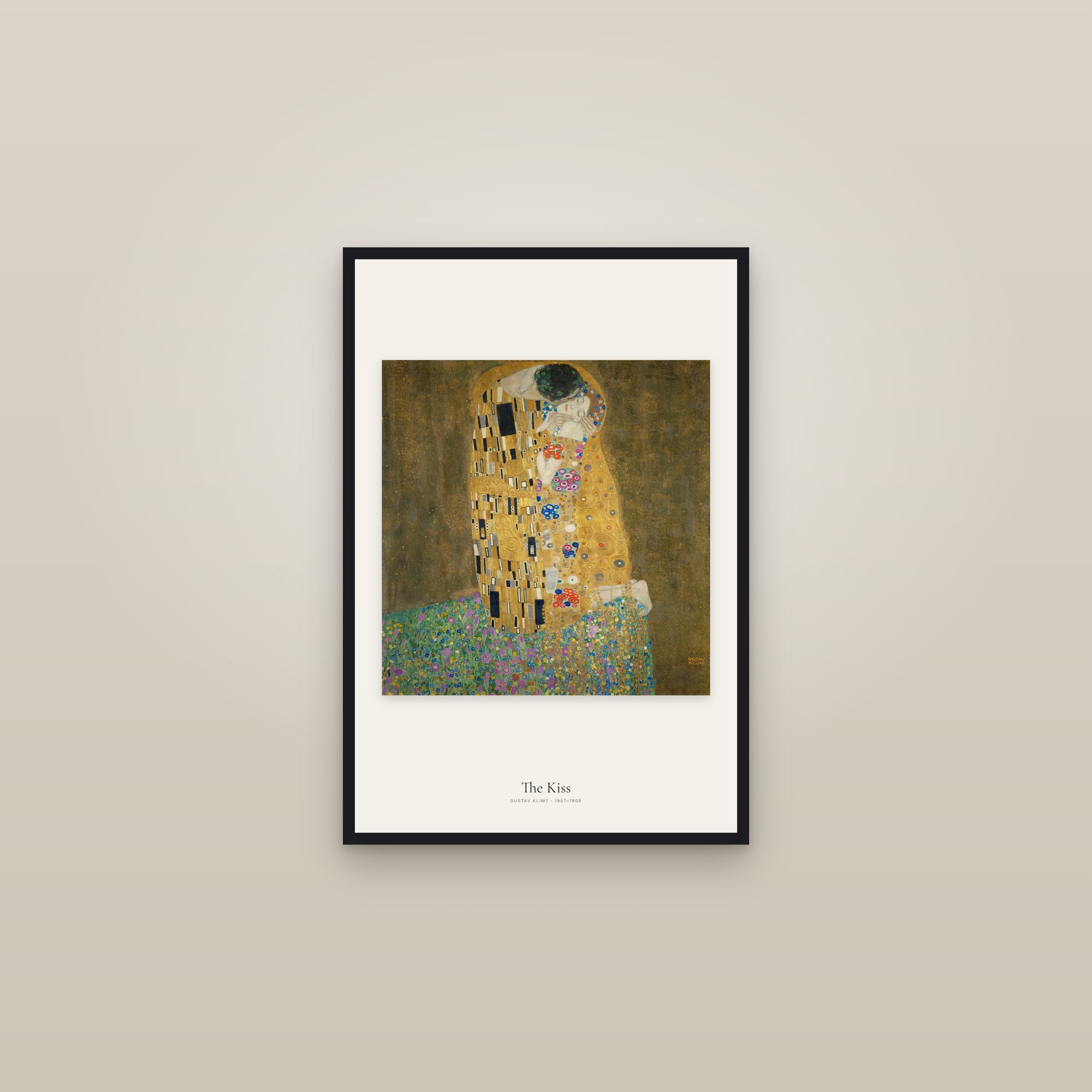
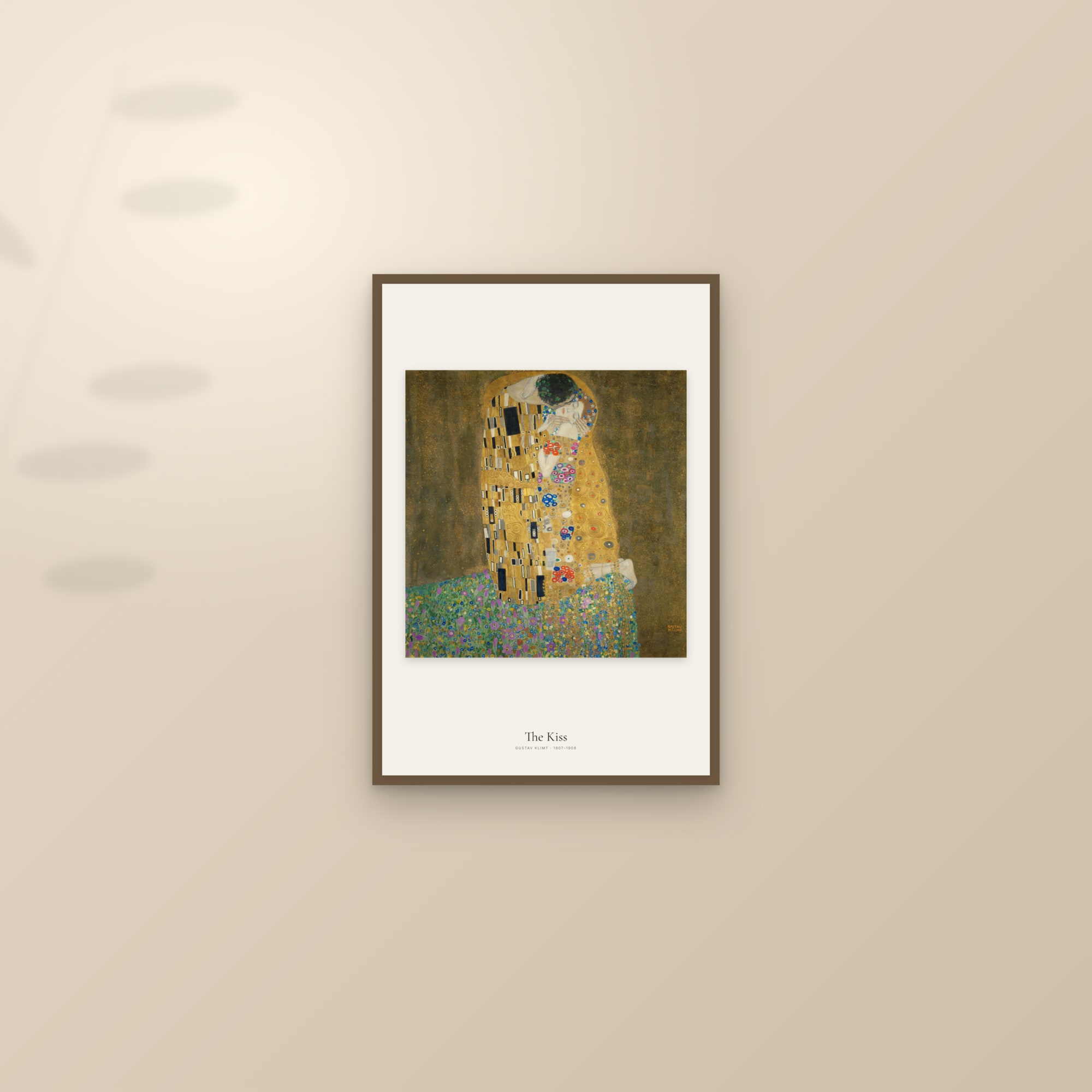
The Kiss, Gustav Klimt, 1908–1909
Where Belvedere, Vienna, which records it as inventory 912, bought by the Austrian state from the 1908 Kunstschau, where it was shown as "Lovers". It is a square, 180 by 180 cm, with real gold, silver and platinum leaf.
Why it is famous gold. It is the most reproduced painting of the twentieth century's first decade and the one that makes people think they like Art Nouveau. What people get wrong: that it shimmers in reproduction. It does not; the leaf reads as a flat yellow on paper, which is why a print of it needs a warm, matte stock and not a glossy one.
Print yes. The Kiss.
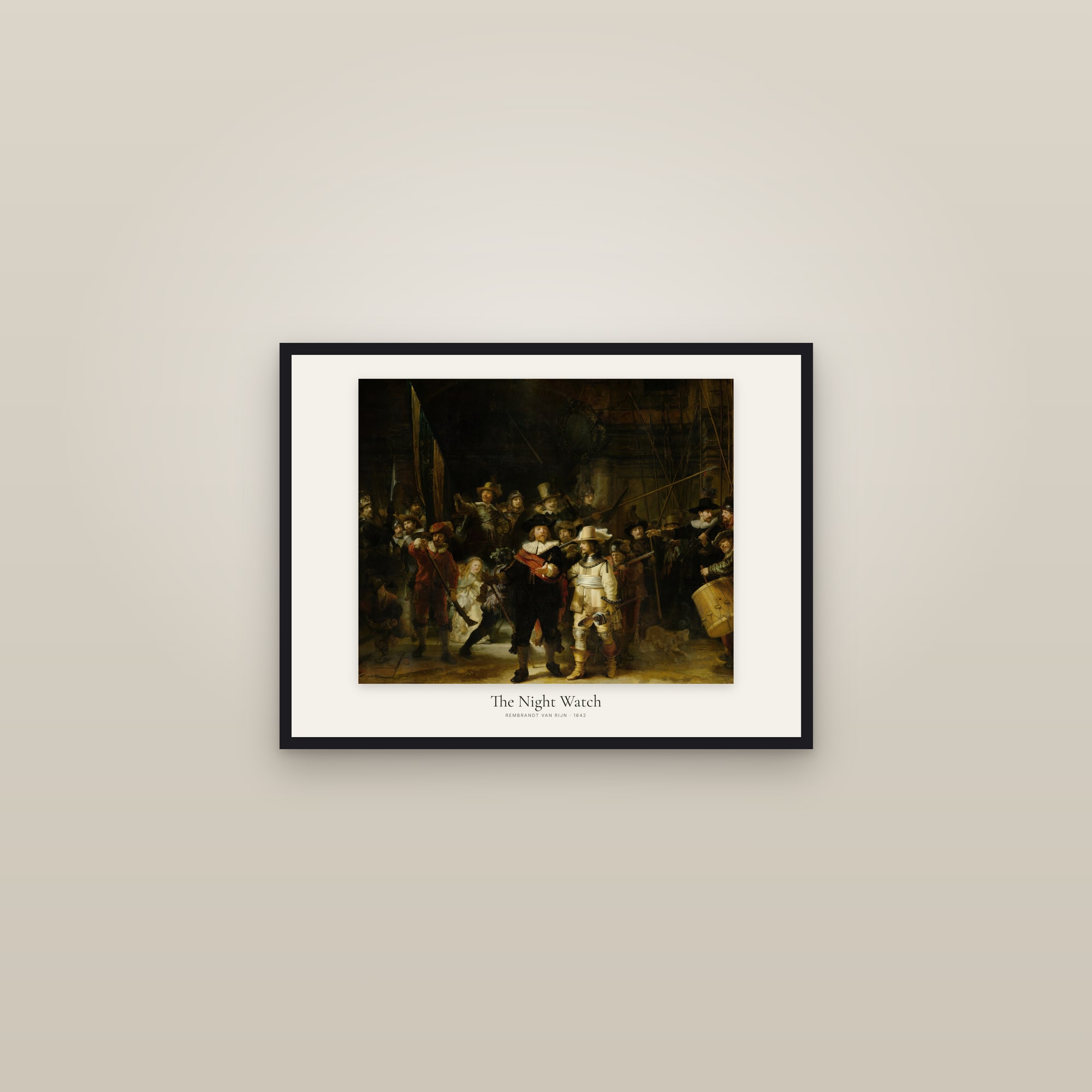
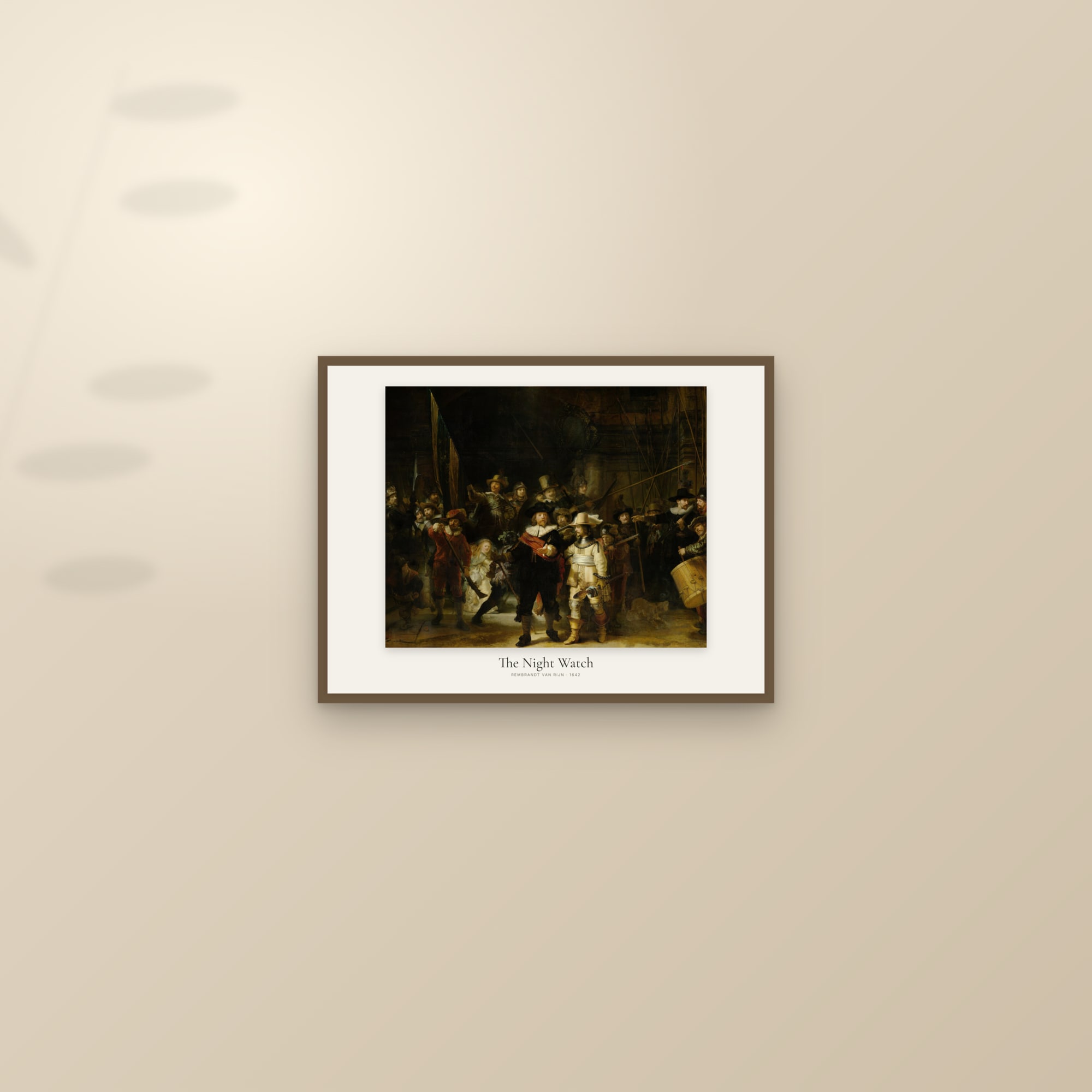
The Night Watch, Rembrandt van Rijn, 1642
Where Rijksmuseum, Amsterdam (SK-C-5), on loan from the City of Amsterdam since 1808. The official title is Militia Company of District II under the Command of Captain Frans Banninck Cocq; the nickname dates from the late eighteenth century.
Why it is famous scale (379.5 by 453.5 cm) and movement. Group portraits of militia companies were rows of men; Rembrandt made his walk out of the picture. What people get wrong: it is not a night scene. The Rijksmuseum calls it a daylight march, despite the dark tones.
Print yes. The Night Watch.
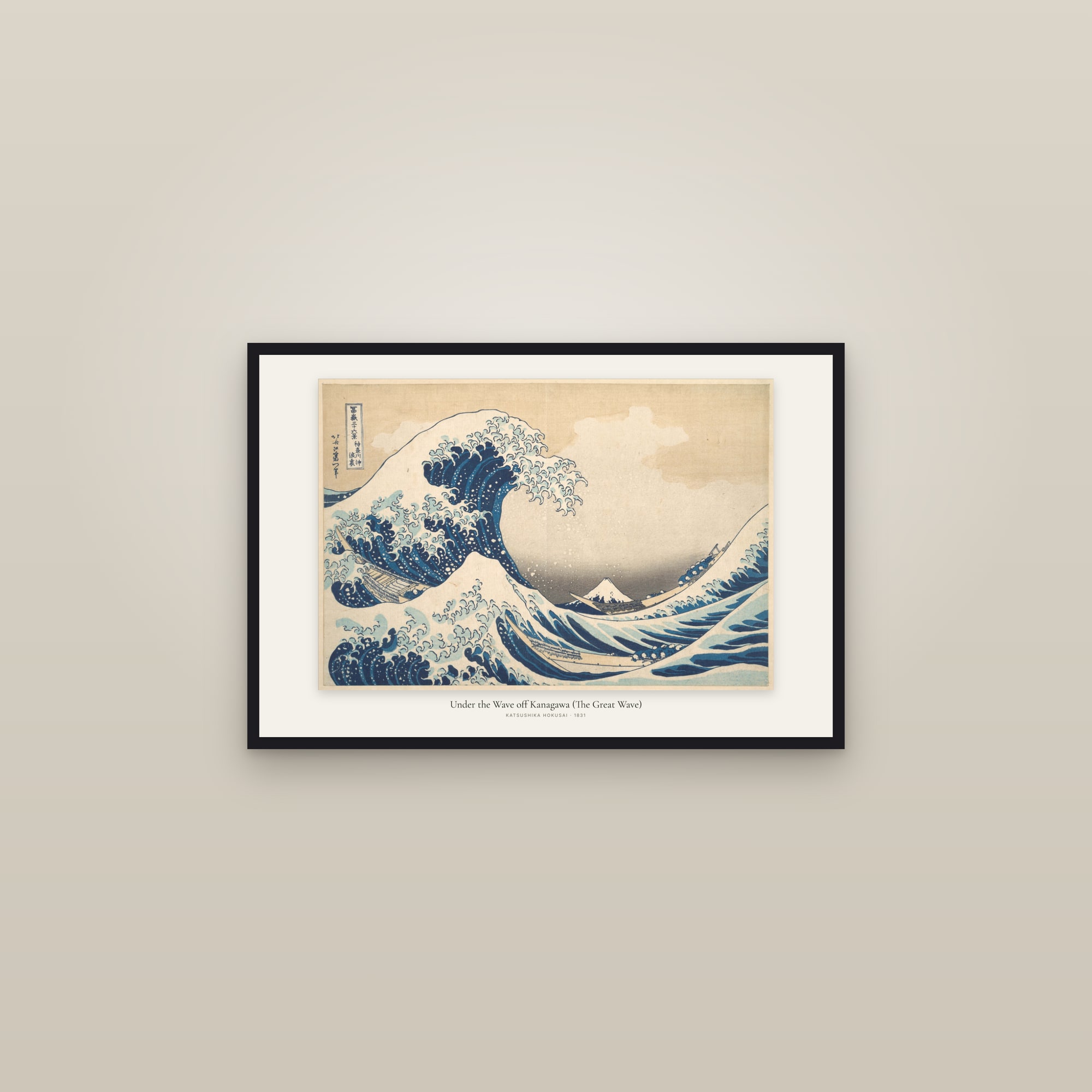
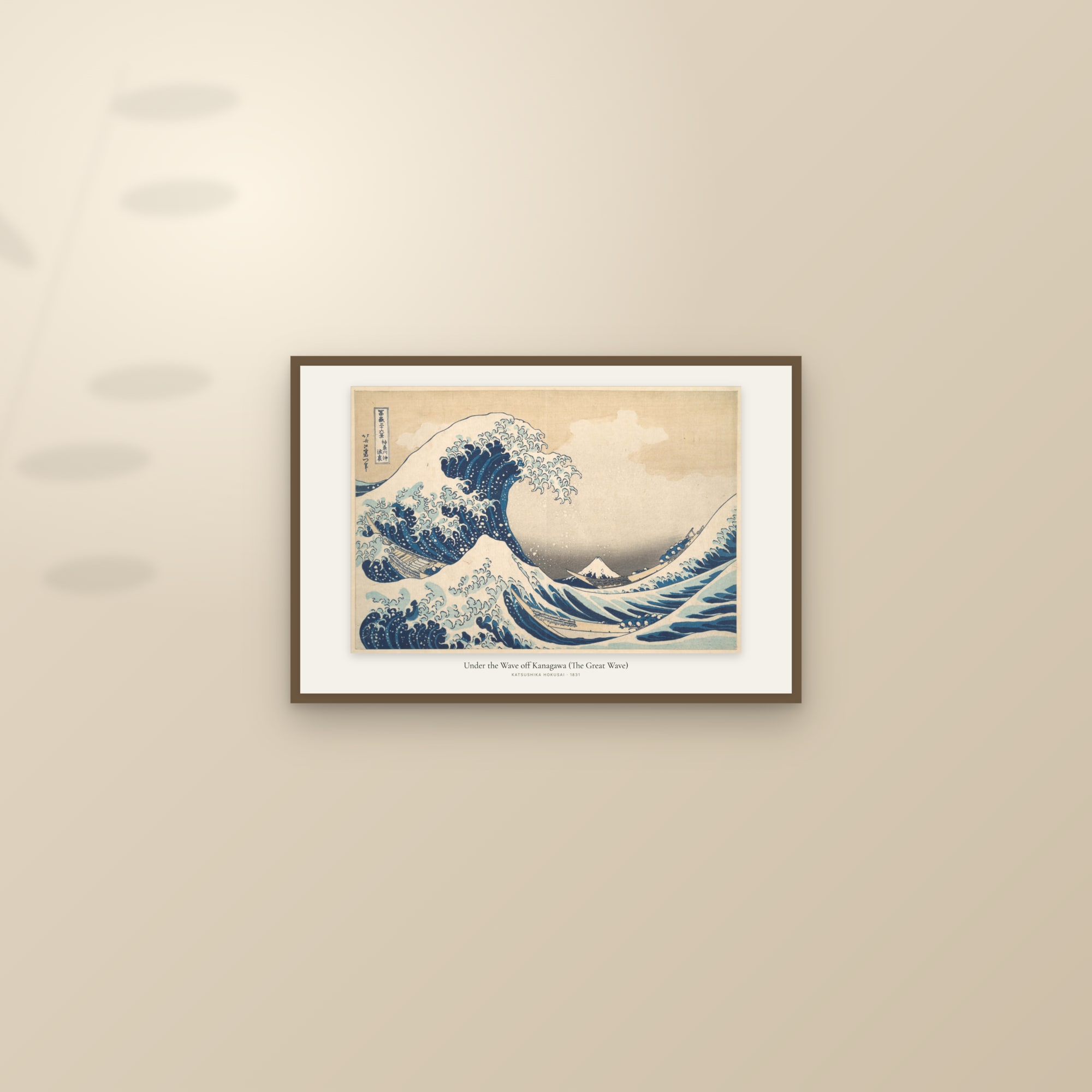
Under the Wave off Kanagawa (The Great Wave), Katsushika Hokusai, c. 1830–1832
Where everywhere, because it is a woodblock print made in an edition of many impressions. The Metropolitan Museum's impression (JP1847) is the one we restore; the British Museum, the Art Institute of Chicago and dozens of others hold their own.
Why it is famous it is the one Japanese image the whole world knows, and the claw of foam has been borrowed by surf brands, emoji designers and climate reports. What people get wrong: that it is a painting, and that Fuji is the subject. Fuji is the small triangle in the trough; the series is Thirty-six Views of Mount Fuji, and this is the view in which the mountain is nearly swallowed.
Print yes. The Great Wave, or as an exhibition poster.
The Persistence of Memory, Salvador Dalí, 1931
Where The Museum of Modern Art, New York.
Why it is famous the melting clocks are Surrealism's logo. What people get wrong: its size. It is a tiny panel, a little larger than a sheet of A4, hung in a room full of people looking for something the size of a wall.
Print no. Dalí died in 1989; the picture is in copyright for decades yet. We do not sell it.
Sunflowers, Vincent van Gogh, 1888
Where National Gallery, London (NG3863), bought in 1924. It is one of seven versions: four painted in Arles in August 1888 to decorate the room Gauguin would stay in, and three replicas made in January 1889. The London picture, fifteen flowers on yellow, is one of the second pair of the August group.
Why it is famous it is the painting that made yellow Van Gogh's colour, and the one most likely to be the first "real art" anyone owned as a poster. What people get wrong: that there is one Sunflowers. Ask which. The Amsterdam replica is at the Van Gogh Museum; the Munich one at the Neue Pinakothek.
Print yes, the London version, and the Amsterdam version too. Sunflowers.
Water Lilies, Claude Monet, 1916
Where there is no single Water Lilies. The series occupied Monet's last three decades at Giverny and the canvases are spread from the Orangerie in Paris to Chicago, New York and Tokyo. The one we print is the two-metre square of 1916 at the National Museum of Western Art, Tokyo, bought from Monet by Kōjirō Matsukata in 1921.
Why it is famous it is the painting people mean by Impressionism, and the one that most often turns up in dentists' waiting rooms, which is a kind of fame. What people get wrong: that it is gentle. The late canvases have no horizon and barely a subject; they are the bridge to abstraction.
Print yes. Water Lilies, and more in Monet.
Las Meninas, Diego Velázquez, 1656
Where Museo del Prado, Madrid, where it has hung since the museum opened in 1819.
Why it is famous among painters it is the most admired painting in the world; Picasso painted fifty-eight variations on it in 1957, now together at the Museu Picasso in Barcelona. The public knows the image, the infanta in the wide dress with her maids, the dwarf, the dog, the painter at his easel and the king and queen in the mirror, and often not the name. What people get wrong: who is being painted. The mirror says the royal couple; the canvas says the viewer.
Print yes. Las Meninas.
Nighthawks, Edward Hopper, 1942
Where Art Institute of Chicago.
Why it is famous the lit diner at night is the picture of American loneliness, parodied with every cast of characters imaginable. What people get wrong: that it is a real place. Hopper said it was suggested by a restaurant on Greenwich Avenue and that he "simplified the scene a great deal and made the restaurant bigger"; the Art Institute calls the result no transcription of a real place.
Print no. Hopper died in 1967 and the work is in copyright. We do not sell it.
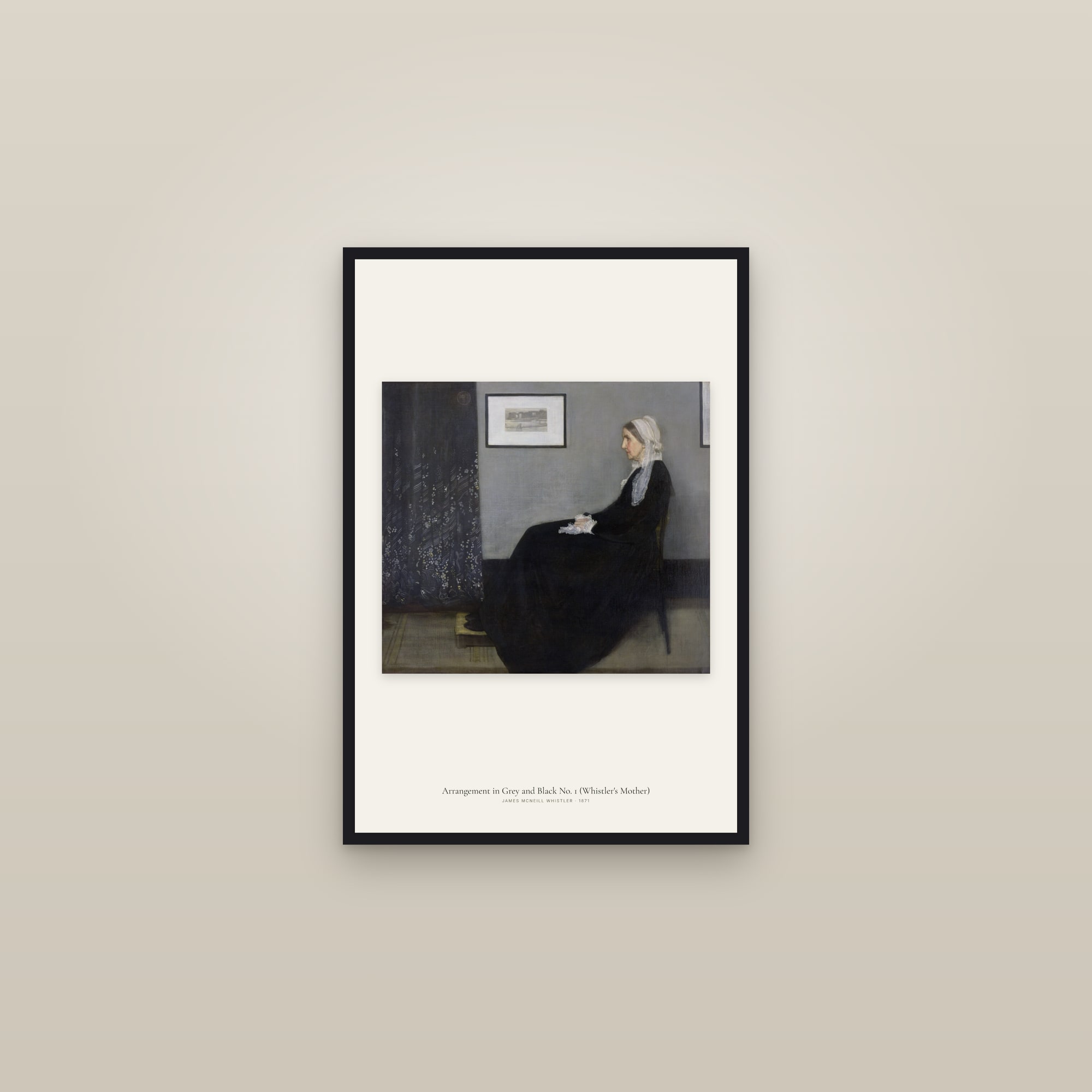
Arrangement in Grey and Black No. 1 (Whistler's Mother), James McNeill Whistler, 1871
Where Musée d'Orsay, Paris, bought by the French state in 1891, which makes it one of the few American paintings almost no American has seen in person.
Why it is famous the United States put it on a postage stamp in 1934 as a symbol of motherhood, and it has been the mother in a hundred cartoons since. What people get wrong: the title. Whistler called it an arrangement of two colours; the sitter was almost incidental, which is the opposite of how it is loved.
Print yes. Whistler's Mother.
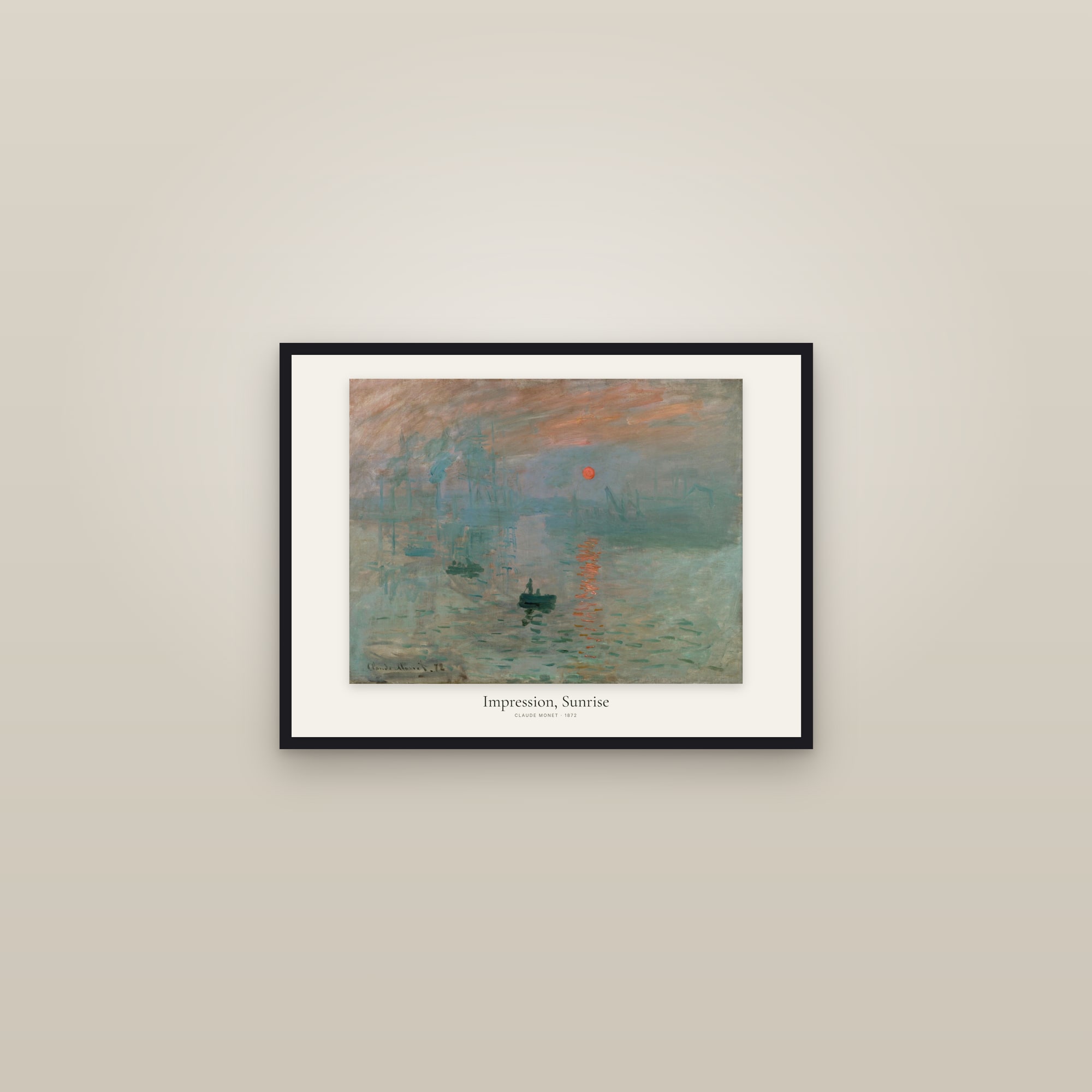
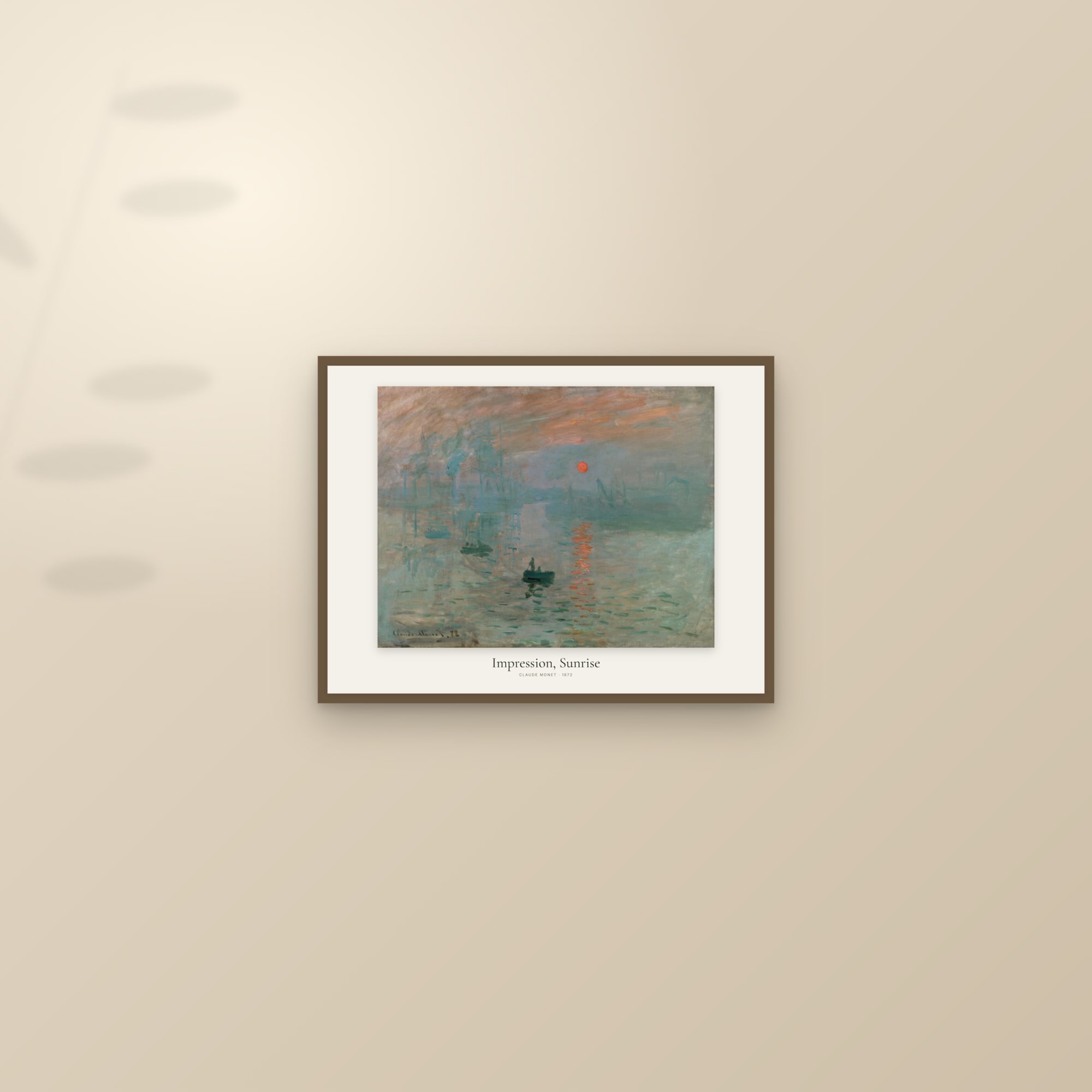
Impression, Sunrise, Claude Monet, 1872
Where Musée Marmottan Monet, Paris (inv. 4014). Painted from a hotel window in Le Havre in November 1872, looking out over the outer harbour.
Why it is famous it named a movement. Shown at the first independent exhibition in April 1874, it was mocked by the critic Louis Leroy under the headline "The exhibition of the impressionists", and the insult became the name. What people get wrong: that it is a great painting. It is a sketch, and Monet gave it the title because it could not pass as a view of Le Havre.
Print yes. Impression, Sunrise.
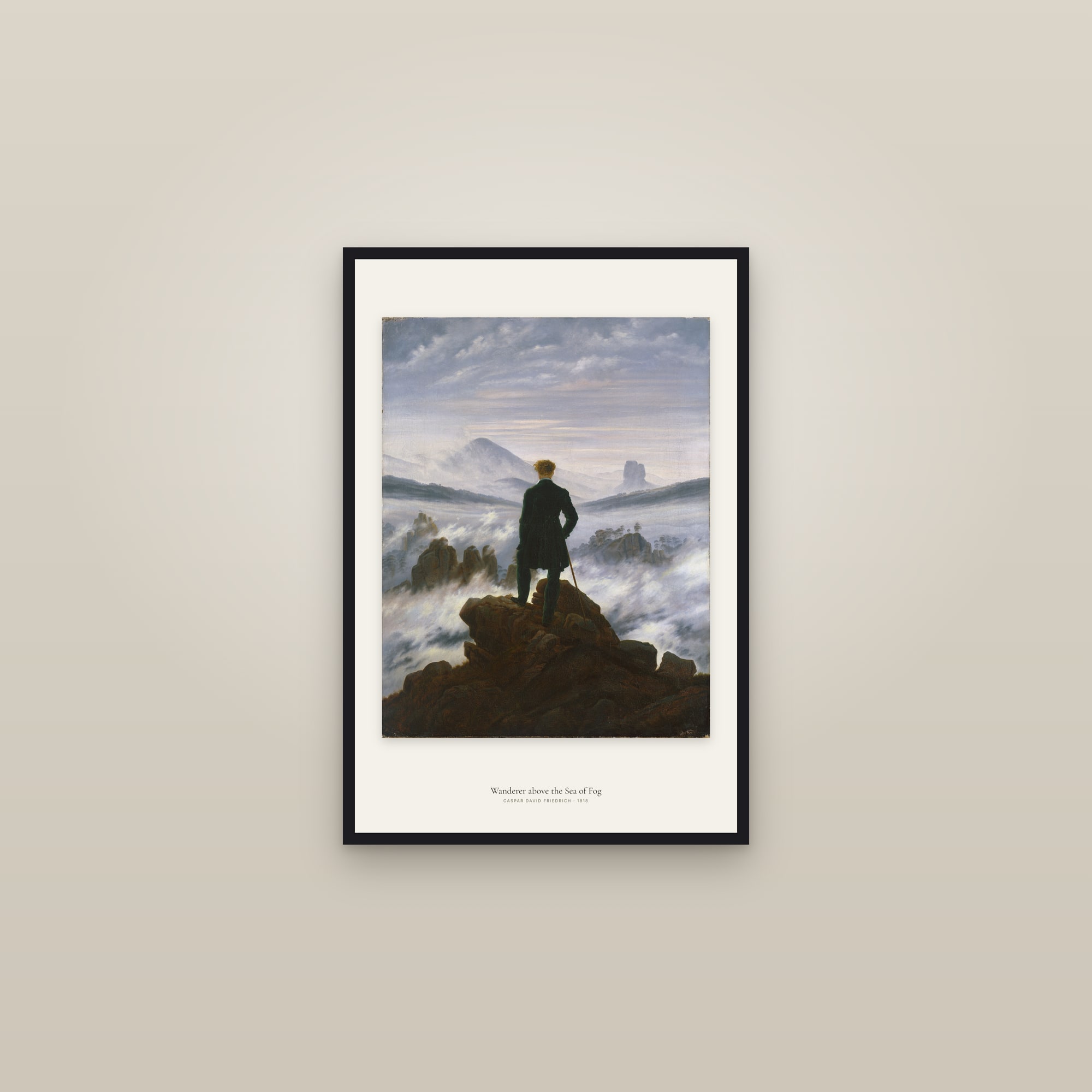
Wanderer above the Sea of Fog, Caspar David Friedrich, c. 1817
Where Hamburger Kunsthalle, Hamburg (HK-5161).
Why it is famous the figure seen from behind, looking out over something vast, is the image of Romanticism and now of every book cover about the self. What people get wrong: that it is securely dated. It is unsigned and undated; the Kunsthalle gives only "around 1817", and bought it as recently as 1970.
Print yes. Wanderer above the Sea of Fog.
Liberty Leading the People, Eugène Delacroix, 1830
Where Musée du Louvre, Paris (RF 129). The Louvre's record: painted between September and December 1830 in Delacroix's studio on the quai Voltaire, shown at the Salon of 1831, bought by the state that August for 3,000 francs.
Why it is famous it is the image of revolution, borrowed for banknotes, stamps, album covers and protest posters. What people get wrong: the revolution. It is not 1789 but the three days of July 1830 that replaced one king with another.
Print yes. Liberty Leading the People.
A Sunday on La Grande Jatte, Georges Seurat, 1884–1886
Where Art Institute of Chicago. Over three metres wide and built from dots.
Why it is famous it is the pointillist painting, and a Broadway musical and a certain 1986 film scene made it a joke everyone is in on. What people get wrong: that the dots blend at a distance into smooth colour. They do not; they shimmer, which was the point.
Print yes, wide format. A Sunday on La Grande Jatte.
The Arnolfini Portrait, Jan van Eyck, 1434
Where National Gallery, London (NG186), bought in 1842 for 600 guineas.
Why it is famous the convex mirror on the back wall, reflecting the room and two figures in the doorway, under the inscription "Johannes de Eyck fuit hic 1434" (Jan van Eyck was here). It is the earliest painting most people can picture from before the Renaissance proper. What people get wrong: that it records a wedding. The gallery's own account calls the identification of the couple uncertain, and the wedding theory is one of several.
Print yes. The Arnolfini Portrait.
The Garden of Earthly Delights, Hieronymus Bosch, 1490–1500
Where Museo del Prado, Madrid. A triptych, 185.8 cm high and about 325 cm wide with the wings open.
Why it is famous the centre panel's naked crowds, giant fruit and impossible animals are the most looked-at square metres in the Prado, and the internet rediscovers a new detail every month. What people get wrong: that it is a celebration. Read left to right, Eden to Hell, it is a warning.
Print yes, the full triptych as one wide sheet. The Garden of Earthly Delights.
Café Terrace at Night, Vincent van Gogh, 1888
Where Kröller-Müller Museum, Otterlo, which dates it to about 16 September 1888. Painted on the spot in Arles, at night, under gaslight, with the stars placed as they stood that night.
Why it is famous it is the warm Van Gogh, the one chosen for kitchens and cafés, and the terrace on the Place du Forum still trades on it. What people get wrong: that it is painted with black. The museum notes he refused the usual black-and-grey of night scenes and built the dark out of blue.
Print yes. Café Terrace at Night.
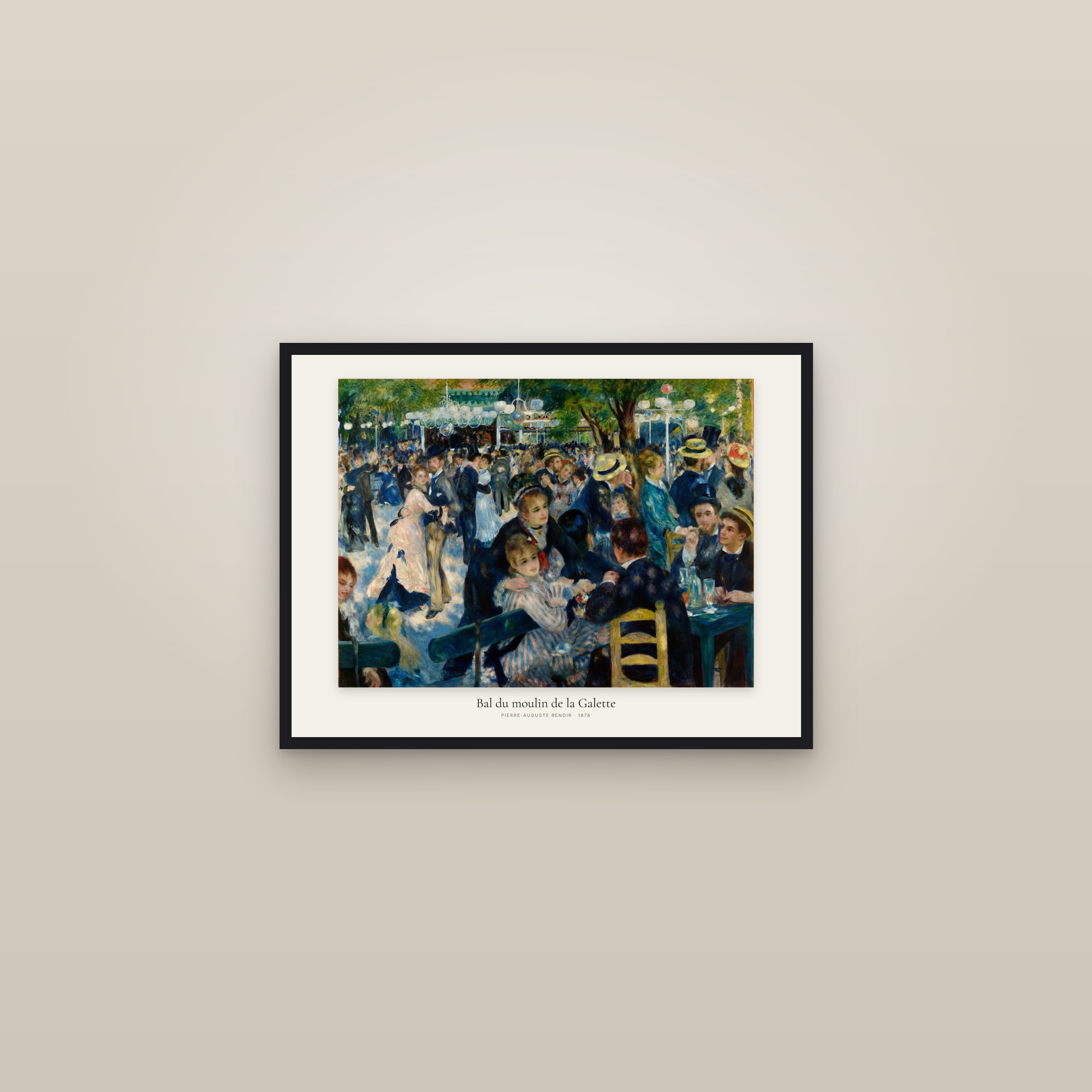
Bal du moulin de la Galette, Pierre-Auguste Renoir, 1876
Where Musée d'Orsay, Paris, from the Caillebotte bequest. A smaller version, in a private collection, sold at Sotheby's New York in May 1990 for $78.1 million (about $201 m today), then the second-highest auction price ever paid.
Why it is famous it is the Impressionist afternoon: dappled light, a Montmartre dance garden, everyone's friends in the picture. What people get wrong: that it was painted in the studio. The Orsay's record says it was painted mostly on the spot in the spring and summer of 1876, and probably finished in the studio over the winter.
Print yes, the Orsay version. Bal du moulin de la Galette.
What the list tells you
Fame clusters. Five of the twenty-five are in Paris. Ten are from the fifty years between 1870 and 1920, when colour reproduction arrived and the pictures that printed well got famous. Three are too new to print, and the rest are old enough to belong to everyone. If you want to see them, four museums (the Louvre, the Orsay, the Prado and MoMA) hold eight of them between them; the Louvre and Orsay pages here list what we print from each.
More in the Journal: the most valuable paintings ever sold (a different list, with almost no overlap), paintings everyone has seen but cannot name, and the most reproduced artworks. For how the reproductions were made, see a short history of the print.
Famous Painting Prints Exhibition PostersQuestions people ask
What is the most famous painting in the world?
The Mona Lisa, by Leonardo da Vinci, in the Louvre in Paris. No other painting is recognised by as many people, and its fame is partly an accident: the 1911 theft and the two-year search made it front-page news around the world before most people had seen a reproduction.
Where is The Starry Night?
At the Museum of Modern Art in New York, which has owned it since 1941. The similar-sounding Starry Night Over the Rhône, painted a year earlier in Arles, is in the Musée d'Orsay in Paris. The two are often confused.
Which famous paintings are in the public domain?
Any painting whose artist has been dead for more than seventy years, which covers everything on this list from Van Eyck to Munch (died 1944). Guernica (Picasso, died 1973), Nighthawks (Hopper, died 1967) and The Persistence of Memory (Dalí, died 1989) are still in copyright, so reproductions of them need a licence and we do not sell them.
Can I buy a print of the Mona Lisa?
Yes. Leonardo died in 1519, so the painting is in the public domain. We print it from a cleaned museum scan at its native proportions, on 250 gsm archival paper, from $39, framed in black or dark wood if you want it framed.
Is The Great Wave a painting?
No, it is a woodblock print, made in an edition of many impressions around 1830–32. It is on this list because it is as recognisable as any painting; the sheet we print is the Metropolitan Museum's impression.
Sources
- Musée du Louvre, collections: Portrait de Lisa Gherardini (Mona Lisa), INV 779
- MoMA, The Starry Night (object 79802)
- MoMA press release, 29 September 1941: The Starry Night acquired through the Lillie P. Bliss Bequest
- Museo del Cenacolo Vinciano, Milan: The Last Supper, 1495–1498, dry wall-painting, refectory of Santa Maria delle Grazie
- Museo del Cenacolo Vinciano: visiting (15-minute visits, 40 people at a time)
- Nasjonalmuseet, Oslo: The Scream, 1893 (NG.M.00939)
- Mauritshuis, The Hague: Girl with a Pearl Earring (inv. 670)
- Museo Reina Sofía, Madrid: Guernica (DE00050)
- Vatican Museums: the Sistine Chapel ceiling
- Uffizi Galleries, Florence: Birth of Venus
- Belvedere, Vienna: The Kiss (Lovers), inv. 912
- Rijksmuseum, Amsterdam: The Night Watch (SK-C-5)
- Rijksmuseum, Operation Night Watch: Why is The Night Watch so famous? (a daylight march, not a night watch)
- The Metropolitan Museum of Art: Under the Wave off Kanagawa (JP1847)
- MoMA, The Persistence of Memory (object 79018)
- National Gallery, London: Van Gogh, Sunflowers (NG3863)
- National Museum of Western Art, Tokyo: Monet, Water Lilies (P.1959-0151)
- Museo del Prado, Madrid: Las Meninas (entered the museum 1819)
- Museu Picasso, Barcelona: the 58 paintings of the Las Meninas series (1957), given in 1968
- Art Institute of Chicago: Nighthawks
- Art Institute of Chicago, Hopper archive: Nighthawks (Hopper on the Greenwich Avenue restaurant, 'simplified the scene a great deal')
- Musée d'Orsay, Paris: Arrangement en gris et noir n°1 (Whistler's Mother), bought by the State 1891
- Smithsonian National Postal Museum: Mothers of America issue, 3-cent stamp of 2 May 1934 after Whistler's painting
- Musée Marmottan Monet, Paris: Impression, soleil levant (inv. 4014)
- Hamburger Kunsthalle: Wanderer über dem Nebelmeer (HK-5161)
- Musée du Louvre, collections: Le 28 juillet 1830, La Liberté guidant le peuple (RF 129)
- Art Institute of Chicago: A Sunday on La Grande Jatte, 1884
- National Gallery, London: Jan van Eyck, The Arnolfini Portrait (NG186)
- Museo del Prado, Madrid: The Garden of Earthly Delights triptych
- Kröller-Müller Museum, Otterlo: Terrace of a Café at Night (Place du Forum)
- Musée d'Orsay: Bal du moulin de la Galette (painted mostly on the spot, spring and summer 1876; Caillebotte bequest)
- Musée d'Orsay: 150 years of Renoir's Bal du moulin de la Galette
- Guinness World Records: most expensive Renoir sold at auction (Bal du moulin de la Galette, 1990)
- MPR News: The Scream (1895 pastel) sells for $119.9 million at Sotheby's, 2012