
Japanese woodblock prints: what they were, how they were made
Cheap pictures for a city crowd, made by four trades with one block per colour and no press: how Hokusai's and Hiroshige's prints were cut and rubbed by hand, and why no two sheets match.
Contents10 sections
- Who actually made the print?
- Step 1: the publisher decides
- Step 2: the design goes onto the wood
- Step 3: the carver cuts the key block
- Step 4: the proofs become colour blocks
- Step 5: kento keep the colours in place
- Step 6: the printer rubs the sheet by hand
- How big was an edition?
- Why do two impressions differ?
- What a reproduction keeps and what it loses
A Japanese woodblock print, or ukiyo-e, was a cheap picture made for a crowd. Only the wealthy could buy paintings, but these prints could be produced quite cheaply and in large numbers, so a wide audience could enjoy them. The Library of Congress calls the art by and for the non-elite classes.
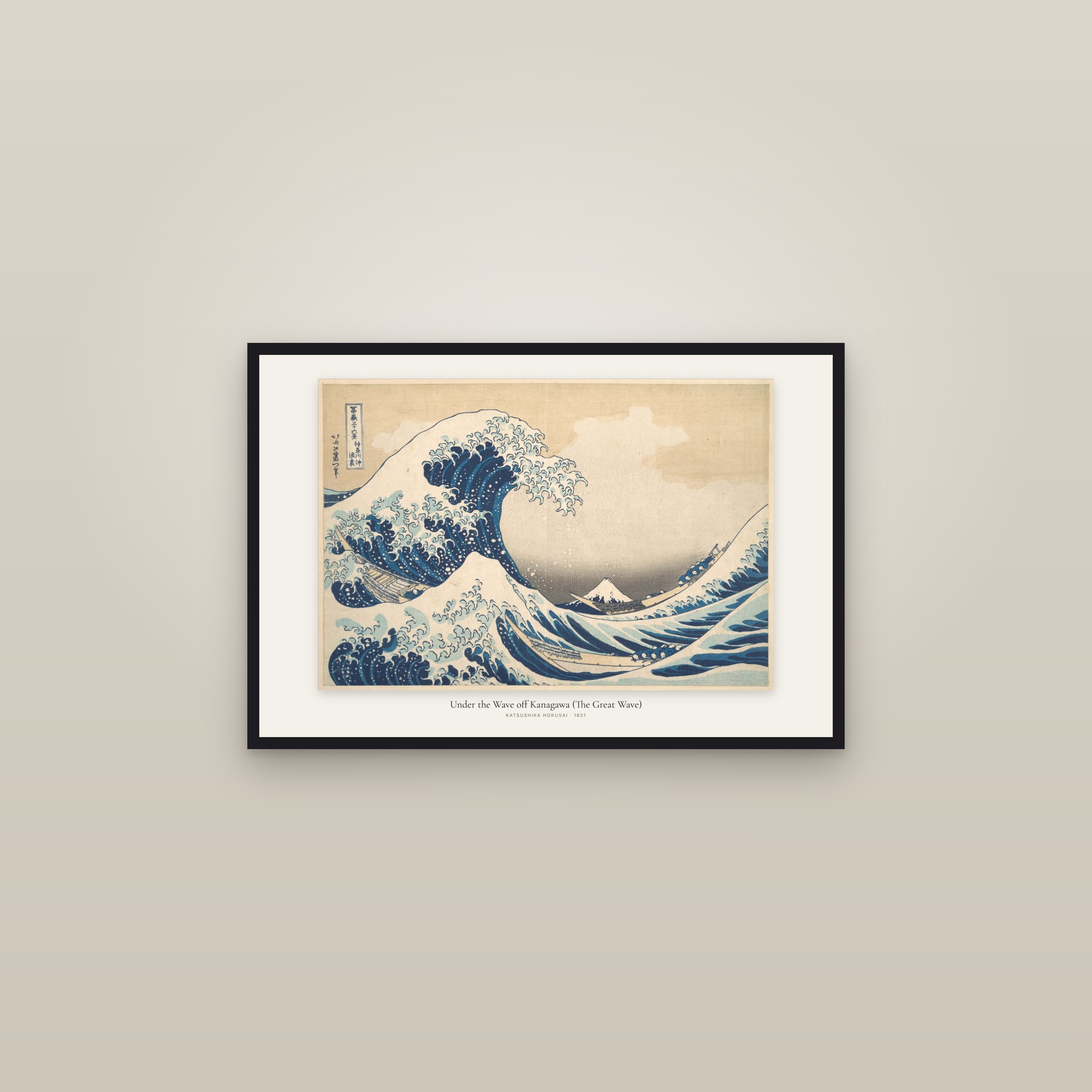
The word means "pictures of the floating world", the licensed theatre and brothel districts of Japan's big cities in the Edo period, which the V&A calls the playgrounds of a newly wealthy merchant class. Actors and courtesans sat low in the social order, yet they were style icons, and inexpensive prints carried their fashions to the general population. And as more people travelled for pleasure, prints of famous landscapes sold as cheap souvenirs. Hokusai's Great Wave, from a series of views of Mount Fuji, came out of that landscape trade.
Each print took four separate trades: a publisher planned and sold it, a designer drew it, a carver cut one block for the outlines and one for each colour, and a printer brushed pigment onto each block in turn and rubbed the paper down by hand, using cut marks called kento to keep every colour in place. No press was involved. The name on the sheet belongs to the designer, who did not touch the blocks. This is how each stage worked, and why two sheets of one design can look like different pictures.
Who actually made the print?
Four people, however famous the designer. The Metropolitan Museum of Art counts four experts behind every print, the Library of Congress lists the same four, and the Victoria and Albert Museum calls them a quartet. Japan House Los Angeles is blunter: the prints carry the signatures of Hokusai and Hiroshige and are attributed to them, but those men didn't make the final sheets. Writing about the Great Wave, the Met's scientist Marco Leona refers to Eijudō's "anonymous printing masters".
| Stage | Trade | The job | Where it shows on the sheet |
|---|---|---|---|
| 1 | Publisher | Plans the print, commissions it, clears the censor, sells it | Publisher's mark or seal |
| 2 | Designer | Draws the design in line, with notes on colour | Signature |
| 3 | Carver | Cuts the key block, then a block for each colour | Line quality, sometimes a name in the margin |
| 4 | Printer | Brushes on pigment, aligns the paper, rubs it down | Colour, gradation, relief in the paper |
Step 1: the publisher decides
A print began as a commercial decision. According to a 2020 study in Heritage Science, the publisher planned a new print as a product, commissioned the drawing and got the censor's approval before any wood was cut. The Met adds that he was often a bookseller as well, and that he chose the theme and set the quality of the work.
Hokusai's Thirty-six Views of Mount Fuji shows how much of a series was a publisher's idea. Nishimuraya Yohachi, the firm Eijudō, advertised it around the New Year of 1831 as blue-printed pictures, one view to a sheet, issued in sequence, at a time when Prussian blue was the new pigment. It sold well enough that ten more designs followed in the mid-1830s, this time with black outlines.
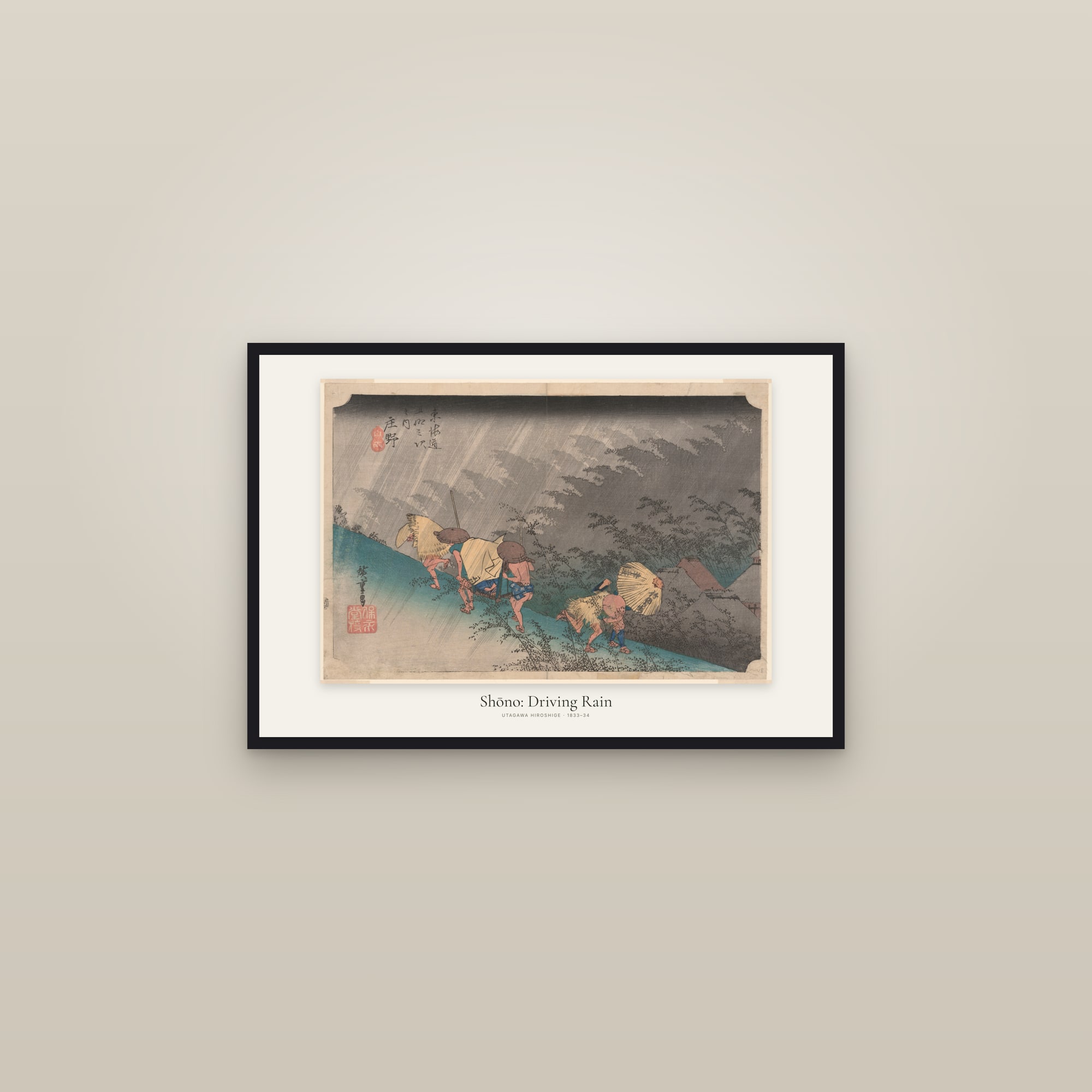
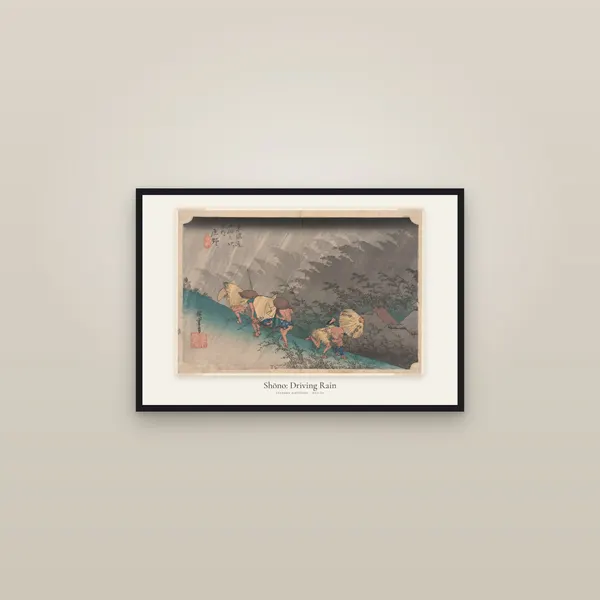
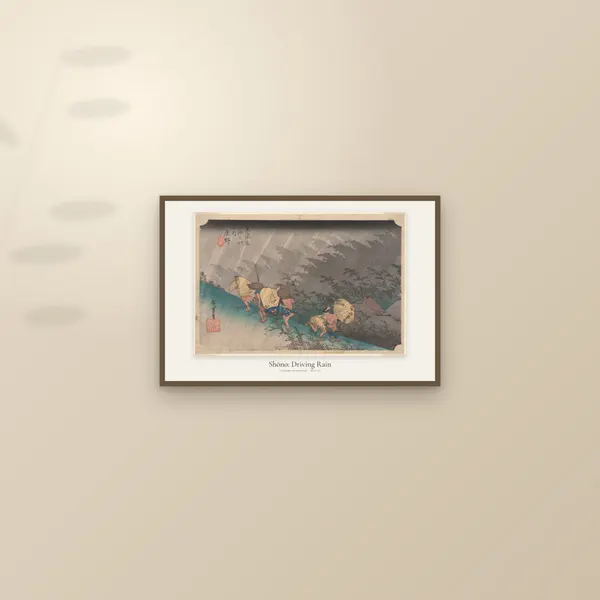
Publishers left their marks on the sheet. On Hiroshige's Shōno: Driving Rain, published by Hōeidō (Takenouchi Magohachi) about 1833–34, the red square seal under the signature is the firm's. As the Cleveland Museum of Art notes of its impression, one traveller's umbrella carries the publisher's name and part of the series title. It's a printed advertisement inside the picture.
Step 2: the design goes onto the wood
The designer made a line drawing with notes on the colours, not a finished picture. A copy on thin, partly transparent paper was then pasted face down on the block, so that the lines showed through in reverse. The V&A notes that this copy was normally destroyed in the cutting, which is why so few survive.
Step 3: the carver cuts the key block
The block was usually cherry, which the V&A says was favoured for its fine, even grain and consistent density. Following the lines through the paper, the carver cut away everything that was not to print, leaving the design standing in relief. This first block is the key block. It holds the outlines, and the Library of Congress notes that publisher and censor seals were often cut among its lines.
Censor seals matter to anyone dating a print, because they changed over time. They are also absent from all of the Thirty-six Views, according to the Heritage Science authors, which is one reason the order of those impressions is so hard to establish.
Step 4: the proofs become colour blocks
The printer pulled proofs, test sheets, from the key block in black. The designer marked the colour areas on them, the marked sheets went back to the carver, and a separate block was cut for each colour. The Met puts the upper limit at twenty blocks; the Library of Congress gives an average of ten to sixteen in the Edo period.
This system was young when Hokusai used it. The V&A traces the earliest prints to a single black block, sometimes coloured by hand, then to pink and green blocks added in the 1740s. Full colour arrived in 1765, as nishiki-e, or brocade pictures. The Met records that the first of them were calendars commissioned by a group of wealthy patrons in Edo.
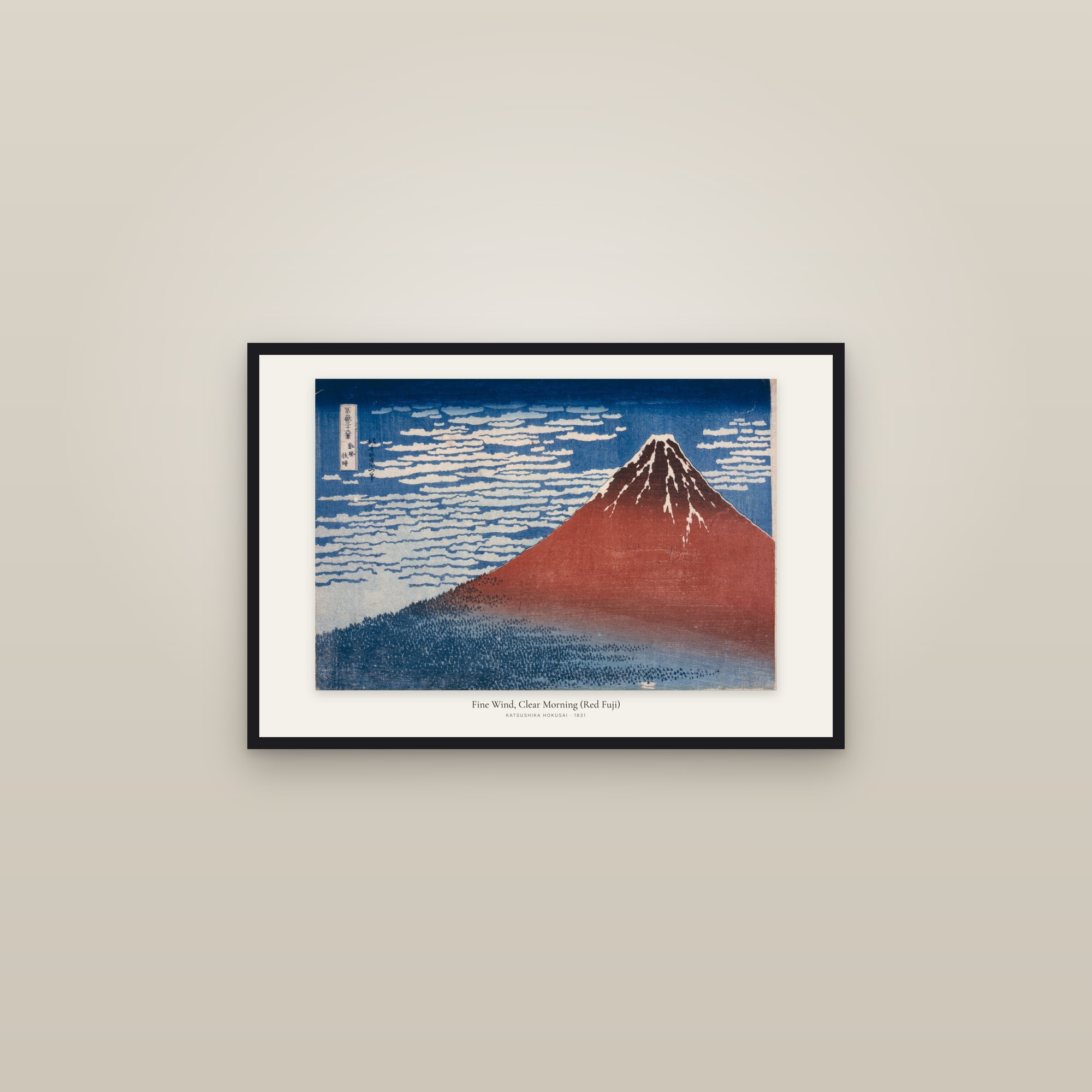
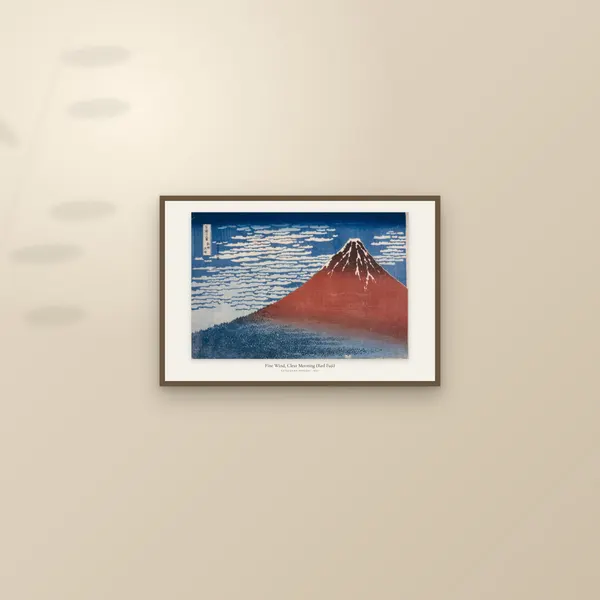
Not every design used the system at full stretch. Fine Wind, Clear Morning, the Red Fuji, is built from colour with almost no line.
Step 5: kento keep the colours in place
A sheet that meets up to twenty blocks has to land in the same place every time. The answer was cut into the wood. The Met describes two cuts on the edge of each block that served as alignment guides, and Japan House uses the Japanese word for them, kentō. The V&A explains how they travelled from block to block: the key-block proofs carried small rectangles outside the picture, and when the colour blocks were cut, those marks became stops for the printer to line the paper up against.
Because the marks repeat the key block's position on every other block, one small piece of carving controls the whole print. When a sheet slips, the colour sits slightly off its outline. On a good impression (a single sheet pulled from the blocks) you won't find the edge.
Step 6: the printer rubs the sheet by hand
The printer mixed pigment with a little water and rice starch paste, brushed it onto the raised surface of the block, and laid the paper on top. The paper was thin, handmade and damp, a kozo sheet from the inner bark of the mulberry, which the Met calls strong enough to withstand repeated rubbing and absorbent enough to take up the pigment. Then came the baren, a round pad covered with bamboo fibre, rubbed over the back of the sheet. Colour by colour, the print built up. The Heritage Science authors estimate about two hundred prints in a day.
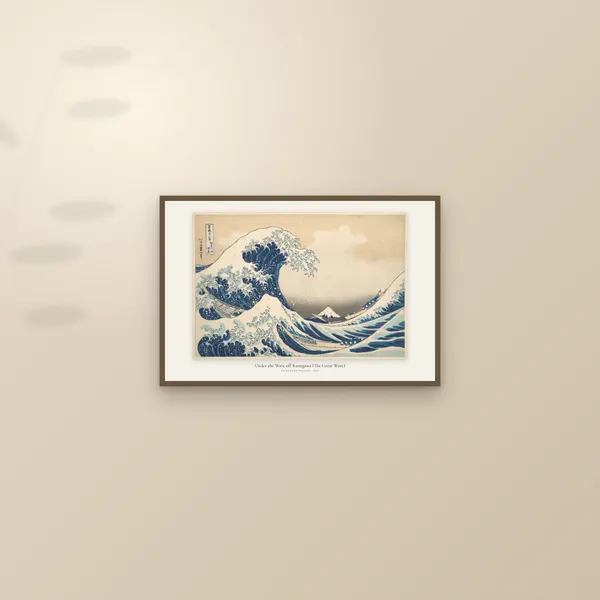
Hand pressure leaves a physical trace. The Met scanned the Great Wave with a 3-D microscope and found the paper stepped: white foam, bright blue and the double-printed deep blue all sit at different heights. That second printing is the printers' contribution. They laid dark stripes of mixed Prussian blue and indigo first, then ran pure Prussian blue across them, which is what gives the hollow of the wave its depth. Even the outlines of the original thirty-six designs are blue rather than the customary black, printed in a mix of the same two pigments.
Gradation: the printer's own effect
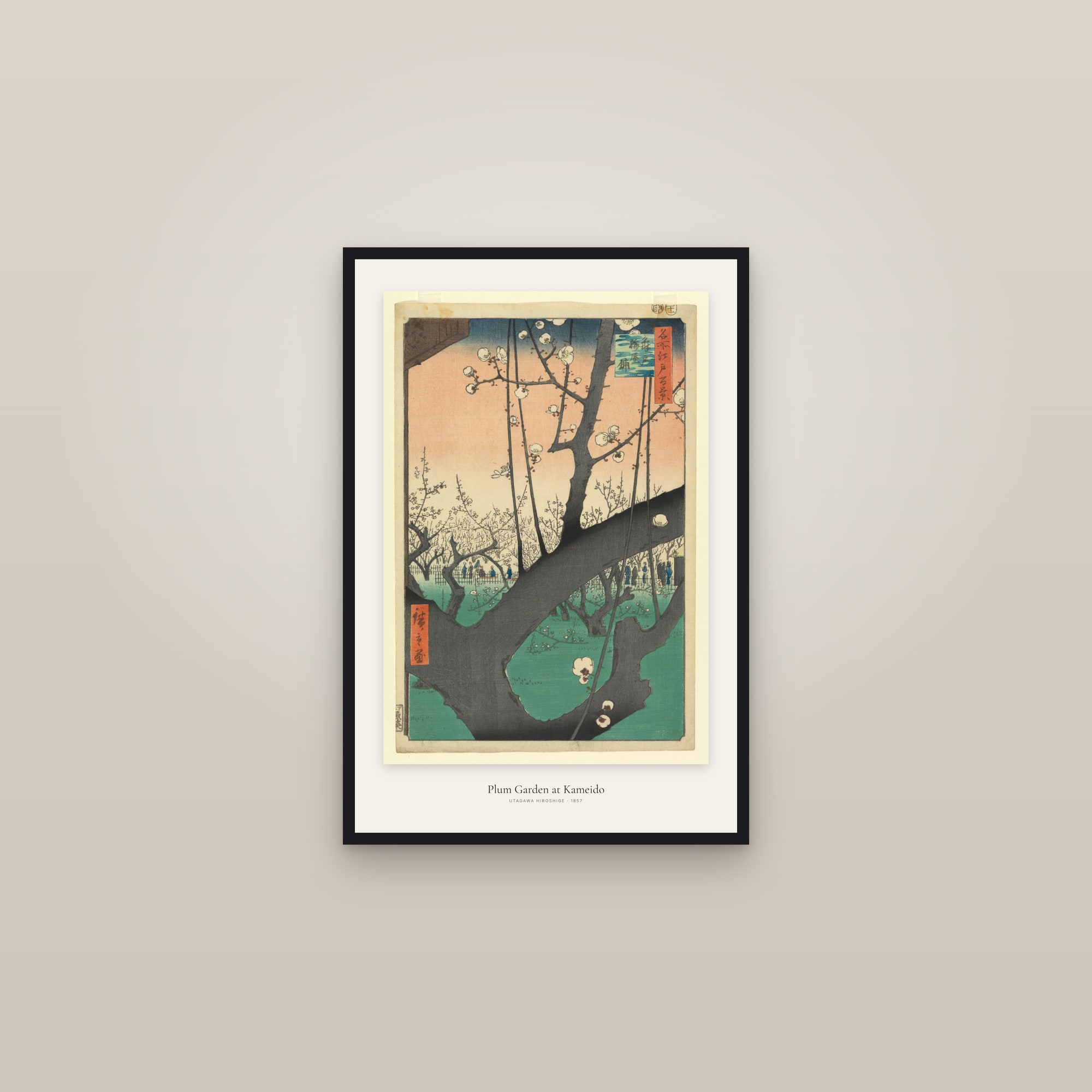
A block prints flat unless the printer intervenes. In the technique called bokashi, the Ashmolean Museum explains, printers wiped and diluted the pigment on the block to get a gradation of colour, which suited the new Prussian blue especially well. Nothing in the wood fixes the result. It's done again for each sheet.
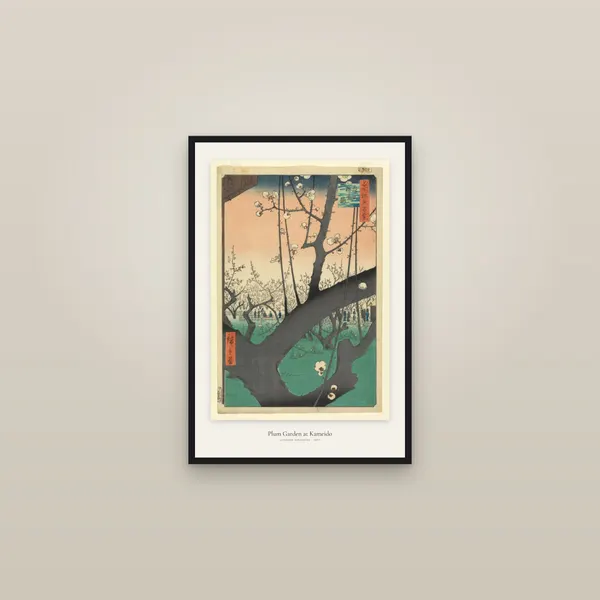
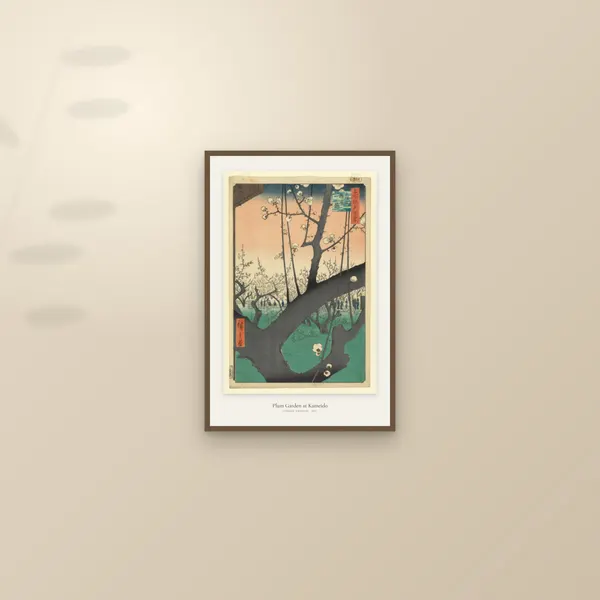
The Plum Garden at Kameido from Hiroshige's One Hundred Famous Views of Edo depends on it: a blue band at the top of the sheet gives way to a red sky that pales toward the horizon.
Rain: the carver's hardest job
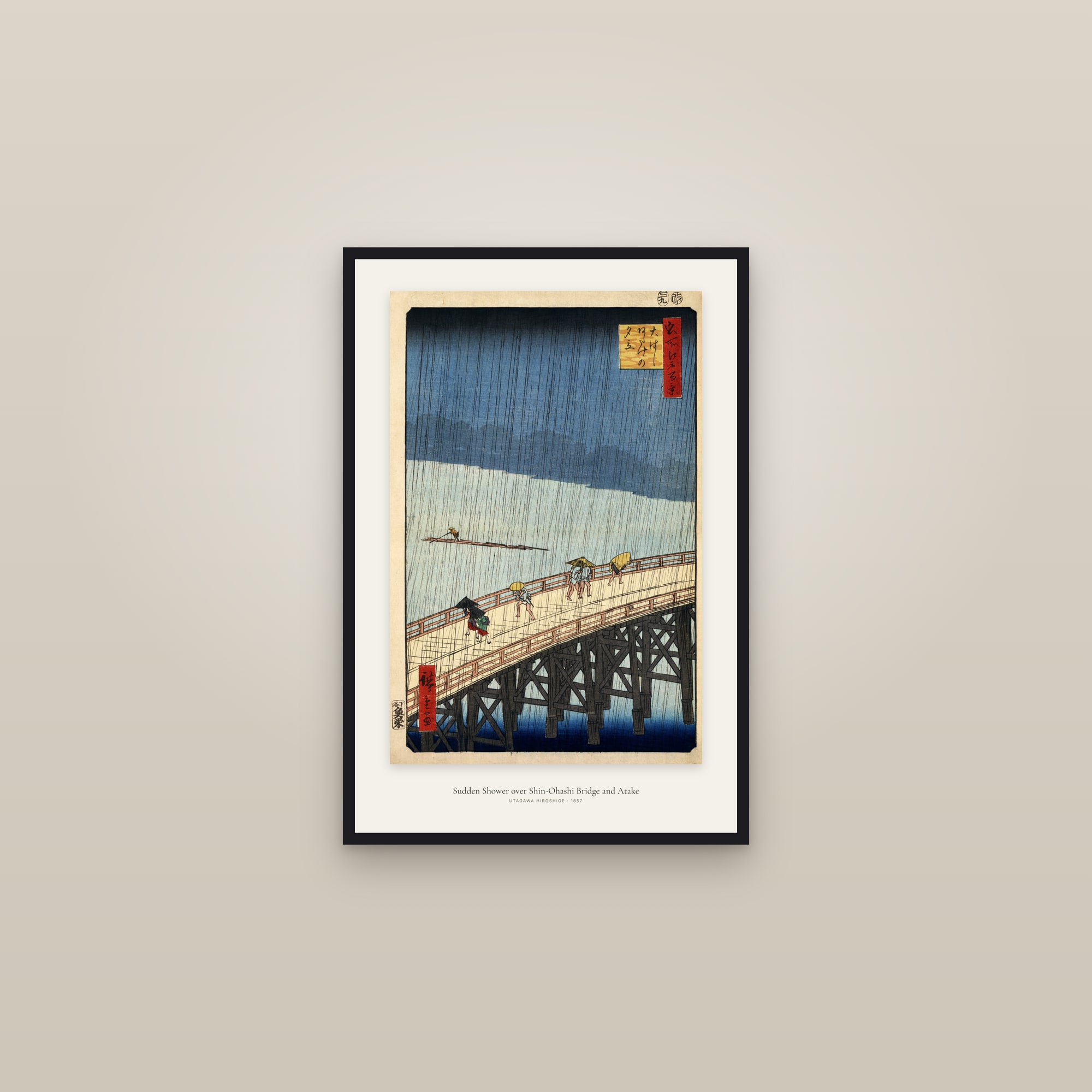
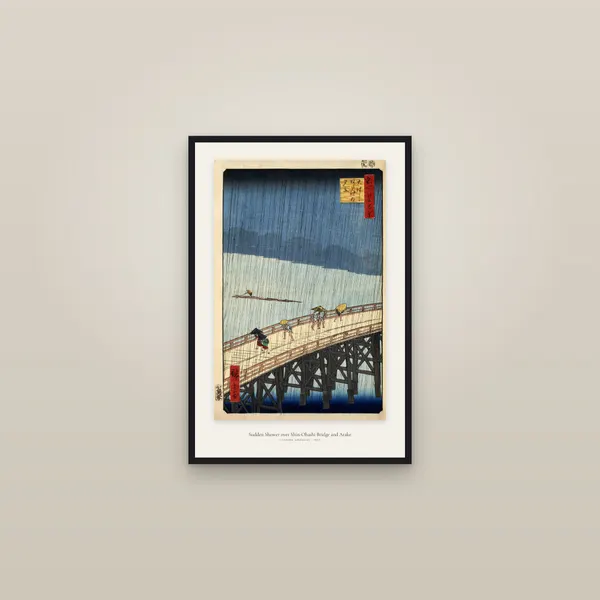
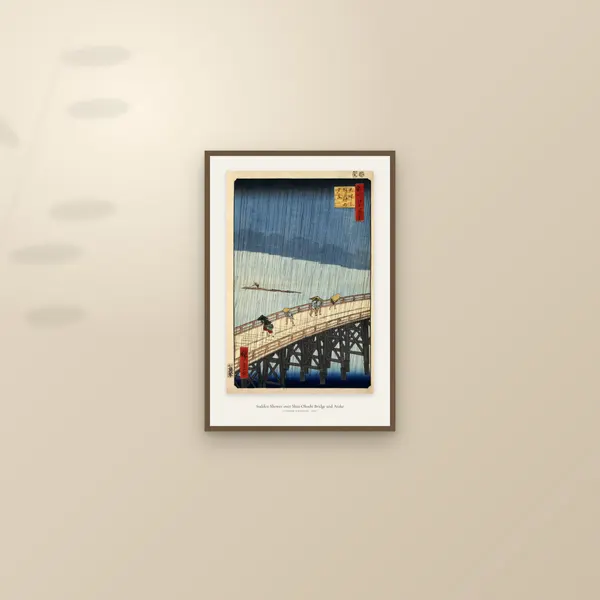
Line can be as demanding as colour. The Brooklyn Museum describes the rain in Hiroshige's Sudden Shower over Shin-Ōhashi Bridge and Atake as an overlay of black and grey lines at different angles. Every one of those lines is a ridge of cherry left standing while the wood on either side was cut away.
How big was an edition?
Nothing limited it except the blocks and the market. The Met says reproductions, sometimes numbering in the thousands, could be made until the carving became worn. The Heritage Science authors say a popular print could be reissued in as many as several thousand impressions, and that the Thirty-six Views was probably reprinted well beyond its original production. Their sample also includes reprints of the late nineteenth or early twentieth century, decades after Hokusai's death in 1849, which they identify as cut from new blocks. A sheet of the series can be from the first months, a much later run of the old blocks, or a reprint.
Why do two impressions differ?
Five reasons, and most sheets show several of them.
The blocks wore down. Repeated passes of the baren widen the printed lines and break small pieces out of the thin ridges. Capucine Korenberg of the British Museum compared 111 photographs of the Great Wave and found damage in eight places on the original key block.
The colour blocks changed. The same study found that the Great Wave's colour blocks were changed three times as the design went on being printed.
The publisher cut costs. A first printing may be careful. Later ones, according to the Heritage Science study, could use less skilled labour, drop some colour blocks altogether and recut worn ones.
The pigment batch moved. That study measured the blue outlines on 141 prints from five museums and libraries and sorted them into nine clusters by the mix of Prussian blue and indigo, treating each cluster as a production batch.
The design itself was altered. Brooklyn's catalogue notes that an earlier version of the Sudden Shower shows an extra two-log raft along the far shore. The impression we restore shows only the boatman's raft on the river.
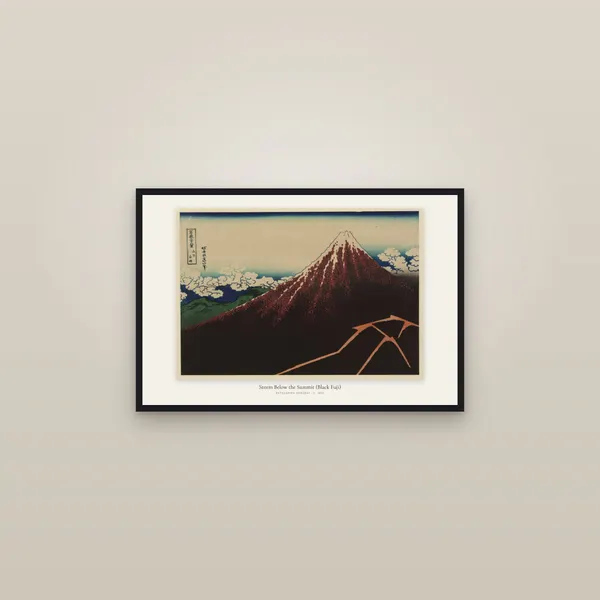
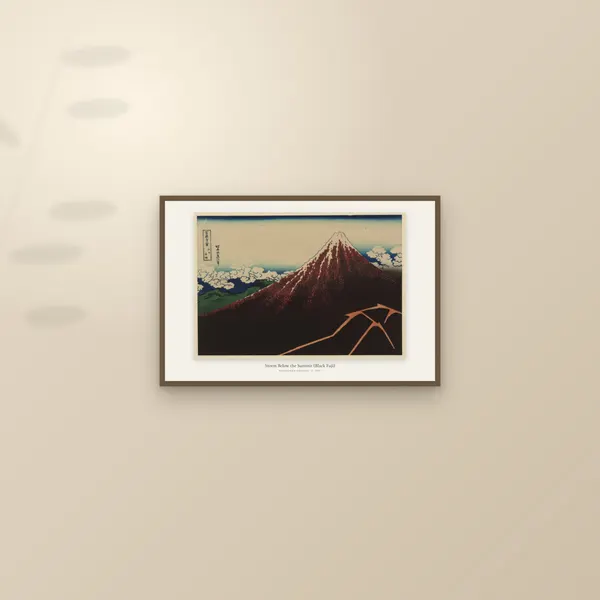
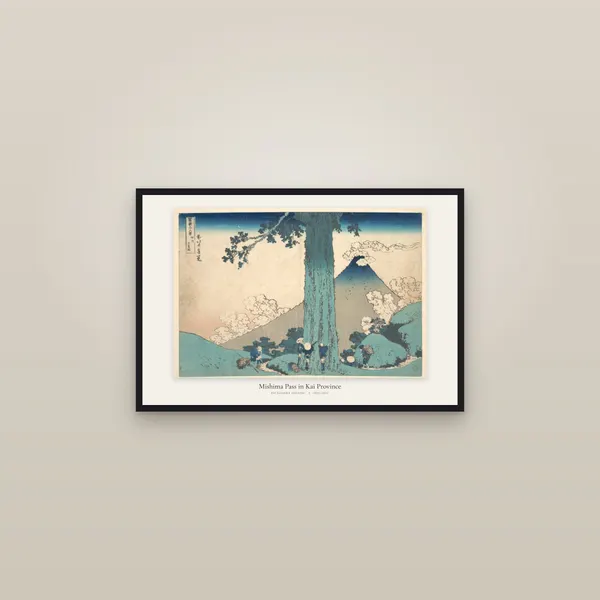
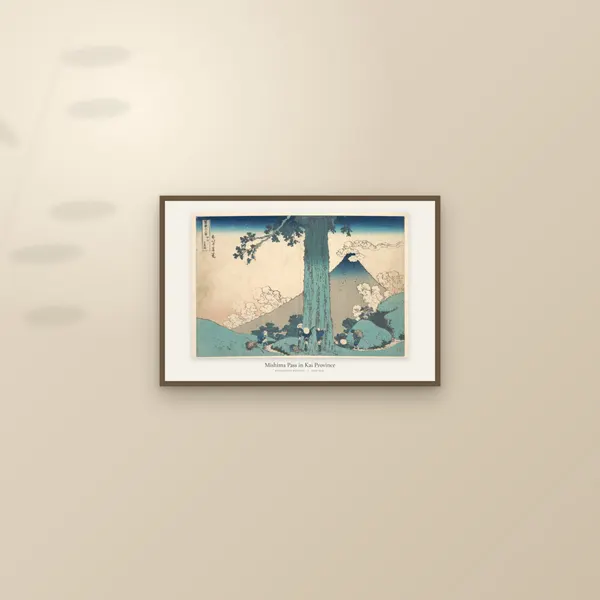
This is why it makes sense to ask which impression you're looking at. The Heritage Science authors say the two best Great Waves at the Met, with impeccable line and little or no wear on the key block, are widely considered among the earliest. A later sheet of the same design can be flatter in colour and broken in line, and still be genuine. The scientists' comparison also covers Rainstorm Beneath the Summit and Mishima Pass in Kai Province, whose several impressions at the Met were studied the same way.
What a reproduction keeps and what it loses
The prints on this site are reproductions, printed to order from restored scans of particular impressions. A scan records the line, colour and wear of one sheet. It does not carry the relief of the block, because nothing has pressed into the paper. You can read more about how we restore a plate, and the wider story, from the first European woodcuts to the inkjet, is in a short history of the print.
The woodblock was one of three great answers to the problem of multiplying a picture. The other two worked in opposite ways: copper engraving prints from lines cut down into metal, and chromolithography prints from a flat stone with no cutting at all.


Questions people ask
Who made a Japanese woodblock print?
Four trades working in sequence. A publisher planned and financed the print and sold it, an artist drew the design, a carver cut the blocks and a printer pulled the sheets. Hokusai and Hiroshige signed the designs, but they did not cut the blocks or print the sheets.
What is a key block?
The first block cut, which carries the outlines of the design. Proofs from it were marked up with the colour areas, and those proofs guided the cutting of a separate block for each colour. On the original thirty-six designs of Hokusai's Thirty-six Views of Mount Fuji, the key block was printed in blue rather than the customary black.
What are kento on a Japanese woodblock?
Registration marks cut into each block, described by the Metropolitan Museum of Art as two cuts on the edge of the block. They act as stops. The printer sets the paper against them on every block, so each colour lands in the right place on the sheet.
What is a baren?
A round pad covered with bamboo fibre that the printer rubs over the back of the paper to transfer pigment from the block. It replaces a press: the pressure comes from the printer's hand.
How many impressions were made of a Japanese print?
There was no fixed edition. According to a 2020 study in Heritage Science, about two hundred prints could be pulled in a day and a popular design could reach several thousand impressions. According to the Metropolitan Museum of Art, printing could go on until the carving wore out.
Why do two copies of the Great Wave look different?
Because they are different impressions, often from different years. The key block picked up damage in eight places, the colour blocks were changed three times, the pigment mix varied from batch to batch, and later printings could be done with less care and fewer blocks.
Sources
- The Metropolitan Museum of Art, Heilbrunn Timeline: Woodblock Prints in the Ukiyo-e Style (four experts, cherry block, up to twenty blocks, two cuts for alignment, mulberry paper, thousands of impressions)
- Marco Leona, The Metropolitan Museum of Art: The Great Wave, anatomy of an icon (double printing, Prussian blue, relief in the paper)
- Vermeulen, Burgio, Leona et al., Heritage Science 8:62 (2020): creating a chronology in Hokusai prints (the production sequence, the blue key block, 141 prints in 9 clusters, wear, run sizes)
- Sainsbury Institute e-Bulletin, November 2020: Capucine Korenberg, The making and evolution of Hokusai's Great Wave (111 photographs, key-block damage in eight places, colour blocks changed three times)
- Victoria and Albert Museum: Japanese woodblock prints, ukiyo-e (the floating world, who enjoyed the prints and why, the production process, key-block proofs, registration marks, 1765)
- Library of Congress: The Floating World of Ukiyo-e, overview (art by and for the non-elite classes, four skilled individuals, ten to sixteen blocks)
- Library of Congress, Conservation Highlights: treatment of a Japanese pillar print (key block, seals, kozo paper, baren)
- Japan House Los Angeles: The Process of Woodblock Printing (roles, kentō, baren, names in the margins)
- Ashmolean Museum, Eastern Art blog, 10 February 2017: Hiroshige's Japan, Views of Mount Fuji (Prussian blue and bokashi)
- Cleveland Museum of Art: Driving Rain at Shōno, 1948.306 (the publisher's seal, the umbrella inscriptions)
- Brooklyn Museum: Sudden Shower over Shin-Ōhashi Bridge and Atake, 30.1478.58 (overlaid rain lines, the earlier version with a second raft)
Start hereA short history of the print, from woodblock to giclée