
What are the USDA Pomological Watercolors?
From 1887 the USDA paid artists to paint fruit, one variety at a time. What the paintings are, why they were made, who painted them and why they are free.
Contents6 sections
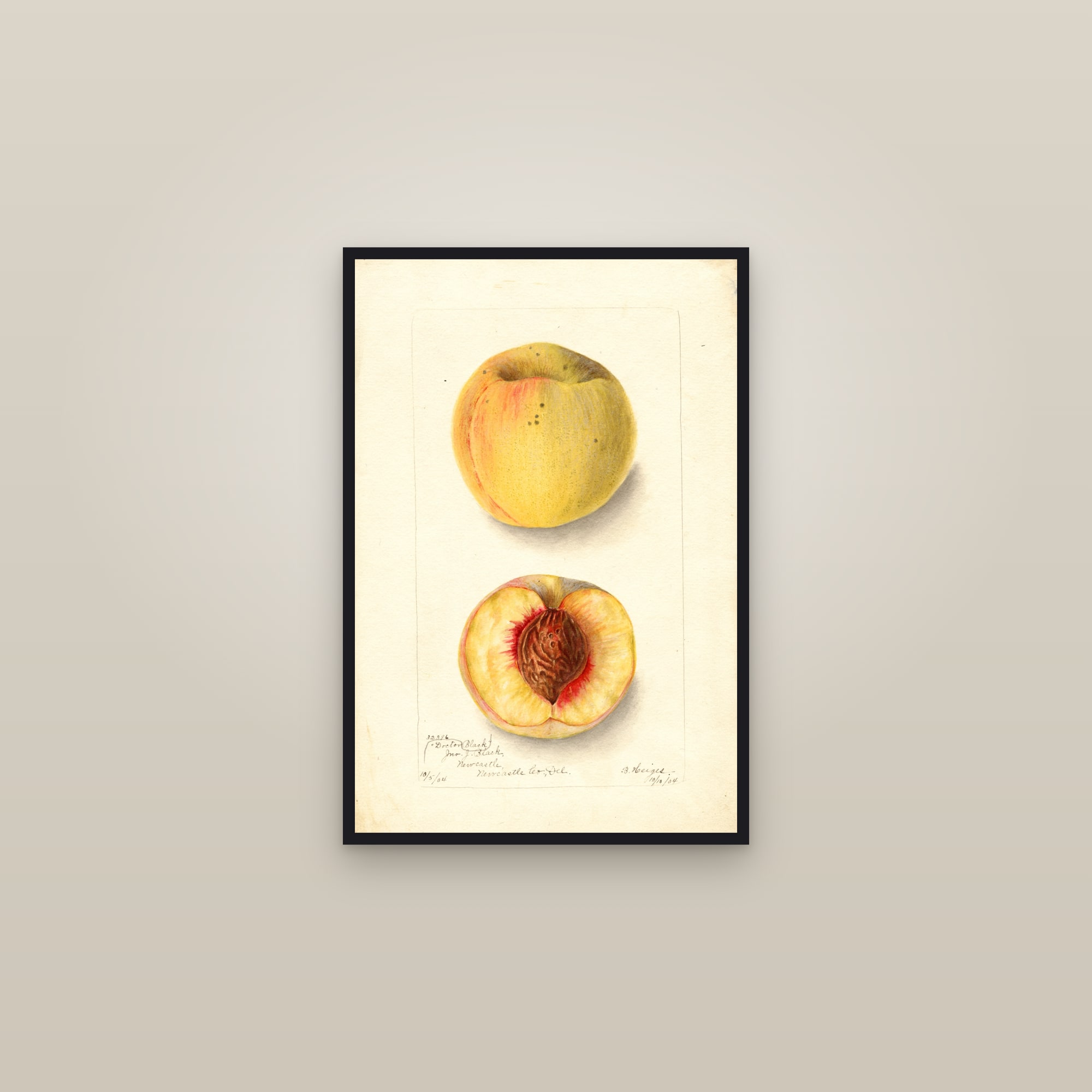
The USDA Pomological Watercolors are about 7,000 paintings of fruit, made by artists on the payroll of the US Department of Agriculture. From 1887 the department's Division of Pomology, the office that studied fruit growing, hired painters to record each new variety of apple, pear, plum, peach, grape, citrus and nut as it reached Washington. The paintings were working documents: a picture of what a Doctor Black peach or an Ayer pear actually looked like, inside and out, so growers across the country could know it. Today they sit in the National Agricultural Library in Beltsville, Maryland, and because the government made them, anyone may use them.
What exactly is in the collection?
The library's finding aid for collection MS0184 describes "approximately 7,000 watercolor paintings of fruit and nut specimens", plus 85 wax models of fruit. The dated sheets run from 1888 to 1939.
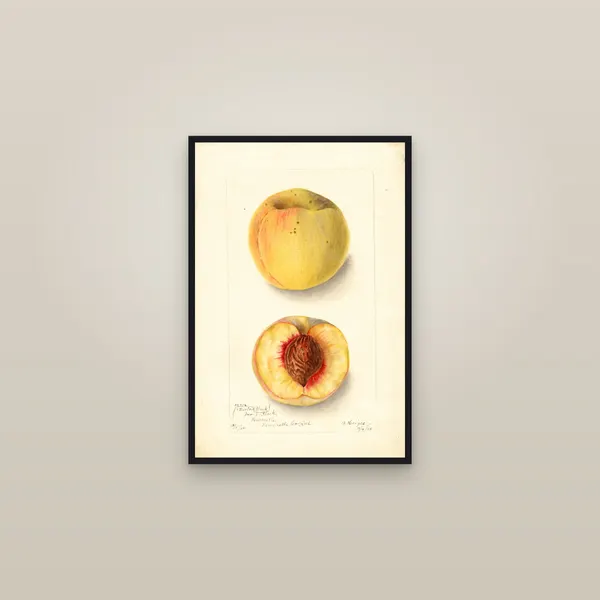
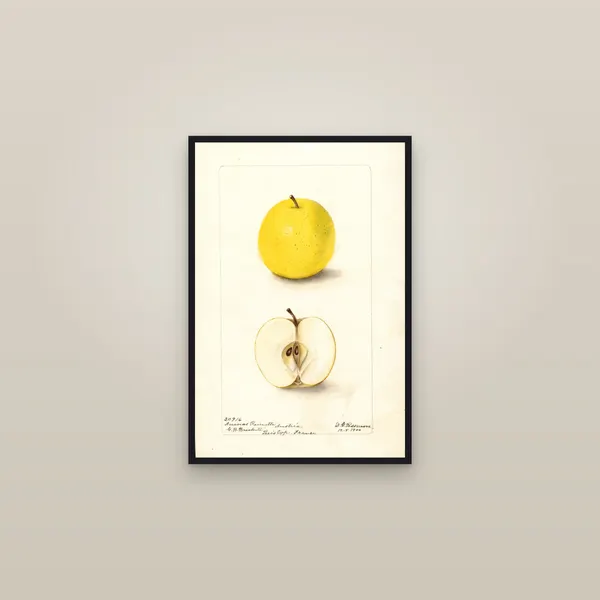
Most sheets follow one pattern. The fruit is painted life-size, usually twice: once whole, once cut open to show the flesh, the core or the stone. A pencilled box frames it. In the bottom corners the artist wrote a reference number, the name of the variety, who sent the specimen and from where, then signed and often dated the sheet. The finding aid notes that this credit information is "written by the artist on each watercolor".
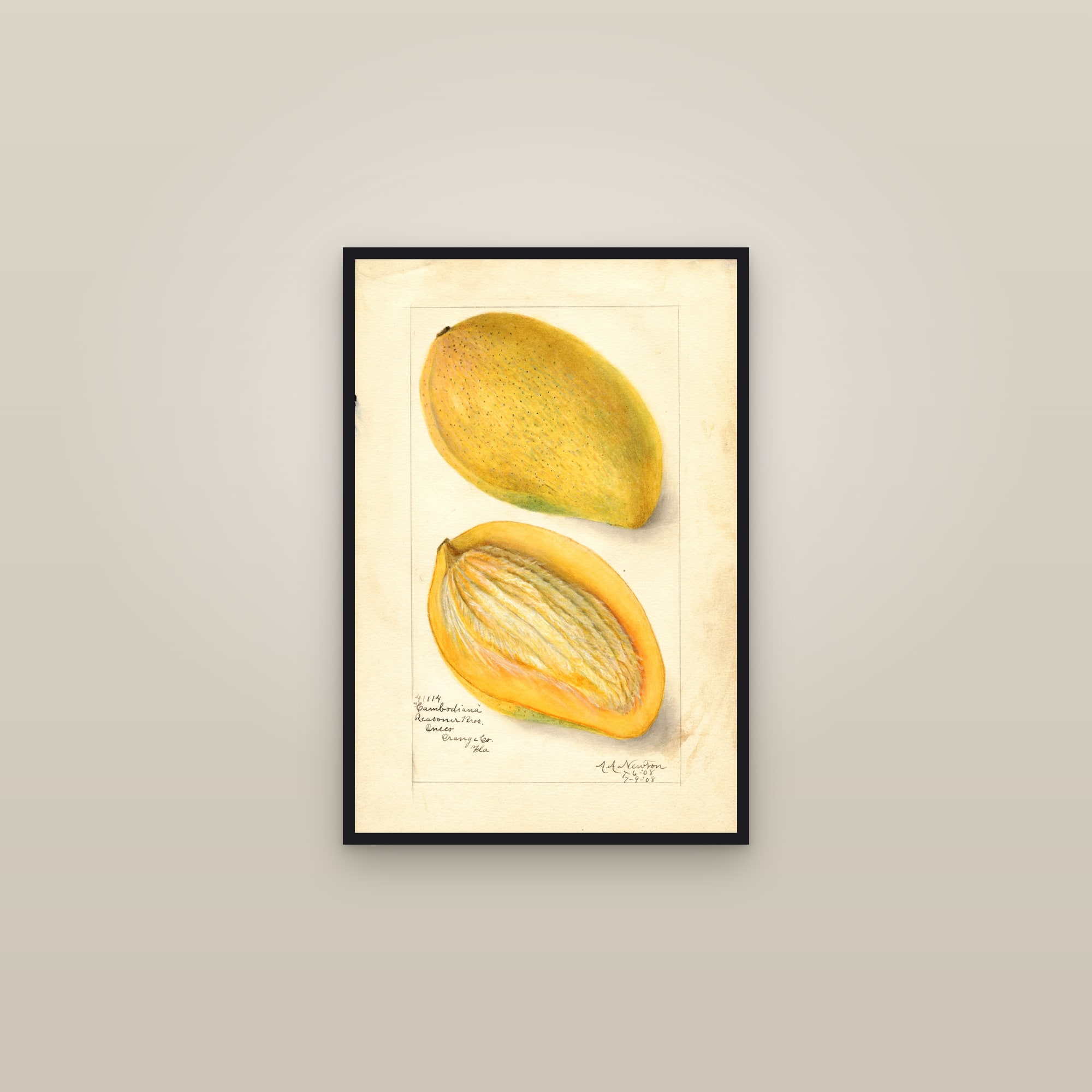
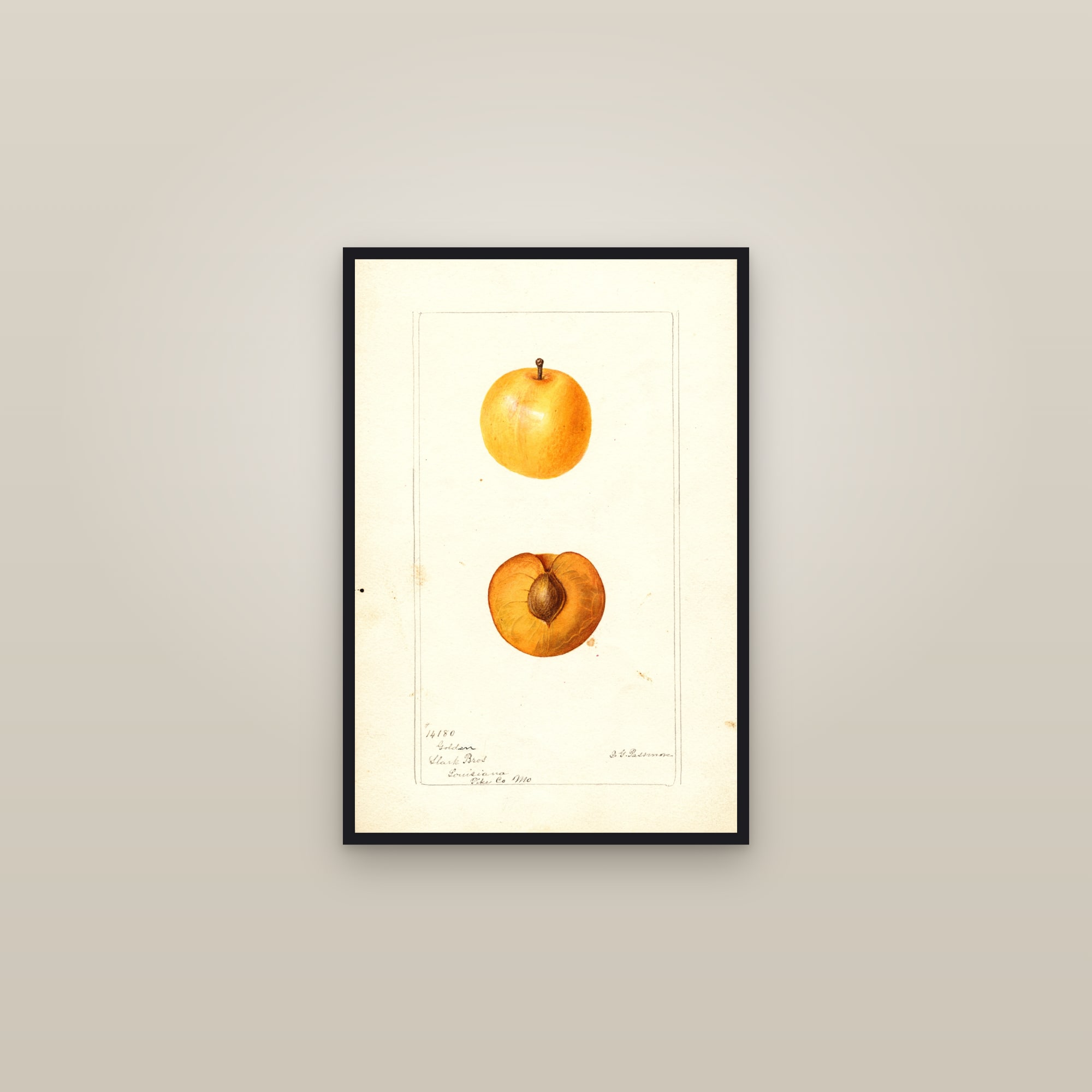
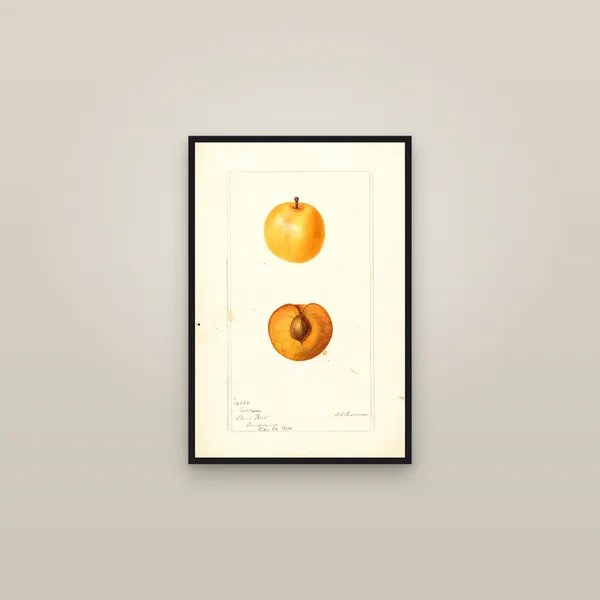
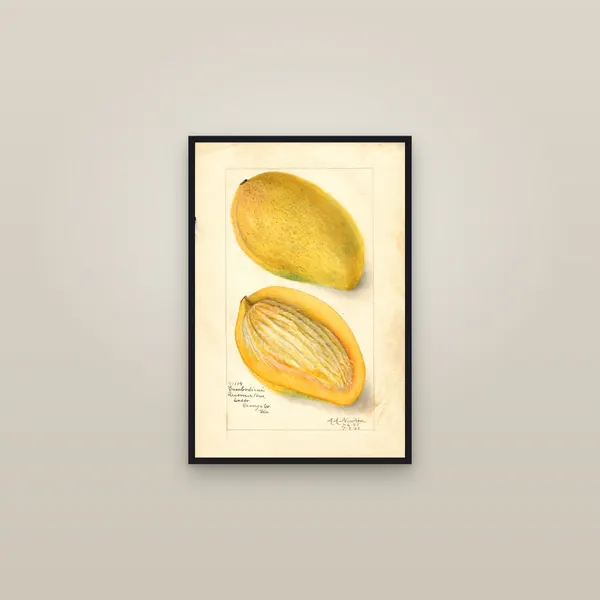
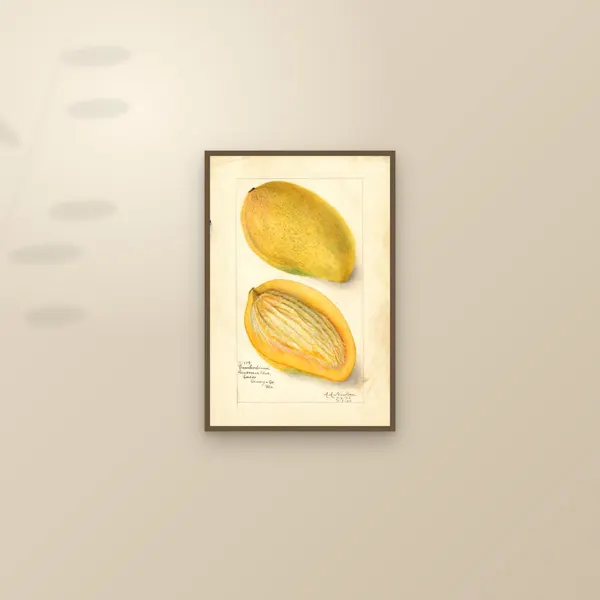
That handwriting is half the charm. The Golden plum in our catalogue came from Stark Bros of Louisiana, Pike County, Missouri. The Cambodiana mango came from Reasoner Bros of Oneco, Florida, and Amanda Newton dated it July 1908.
Why did the government pay for paintings of fruit?
Because it needed accurate pictures and had no better way to get them. American fruit growing was expanding fast in the late nineteenth century. New varieties arrived from private breeders and from the department's own plant-collecting trips abroad. A grower deciding what to plant needed to know what a variety looked like, how big it grew, what colour it ripened to, and how to tell it from its look-alikes.
The paintings did that job. The finding aid says the artists illustrated "fruit varieties for lithographic reproduction in USDA articles, reports, and bulletins", and that the colour plates helped farmers "visualize crop characteristics, as well as the effects of diseases, pests, and storage methods." Some sheets show rot, scab or bruising on purpose.
Why not photograph the fruit? In a 2000 article in the USDA's Agricultural Research magazine, Susan Fugate, then head of the library's special collections, put it plainly: the department "couldn't just pick up a handy camera and pop in a roll of color film." A skilled painter was the most reliable colour record available.
Who painted them?
Over the years the department hired about fifty illustrators, according to its own 2000 article. But a handful of them painted most of the sheets, and most of that handful were women. The finding aid names the first staff artist: William Henry Prestele, who joined the new Division of Pomology in 1887. He was a German-born lithographer who had run his own print business in Iowa.
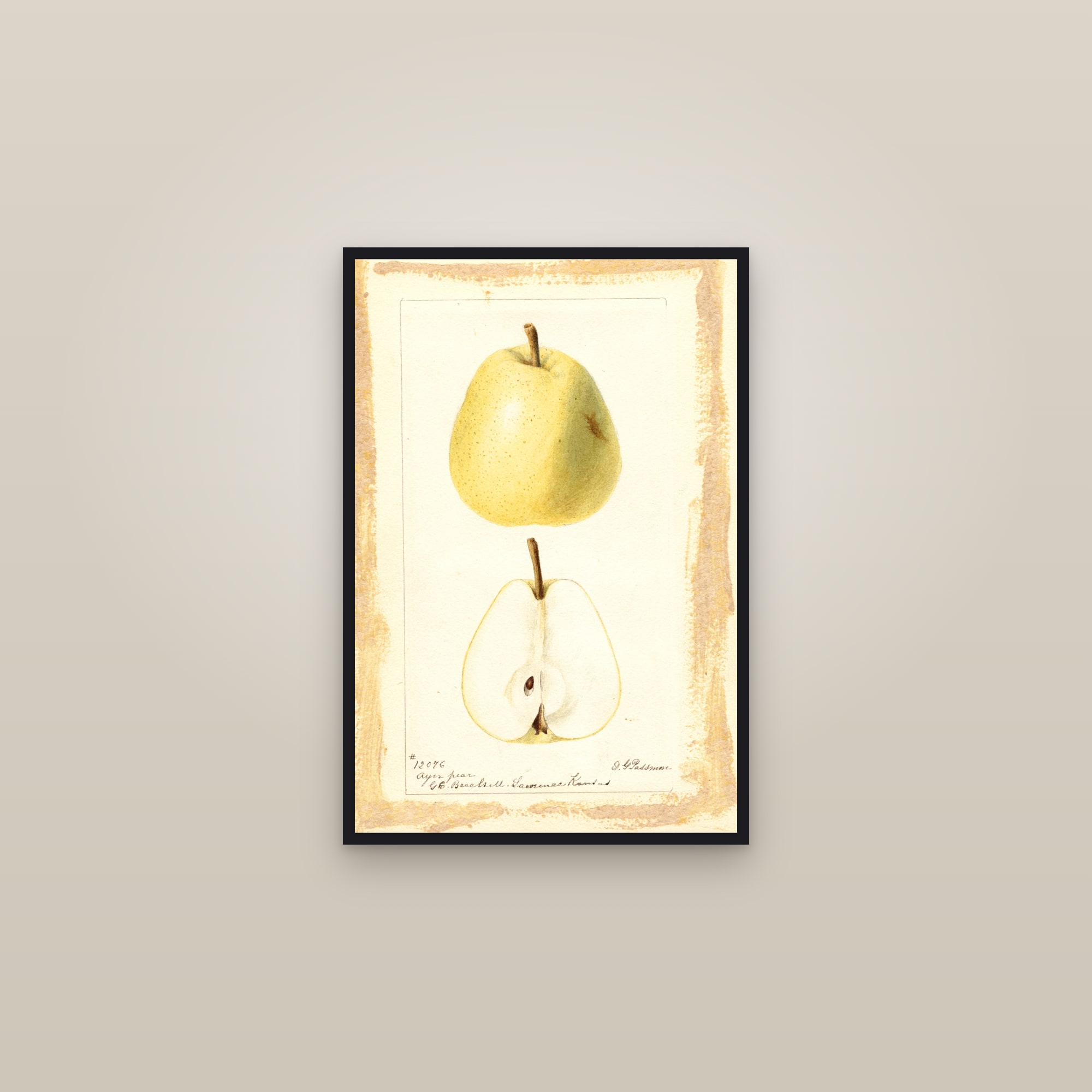
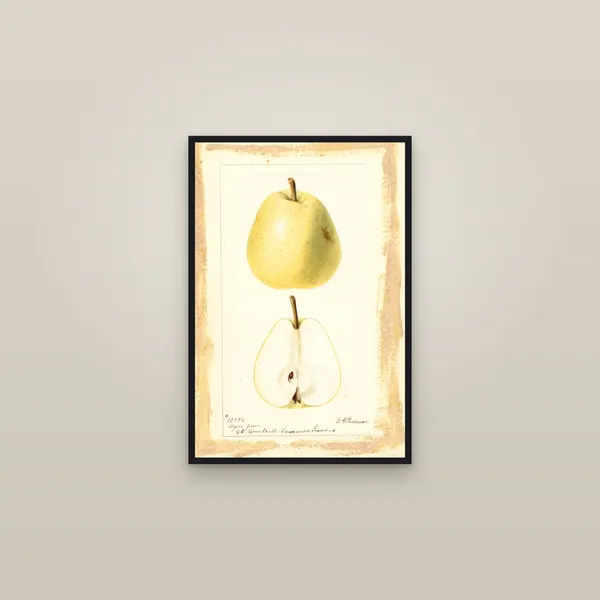
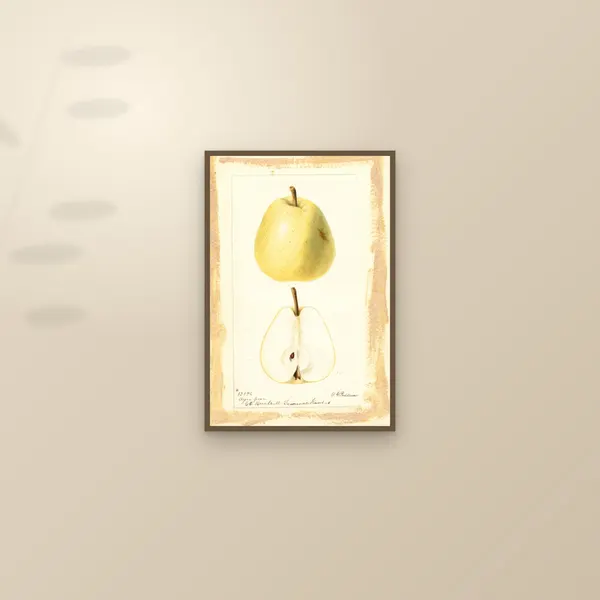
The most prolific was Deborah Griscom Passmore. She joined the division in 1892 and painted for it until her death in 1911. She made over a thousand sheets, more than any other artist. Our Ayer pear, Golden plum, Beurre Baltet pear, Figue d'Alençon pear and Ananas Reinette apple are all hers.
Others include Amanda Newton, who also modelled fruit in wax for the department's exhibits; Mary Daisy Arnold, who joined in 1904 and stayed more than thirty-five years; Ellen Isham Schutt, who painted for the department from 1904 to 1914; Bertha Heiges; and Royal Charles Steadman, who joined in 1915. Our reference page on the USDA watercolour painters has a short biography of each, with their plates.
| Painter | A sheet in our catalogue | Year painted |
|---|---|---|
| Deborah Griscom Passmore | Ayer Pear | 1896 |
| Bertha Heiges | Doctor Black Peach | 1904 |
| Amanda Newton | Cambodiana Mango | 1908 |
How did they become free for everyone?
For most of the twentieth century the paintings sat in boxes, seen by researchers and by readers of old USDA yearbooks. The library digitised them and put low-resolution copies online in 2011, but charged for full-size files beyond a few free requests.
In 2015 Parker Higgins, a writer and campaigner for the public domain, asked the department under the Freedom of Information Act what that had earned. The request and its answer are public. By his account, the scanning had cost $288,442, and since 2011 the public had ordered 81 images for a total of $565. The library now offers the high-resolution scans free in its digital collection.
The legal position was never in doubt. Work made by US government employees as part of their jobs is not protected by copyright in the United States. The paintings belong to everyone. What changed was that everyone could finally download them.
Why do they look so good on a wall?
They were never meant for one, which is partly why they work. The fruit is painted at life size on a plain sheet, with no background to compete with a room. The colours are true to the specimen, not to a fashion. And the pencil notes give each sheet a reason to be read up close.
Three practical notes. A single sheet is small and quiet, so it suits a kitchen, a pantry door or a narrow wall by a dining table; our kitchen wall art guide covers placement near heat and steam. Three sheets of one fruit, three pears or three plums, make an easy row. And the white-paper look changes completely on a dark ground, which is why each of ours also comes as a specimen print on deep forest green.
Which USDA fruit prints do we sell?
Hundreds, across apples, pears, plums, peaches, berries, citrus, grapes and tropical fruit, all in our vintage fruit prints collection. Each is restored from the library's scan and printed on museum-quality archival paper, heavyweight and acid-free.
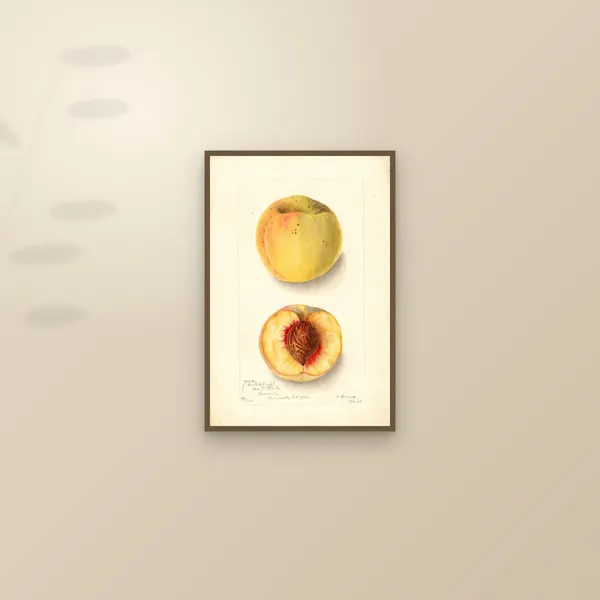
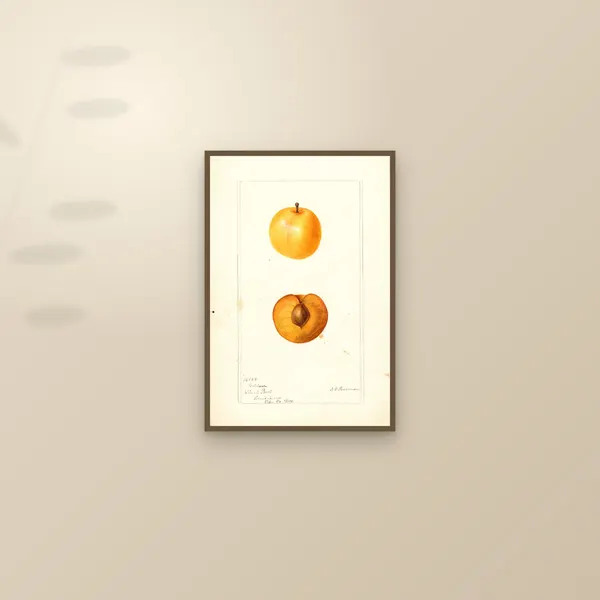
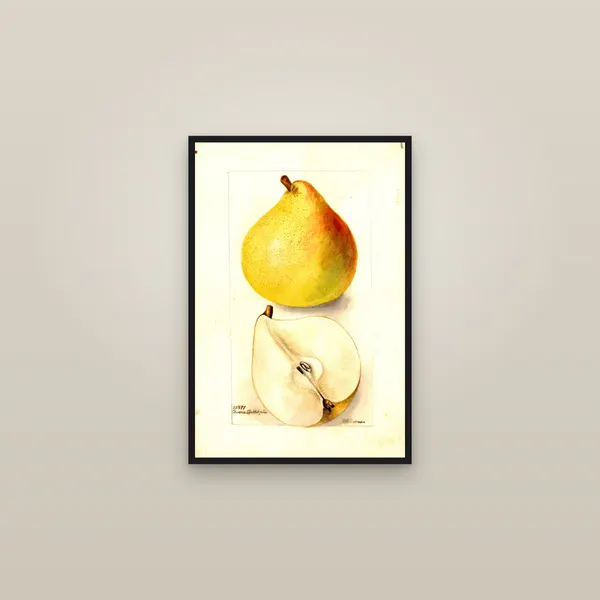
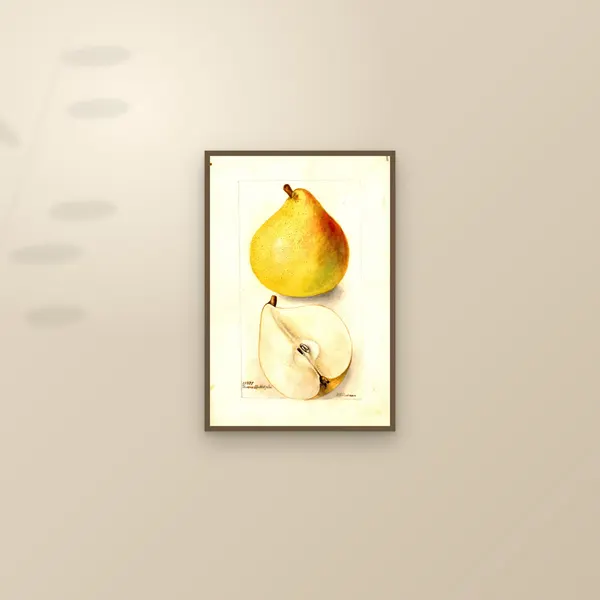
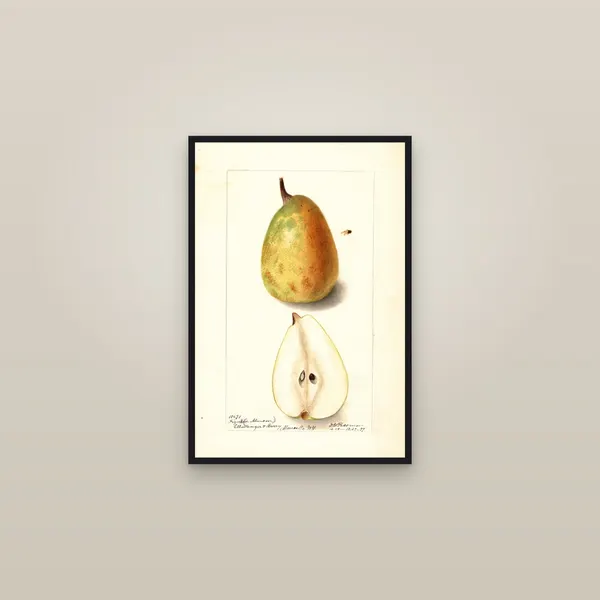
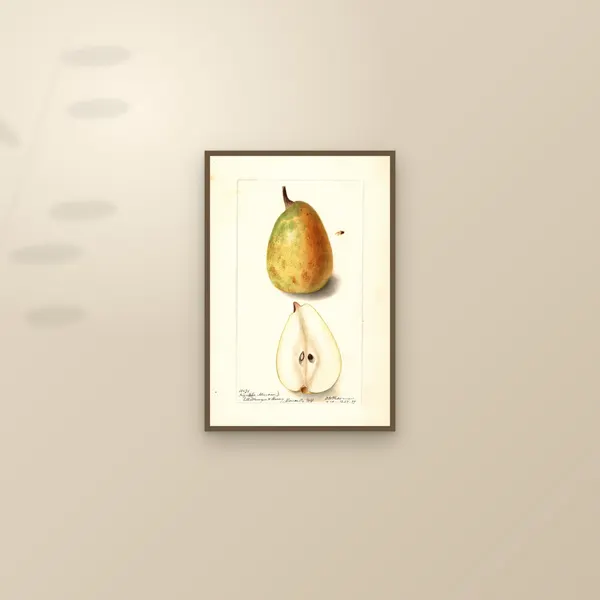
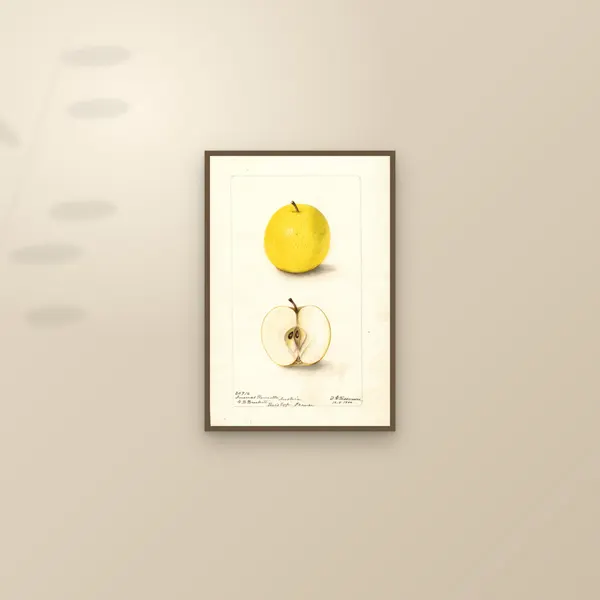
A few to start with. The Doctor Black Peach is Bertha Heiges's 1904 study of a pale yellow peach with a red-stained stone. The Cambodiana Mango is Amanda Newton's 1908 mango, cut to show its fibrous stone. Passmore's Golden Plum of 1897 is the warmest yellow in the set. Her Ayer Pear of 1896 keeps its painted wash border. Her Beurre Baltet Pear of 1901 and Figue d'Alençon Pear of 1899 make a pair with it. For an apple, her Ananas Reinette Apple of 1900 is a small yellow russet.
Every one comes two ways: the whole watercolour edge to edge, or the trimmed sheet on a forest-green ground with its variety name, botanical name and painter. Sizes start at 12 × 18 in unframed for $39, and frames are black or dark wood. For apples and strawberries, our reference pages list every apple and every strawberry in the catalogue with its year and painter.
Questions people ask
What are the USDA Pomological Watercolors?
They are about 7,000 watercolour paintings of fruit and nut varieties, painted from real specimens by artists working for the US Department of Agriculture, from 1887 until the late 1930s. The National Agricultural Library holds them as collection MS0184.
Why did the USDA paint fruit?
To record what each variety looked like. New apples, pears, plums, peaches and tropical fruit were arriving from breeders and from plant-collecting trips abroad, and the department needed accurate pictures for its reports and bulletins at a time when colour photography was not practical.
Who painted the USDA fruit watercolours?
A staff of USDA artists. William Henry Prestele was the first, in 1887. Deborah Griscom Passmore painted the most, over a thousand sheets. Amanda Newton, Mary Daisy Arnold, Ellen Isham Schutt, Bertha Heiges and Royal Charles Steadman are among the others.
Are the USDA Pomological Watercolors public domain?
Yes. They were made by employees of the US government as part of their work, which places them in the public domain in the United States. The National Agricultural Library publishes the scans online free of charge.
Where can I see the original paintings?
The originals are kept by the National Agricultural Library's Special Collections in Beltsville, Maryland, and researchers can ask to see them. The library's digital collection shows the scans online.
What sizes are USDA fruit prints?
Ours start at 12 by 18 inches unframed for $39. The four watercolours pictured in this article go up to 16 by 24 inches, the largest size their scans support, unframed or in a black or dark wood frame.
Sources
- USDA Pomological Watercolor Collection, finding aid MS0184, National Agricultural Library ArchivesSpace (about 7,000 watercolours, 85 wax models, hiring from 1887, dates 1888–1939, William Prestele the first staff artist, purpose and lithographic reproduction)
- USDA Pomological Watercolor Collection, National Agricultural Library Digital Collections (the scans)
- Marcia Wood, 'Pomological Watercolors: A Wealth of Beauty and Detail', Agricultural Research, USDA-ARS, September 2000 (new varieties and plant-collecting expeditions, the camera quote)
- Deborah Griscom Passmore Watercolors, National Agricultural Library Special Collections (biographical note: appointed to the USDA in 1892, died 1911)
- USDA Agricultural Research Service, 2006: Botanical feast for the eye, the Prestele exhibit (Prestele joined the Division of Pomology in 1887)
- Parker Higgins, 'The US Government Should Release These 7,584 Fruit Paintings', Techdirt, 27 April 2015 (archived): $288,442 to digitise, 81 images ordered for $565 since 2011
- Pomological Watercolor Collection, Wikipedia (artists and per-artist counts, citing the National Agricultural Library)
- 17 U.S.C. § 105: works of the United States Government are not subject to copyright (Cornell Legal Information Institute)
- J. White and A. Neumann, 'The collection of pomological watercolors at the U.S. National Arboretum', Huntia 4(2): 103–124 (1982)
- Ellen I. Schutt Pomological Watercolors, D-453, Online Archive of California (UC Davis Library finding aid)
- MuckRock: 'Pomological Library costs and revenues', Freedom of Information request by Parker Higgins, 2015
Start hereA short history of the print, from woodblock to giclée