
The most famous winter paintings, and where to see them
Ten snow scenes everyone recognises, from Bruegel's hunters to Monet's magpie and Hiroshige's night snow: what each shows, why it matters, and where it hangs.
Contents11 sections
- The Hunters in the Snow, Pieter Bruegel the Elder, 1565
- Winter Landscape with a Bird Trap, Pieter Bruegel the Elder, 1565
- Winter Landscape with Ice Skaters, Hendrick Avercamp, c. 1608
- Winter Landscape, Caspar David Friedrich, probably 1811
- The Magpie, Claude Monet, 1868–69
- Snow at Louveciennes, Alfred Sisley, 1878
- Stack of Wheat (Snow Effect, Overcast Day), Claude Monet, 1890–91
- The Louvre under Snow, Camille Pissarro, 1902
- Kanbara: Night Snow, Utagawa Hiroshige, c. 1833–34
- Central Park, Winter: The Skating Pond, Currier & Ives, 1862
- Which winter painting should you hang where?
The most famous winter painting in the world is Pieter Bruegel the Elder's The Hunters in the Snow, painted in 1565 and now in the Kunsthistorisches Museum in Vienna. After it come a handful of pictures most people know by sight: Avercamp's crowded Dutch ice, Friedrich's church in the mist, Monet's magpie on a gate, Hiroshige's village under night snow. Here are ten, in date order, with what each shows, why it became famous, and where to see it. Every one of them is a print we make from the museum's own scan.
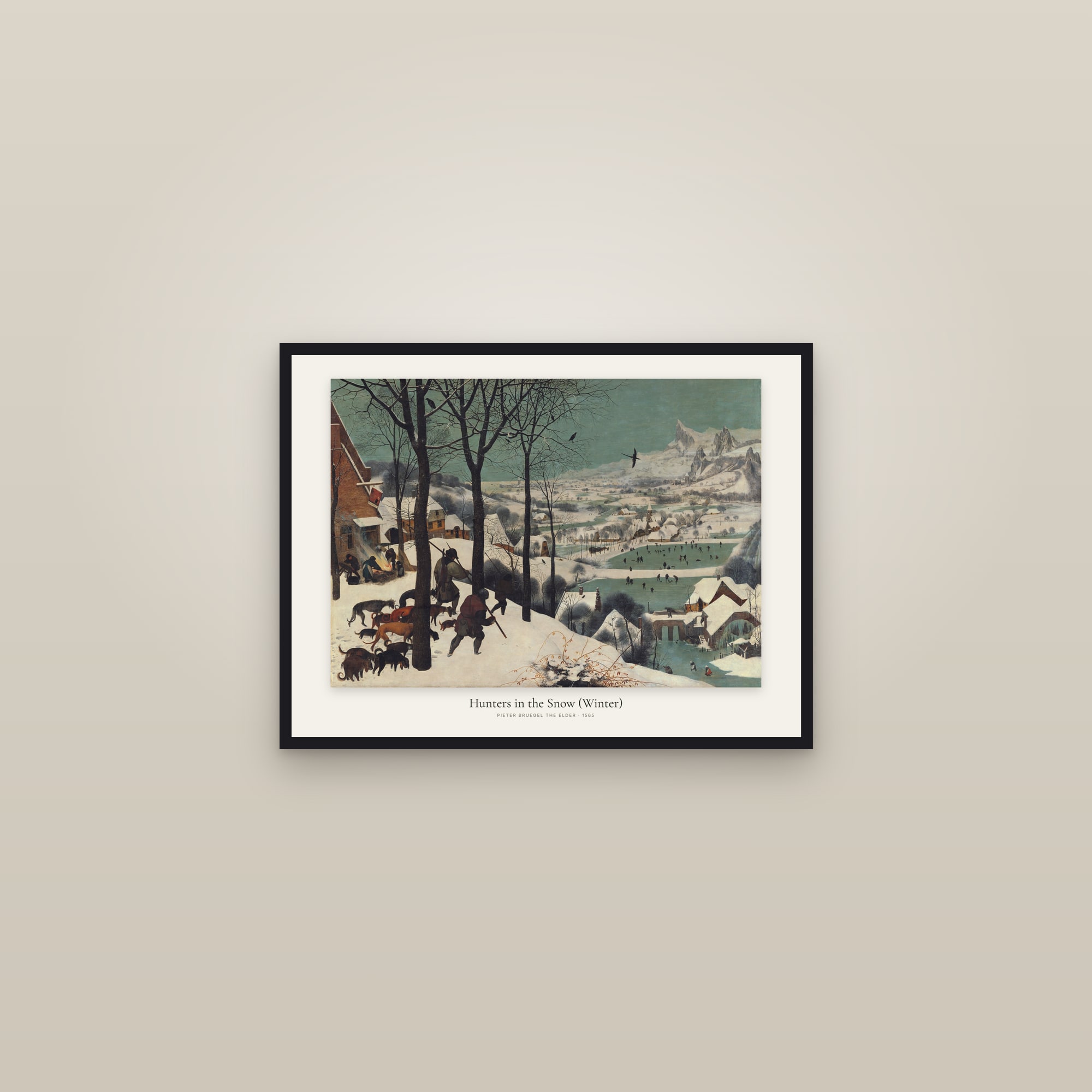
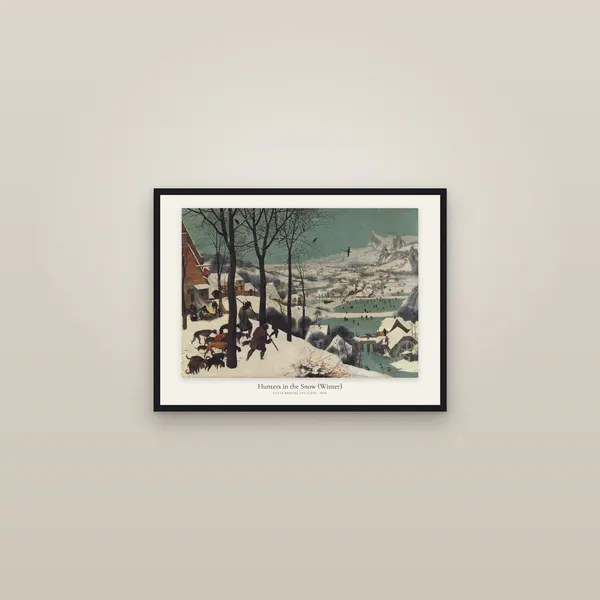
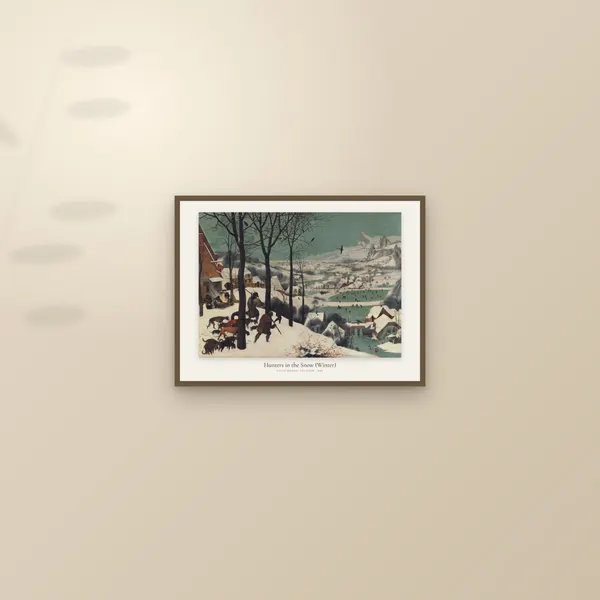
The Hunters in the Snow, Pieter Bruegel the Elder, 1565
Three hunters trudge home over a ridge with their lean dogs. The day has gone badly. "Only a single fox hangs on one of the spears slung over the men's shoulders," the Kunsthistorisches Museum notes. Below them a whole valley opens out: frozen ponds full of skaters, a village, a mill, mountains, crows in a pale green sky.
It was one of a set. The museum's Bruegel exhibition explains that the series "originally comprised six large-scale panel paintings" of the seasons, made for the Antwerp merchant Nicholaes Jongelinck and probably hung in his dining room. Five survive. Three are in Vienna, one in Prague and one, The Harvesters, at the Metropolitan Museum in New York.
The panel is 116.5 by 162 cm. Our print of Hunters in the Snow is landscape, 16 × 12 up to 32 × 24 inches.
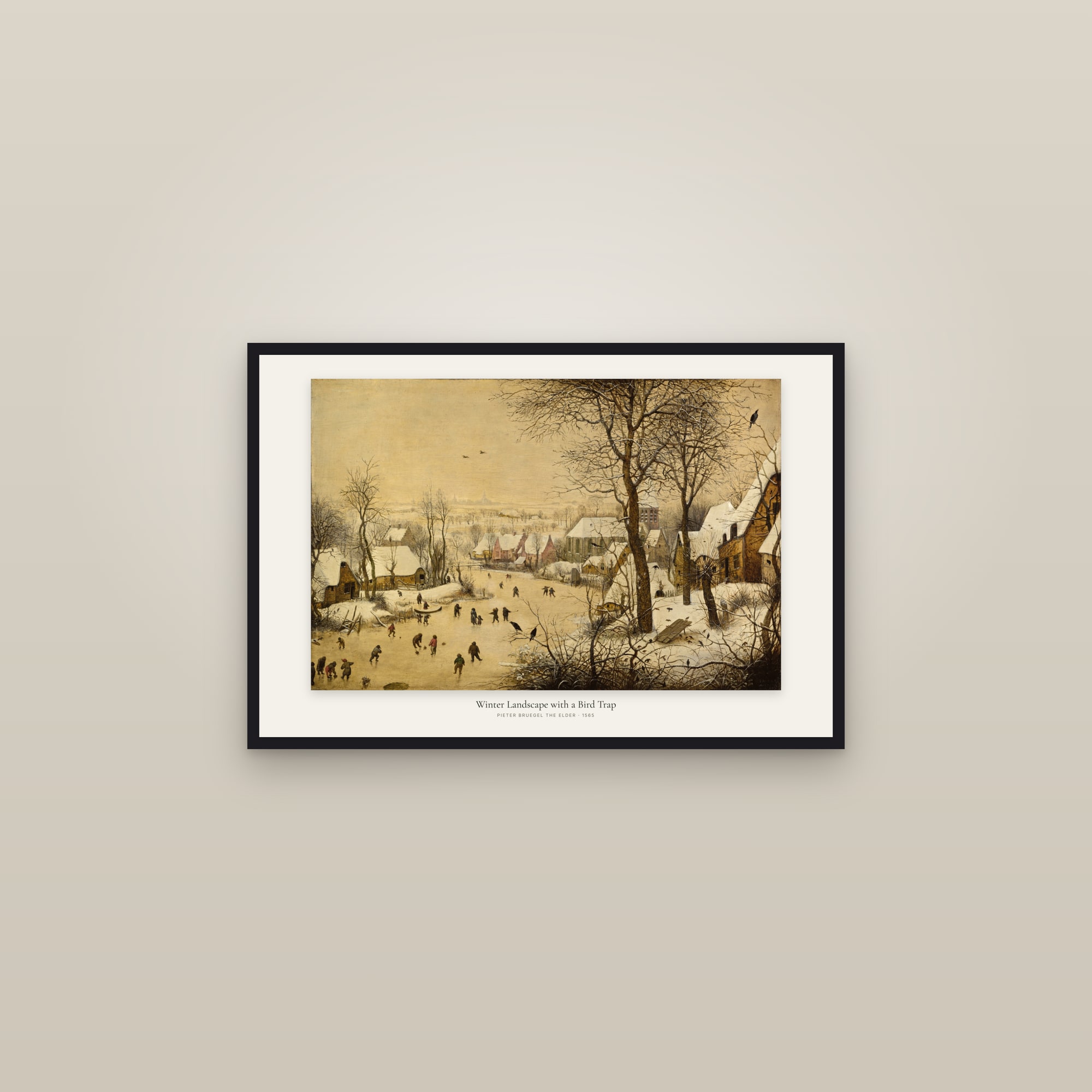
Winter Landscape with a Bird Trap, Pieter Bruegel the Elder, 1565
Villagers skate and play on a frozen river between snowy roofs. On the right, a wooden board is propped on a stick over scattered seed, and birds peck underneath. The Royal Museums of Fine Arts of Belgium in Brussels, which owns it, reads the ice as a moral warning: "life, like ice, is dangerous and slippery."
It is small, 37 by 55.5 cm, and it was a hit. "Around 100 copies prove the extraordinary popularity of this composition," the Kunsthistorisches Museum writes about one of them; the Brussels museum counts no fewer than 140. Researchers at Smith College point out that the picture may allude to the winter of 1564–65, which chronicles of the time describe as particularly severe.
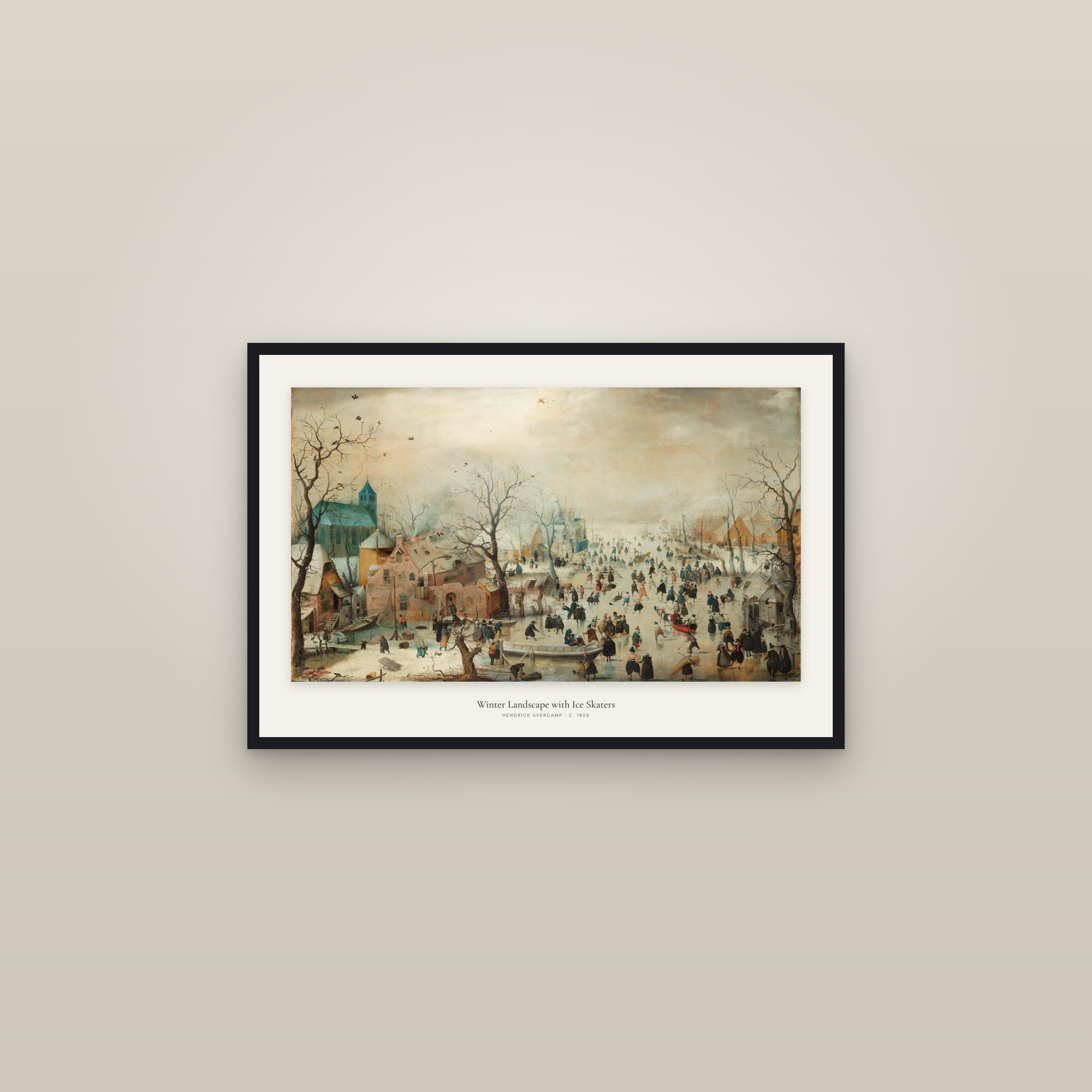
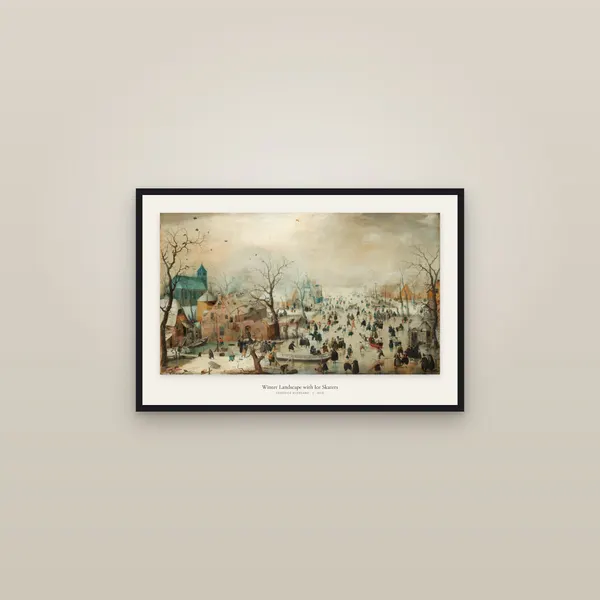
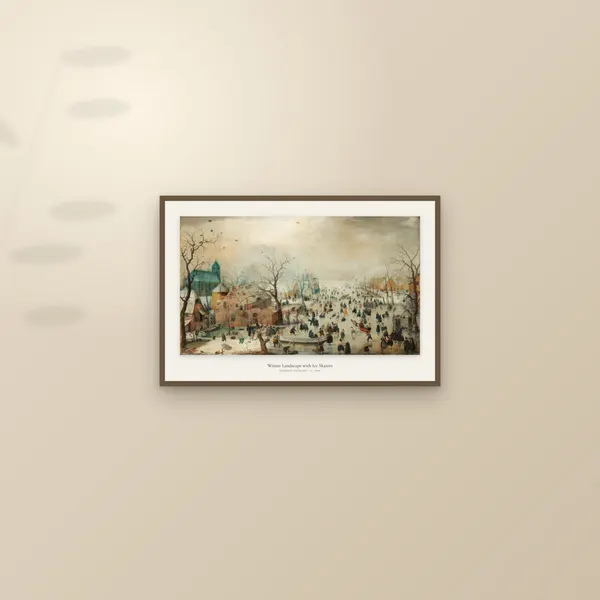
Winter Landscape with Ice Skaters, Hendrick Avercamp, c. 1608
A frozen river outside a Dutch town, seen from above. "Hundreds of people are out on the ice, most of them for pleasure," says the Rijksmuseum: couples, children, a sledge, kolf players (kolf was an early form of golf). Look at the left foreground and the mood shifts. There, the museum notes, "crows and a dog feast on the carcass of a horse that has frozen to death."
Avercamp was deaf and unable to speak from birth, and was known as "de Stomme", the mute. The panel is 77.3 by 131.9 cm; our print of Winter Landscape with Ice Skaters goes up to 36 × 24 inches, large enough to find every figure.
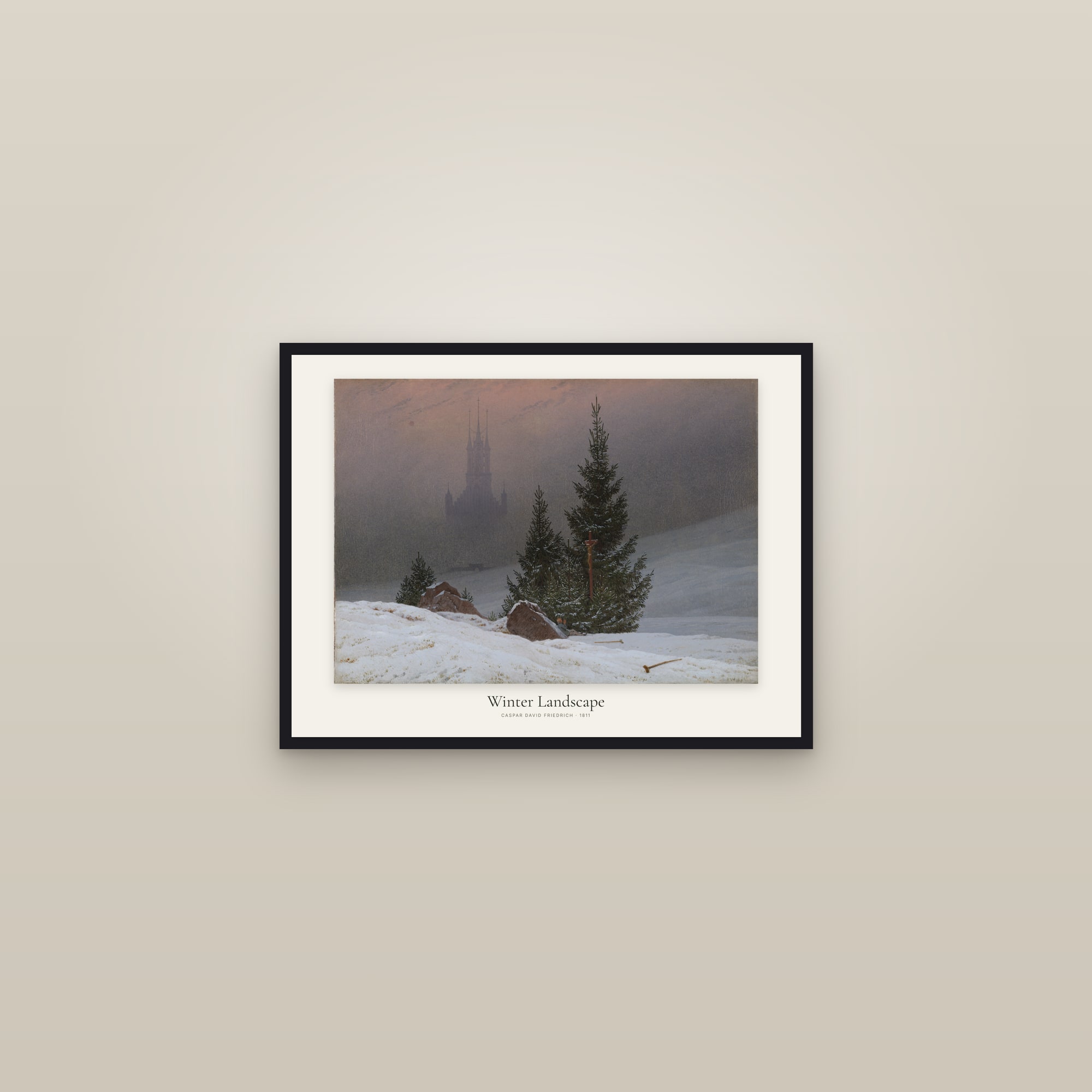
Winter Landscape, Caspar David Friedrich, probably 1811
A man has thrown away his crutches. "A man, having cast aside his crutches, lies against a large boulder in a snowy landscape as he prays in front of a shining crucifix," the National Gallery in London describes it. Behind him, three dark firs, and through the mist the outline of a Gothic church.
The painting is small, 32.5 by 45 cm, and it seems to have a bleak twin. The gallery says it "appears to be a companion" to another Winter Landscape of the same date in Schwerin, where a tiny figure on a crutch stares at an empty snowfield. Read together, one is despair and the other is hope. Friedrich's best-known picture, the Wanderer above the Sea of Fog, stands on a mountain rather than in snow, but it has the same lone figure facing a vast view.
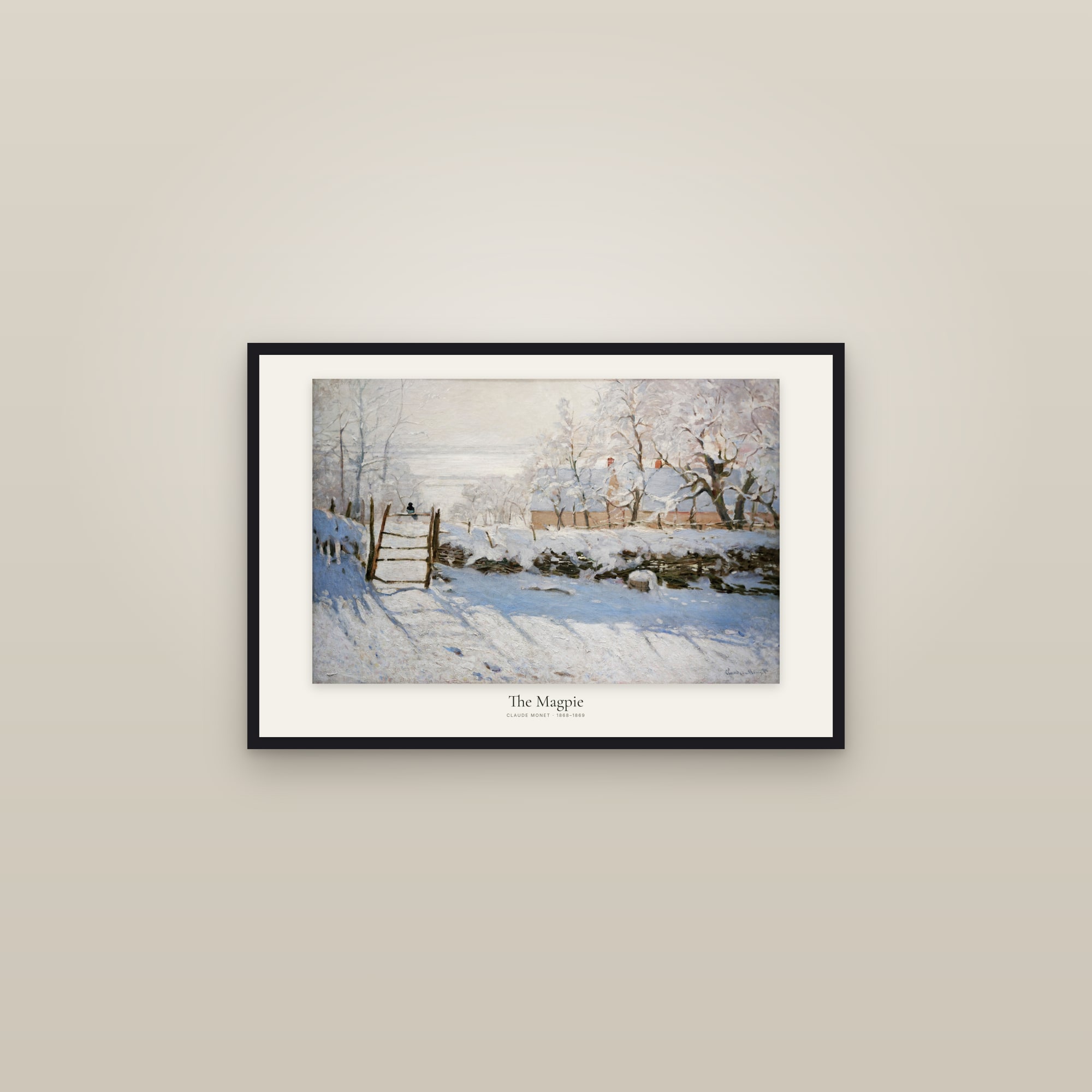
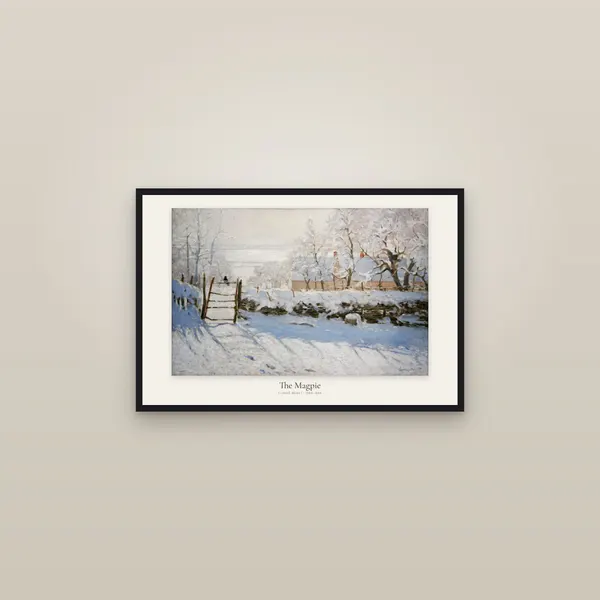
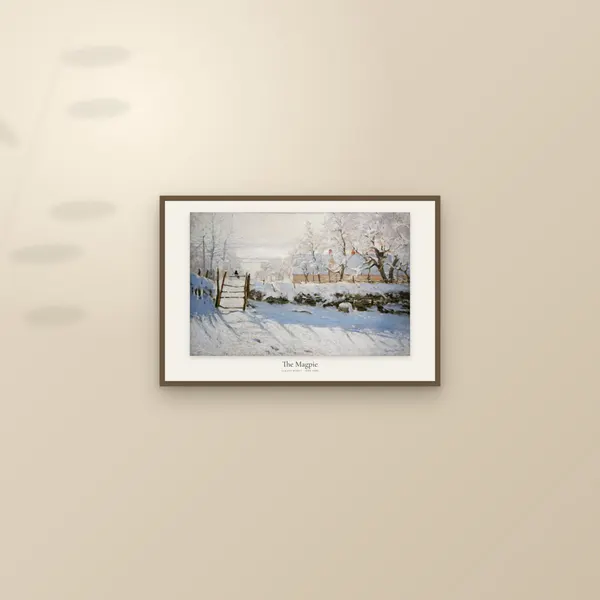
The Magpie, Claude Monet, 1868–69
A field of fresh snow, a wattle fence, a gate, and on the gate a single black-and-white bird. Monet painted it in the countryside near Étretat, on the spot, during the winter of 1868–69. The Musée d'Orsay puts the bird beautifully: "like a note on a staff of music."
The jury of the 1869 Salon, the official Paris exhibition, rejected it. The museum puts that down to "the novelty and daring of Monet's approach, which was more about perception than description." Its "very unusual pale, luminous colours" left the public, in the critic Félix Fénéon's words, "flabbergasted by this pale painting." Our print of The Magpie is landscape, up to 36 × 24 inches.
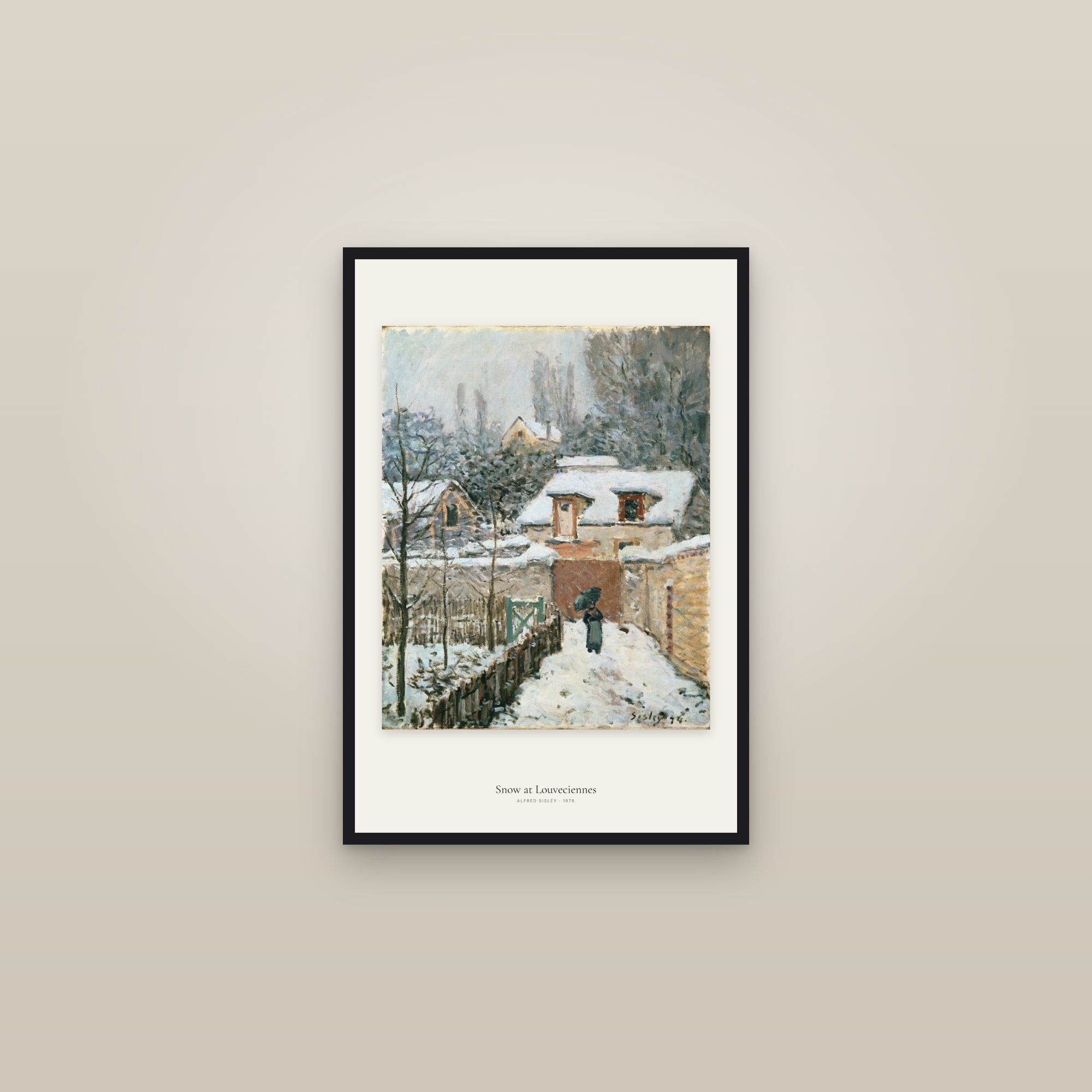
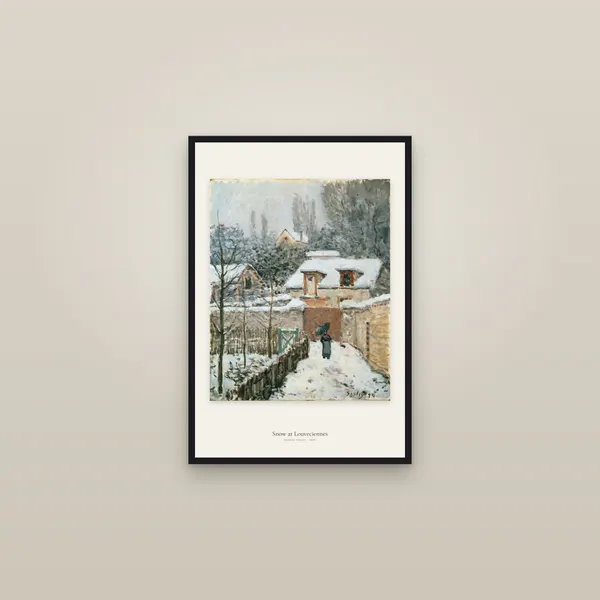
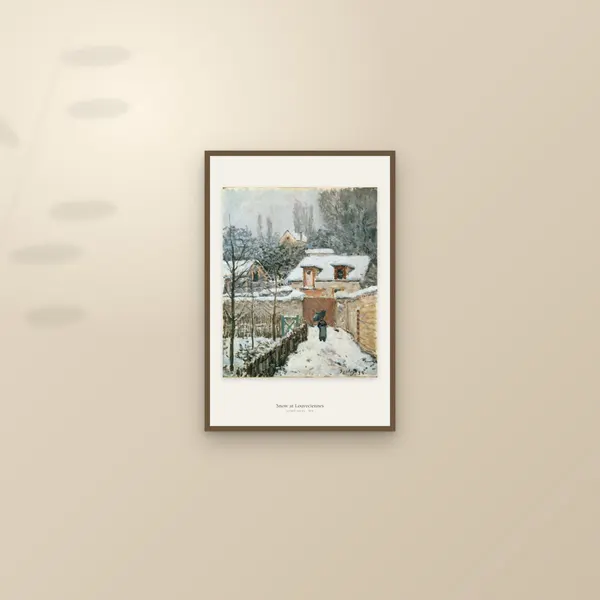
Snow at Louveciennes, Alfred Sisley, 1878
A snowy lane in Louveciennes, a village west of Paris where Sisley spent several winters, narrowing between walls toward one small figure. The Musée d'Orsay describes a road that "disappears into the background, inhabited only by one small, isolated character", and ground that looks "iridescent with bluish reflections rather than uniformly white." It adds that, like Monet, Sisley "followed Courbet's example in painting snow scenes."
At 61 by 50 cm it is an upright, quiet picture, and our print of Snow at Louveciennes keeps that shape, at 12 × 18 or 16 × 24 inches.
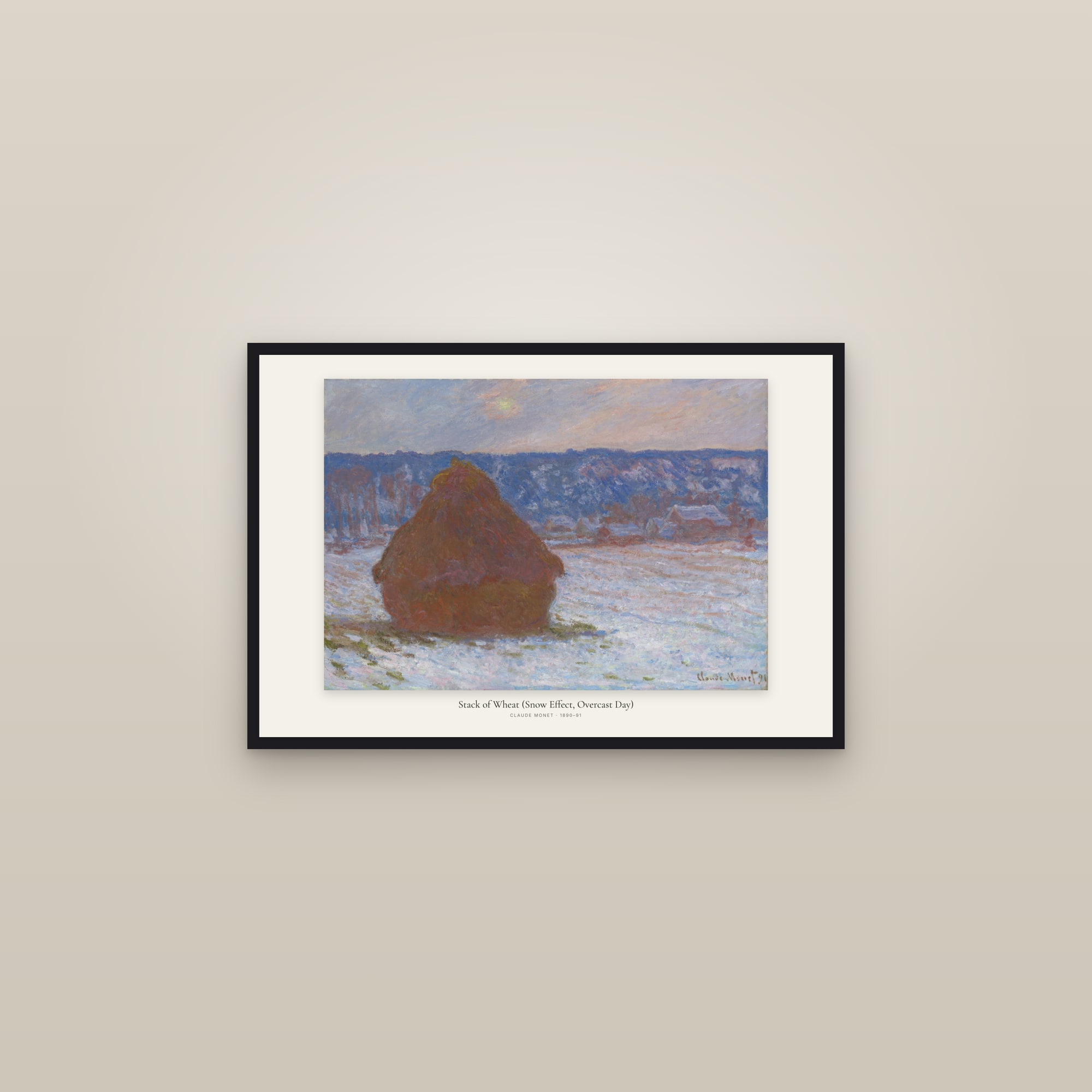
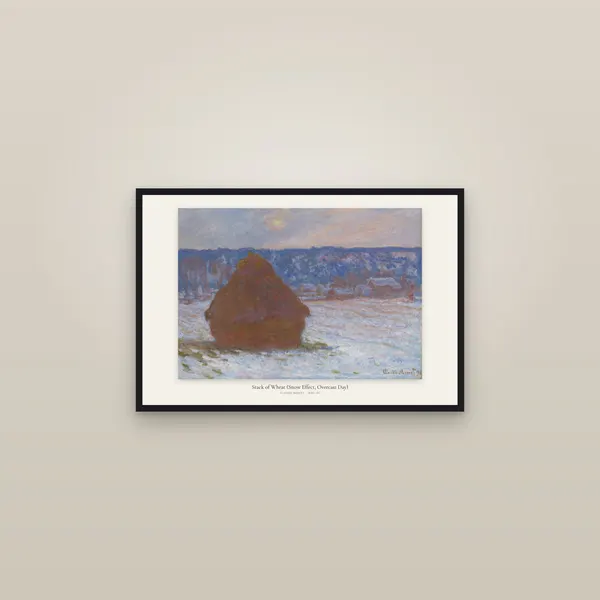
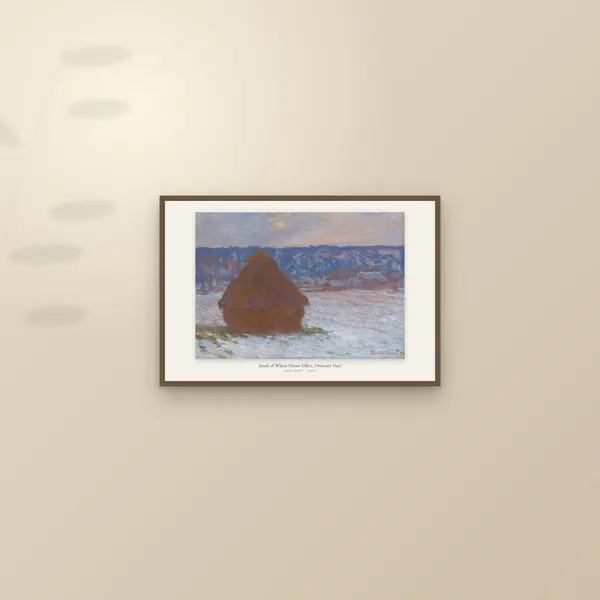
Stack of Wheat (Snow Effect, Overcast Day), Claude Monet, 1890–91
One tall stack of wheat in a snowy field near Monet's house at Giverny. The real stacks, the Art Institute of Chicago says, "rose fifteen to twenty feet and stood just outside the artist's farmhouse." He painted them again and again, in every light.
In May 1891, the museum records, Monet hung fifteen of these canvases side by side in one room at the Galerie Durand-Ruel in Paris, and the winter views were "the core of the series." The Art Institute now holds the largest group of the Stacks of Wheat anywhere; our print of Stack of Wheat (Snow Effect, Overcast Day) is from its canvas.
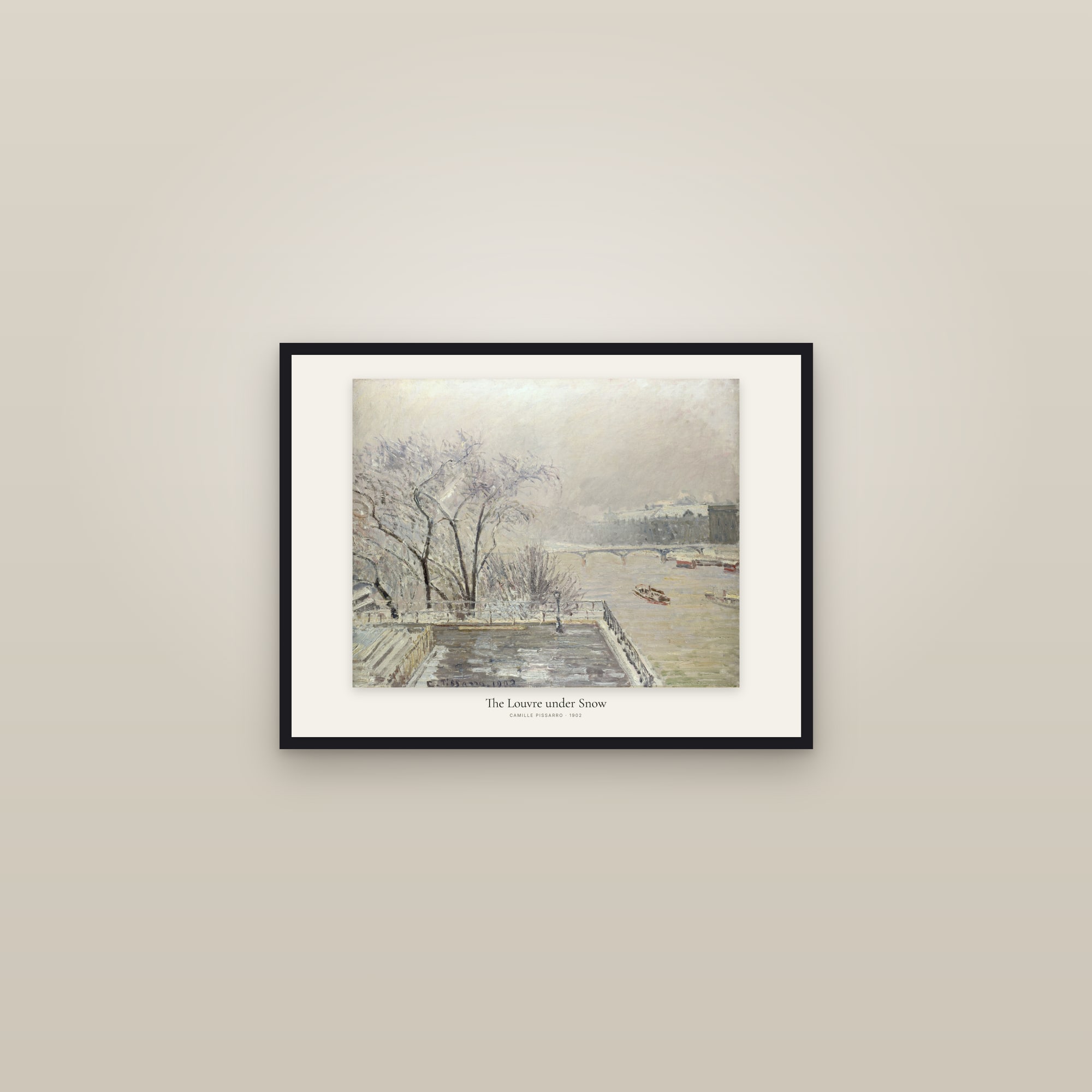
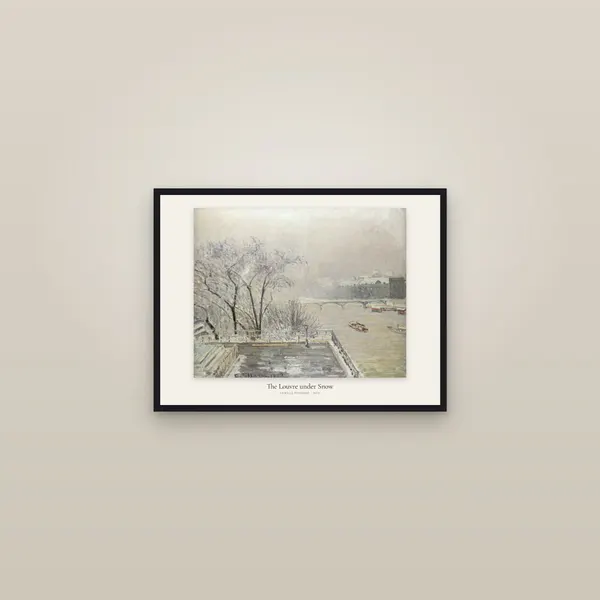
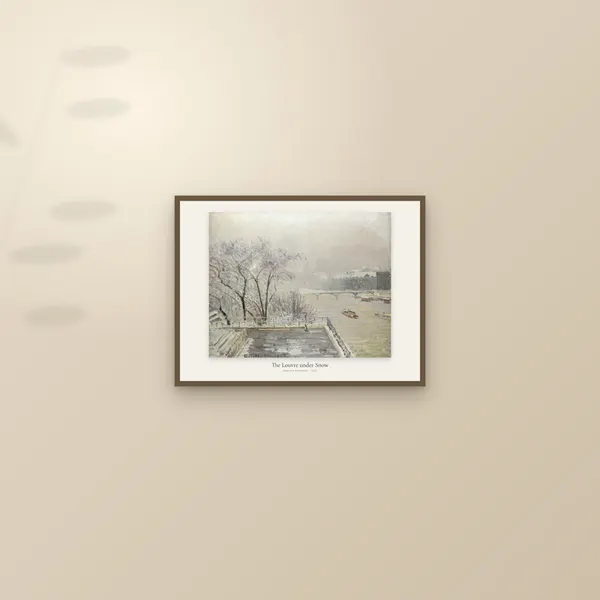
The Louvre under Snow, Camille Pissarro, 1902
Paris from a window. Pissarro rented an apartment on the place Dauphine, on the Île de la Cité, and painted the view from it, the National Gallery in London explains: a snowy garden at the tip of the island, the grey Seine, the Pont des Arts, and the long front of the Louvre on the right. He was seventy-one and painted it, probably, in the first months of 1902, the year before he died.
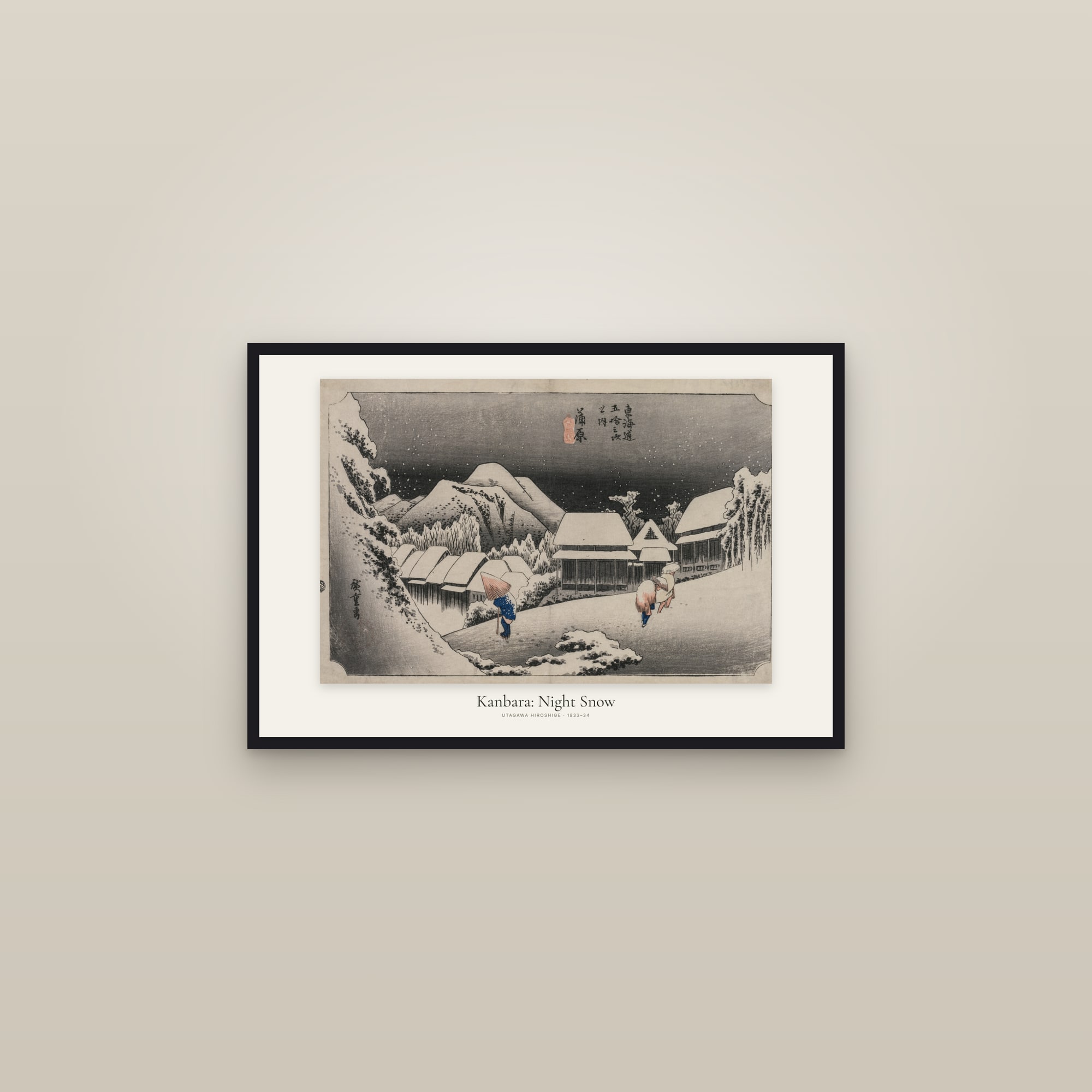
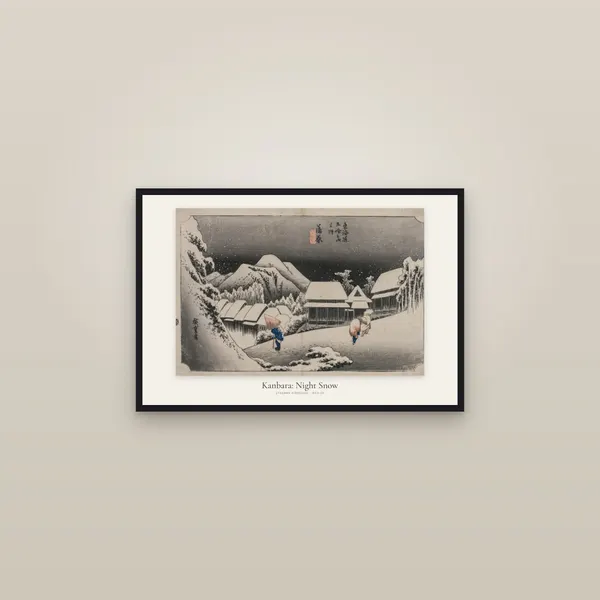
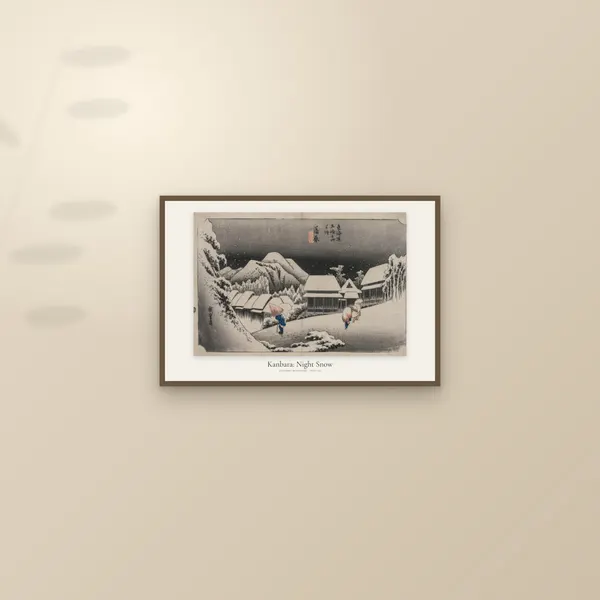
Kanbara: Night Snow, Utagawa Hiroshige, c. 1833–34
Snow falls through a black sky on a sleeping village. Three travellers bend under umbrellas and straw capes on an empty road. It is number sixteen in Hiroshige's Fifty-three Stations of the Tōkaidō, and one of its best-known prints.
There is a quiet joke in it. "The coastal town of Kambara rarely experiences snowfall," the Cleveland Museum of Art notes. The museum adds that the falling flakes are made by carving their shapes out of the woodblock, and that this "may be the first by Hiroshige to depict falling snow." Our print of Kanbara: Night Snow goes up to 36 × 24 inches.
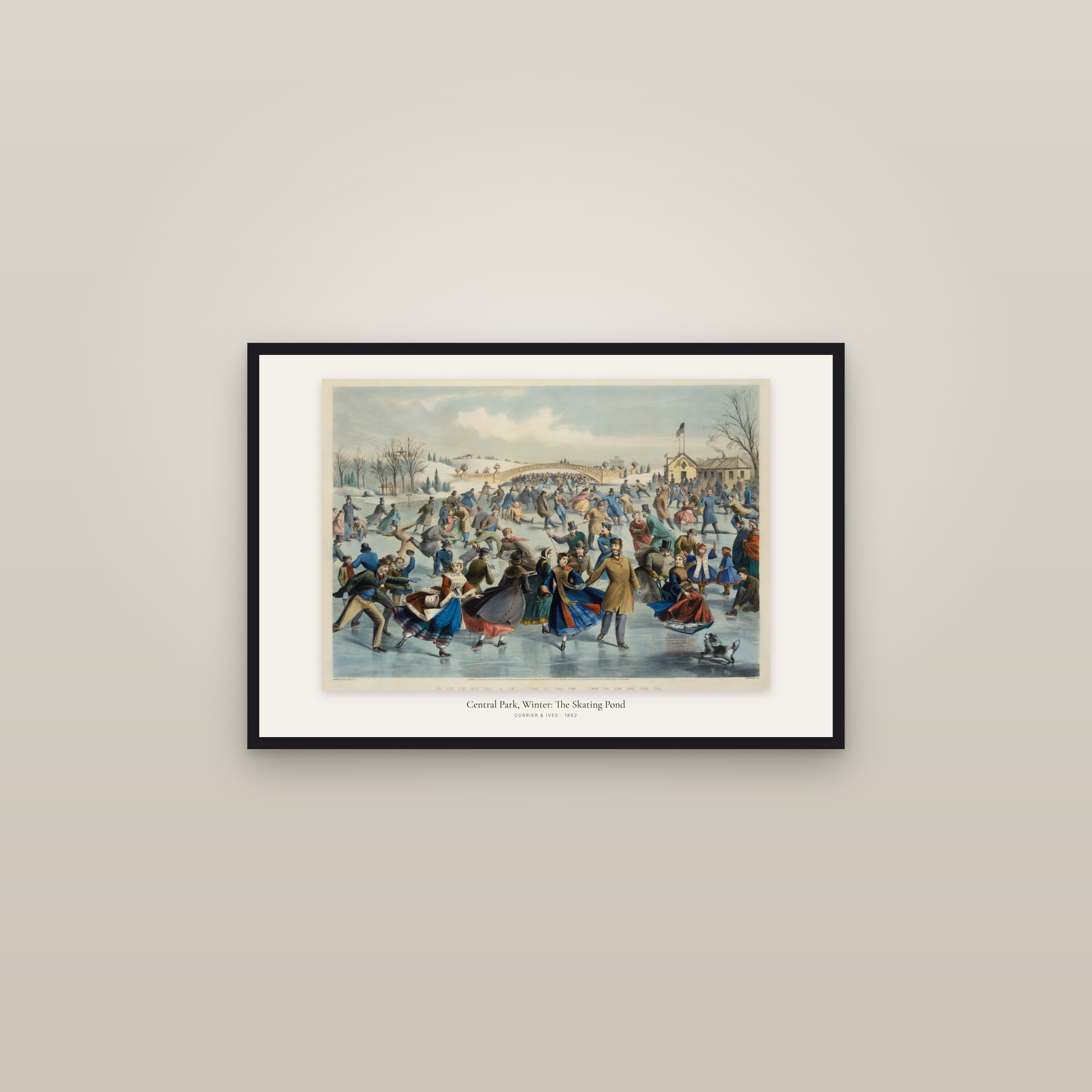
Central Park, Winter: The Skating Pond, Currier & Ives, 1862
New York on the ice. Couples skate arm in arm, a man pushes a woman in a chair sledge, a child falls, a small dog barks. It is a hand-coloured lithograph after a painting by Charles Parsons, published by Currier & Ives, and the Metropolitan Museum of Art holds an impression.
The scene was new. The Central Park Conservancy records that in the winter of 1858 the Lake was the first part of the park to open, that it was originally called the "Skating Pond", and that on Christmas morning an estimated 8,000 people went onto the ice. Currier & Ives sold such pictures cheaply and in huge numbers; the firm advertised itself, Winterthur Museum notes, as the "Grand Central Depot for Cheap and Popular Prints."
Which winter painting should you hang where?
Choose by shape first. Most snow scenes are wide, so they suit a sofa, a bed or a long sideboard.
| Painting | Shape | Largest size we print | Best for |
|---|---|---|---|
| Hunters in the Snow | Landscape | 32 × 24 in | A living-room wall; one big piece |
| Winter Landscape with Ice Skaters | Landscape | 36 × 24 in | Above a sofa; a family room |
| The Magpie | Landscape | 36 × 24 in | A pale, calm bedroom |
| Snow at Louveciennes | Portrait | 16 × 24 in | A hallway or a narrow wall |
| Nihonbashi: Clearing after Snow | Portrait | 24 × 36 in | A tall wall by a staircase |
| Kanbara: Night Snow | Landscape | 36 × 24 in | A study or a dark-walled room |
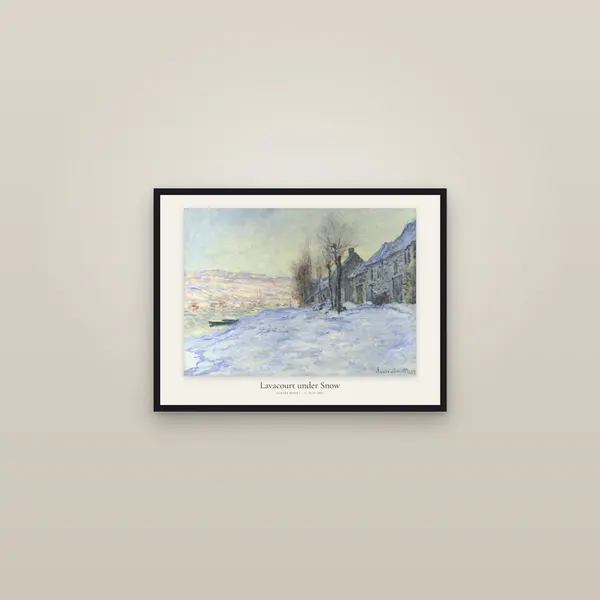
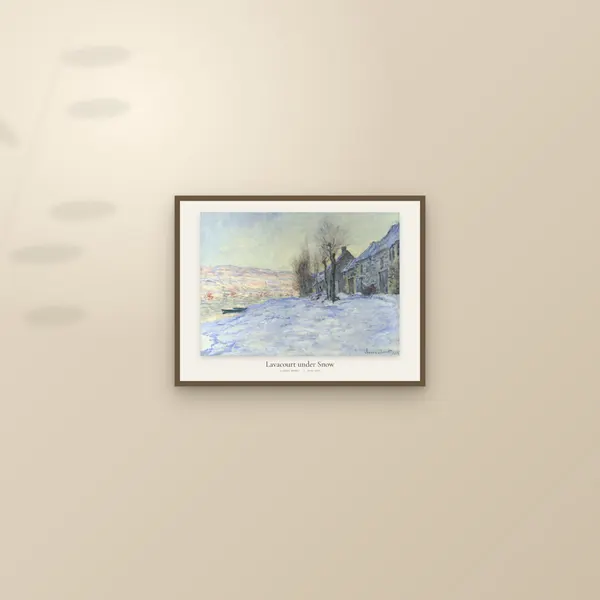
All print whole and uncropped on museum-quality archival paper, from $39 unframed at the smallest size, or in a black or dark wood frame. For a pair, two Monets work well together: hang The Magpie beside Lavacourt under Snow, the National Gallery's view of a snowy Seine village in pale pink sunlight. For a winter hallway, Hiroshige's upright Nihonbashi: Clearing after Snow, from his One Hundred Famous Views of Edo, shows a snowy bridge and a white Fuji above the city.
If you are unsure of size, our guide to art above a sofa gives the widths. Every print here is in Winter wall art; the paintings sit with the rest of the movement in Impressionism prints and Famous painting prints, and the cosier, more festive scenes are on Christmas wall art.
Questions people ask
What is the most famous winter painting?
The Hunters in the Snow by Pieter Bruegel the Elder, painted in 1565 and now in the Kunsthistorisches Museum in Vienna. Three hunters and their dogs come home over a snowy ridge with a single fox, above a valley of frozen ponds full of skaters.
Why did so many painters paint snow?
Snow is a test of colour. The Musée d'Orsay notes that Monet and Sisley followed Courbet in painting snow scenes, and that in Sisley's Snow at Louveciennes the ground looks iridescent with bluish reflections rather than plain white. Earlier, Dutch painters of the Little Ice Age often showed people skating on canals, lakes and rivers that regularly froze, as researchers at Smith College note.
Where can I see Monet's winter paintings?
The Magpie is in the Musée d'Orsay in Paris. Lavacourt under Snow is in the National Gallery in London. The Art Institute of Chicago holds the largest group of his Stacks of Wheat, including Stack of Wheat (Snow Effect, Overcast Day), 1890–91.
What is the best winter painting for a living room?
A wide one. Hunters in the Snow and Avercamp's Winter Landscape with Ice Skaters are landscape-shaped and full of small figures, so they reward a large size above a sofa: we print Hunters up to 32 by 24 inches and the Avercamp up to 36 by 24.
Is a winter painting only for Christmas?
No. Most of these show ordinary winter days, a magpie on a gate, a lane, a river under snow, with nothing seasonal in them. They can hang from November to March, or all year in a cool, pale room.
Sources
- Kunsthistorisches Museum Vienna: Pieter Bruegel the Elder, Hunters in the Snow (Winter), 1565, inv. 1838
- Kunsthistorisches Museum, Bruegel 2018: Six seasons for a dining room (six panels, five survive, Nicholaes Jongelinck)
- Kunsthistorisches Museum: Winter Landscape with Bird Trap, copy after Bruegel (around 100 copies)
- Royal Museums of Fine Arts of Belgium: Pieter Bruegel the Elder, Winter Landscape with Skaters and Bird Trap, 1565, inv. 8724
- Royal Museums of Fine Arts of Belgium on Google Arts & Culture: Bruegel's winter landscape (life, like ice, is dangerous and slippery; 140 known copies)
- Smith College, ClimateLit: winter landscape paintings by Dutch and English masters (the winter of 1564–65, the Little Ice Age)
- Rijksmuseum: Hendrick Avercamp, Winter Landscape with Ice Skaters, c. 1608, SK-A-1718
- The National Gallery, London: Caspar David Friedrich, Winter Landscape, probably 1811, NG6517
- Musée d'Orsay: Claude Monet, La Pie (The Magpie), 1868–69
- Musée d'Orsay: Alfred Sisley, La Neige à Louveciennes, 1878
- Art Institute of Chicago: Claude Monet, Stack of Wheat (Snow Effect, Overcast Day), 1890–91, 1933.1155
- The National Gallery, London: Camille Pissarro, The Louvre under Snow, 1902
- Cleveland Museum of Art: Hiroshige, Evening Snow at Kambara, 1985.317
- The Metropolitan Museum of Art: Central Park, Winter: The Skating Pond, 1862, 63.550.266
- Central Park Conservancy: the history of ice skating in Central Park
- Winterthur Museum: Lasting Impressions, Currier & Ives ('Cheap and Popular Prints', more than 7,500 titles)
Start hereThe most famous paintings in the world and where to see them