
The 53 Stations of the Tōkaidō, explained
Hiroshige's most famous series follows the road from Edo to Kyoto in 55 woodblock prints. What the road was, why there are 55, which prints to know, and how to hang them.
Contents7 sections
The Fifty-three Stations of the Tōkaidō is a series of colour woodblock prints by Utagawa Hiroshige, published around 1833 to 1834. It follows the Tōkaidō, the main road of Edo-period Japan, from the shogun's city of Edo (now Tokyo) to the old imperial capital, Kyoto. Each print shows one of the road's post towns, where travellers ate, slept and changed horses. It was made to sell to people who dreamed of the journey, and it worked: the series turned a little-known artist into the leading landscape designer of his day. This piece covers what the road was, why the set has 55 prints, which ones to know, and how to choose and hang them.
What was the Tōkaidō?
It was the most important road in Japan. It ran from Nihonbashi, a bridge in the middle of Edo, to Sanjō Ōhashi, a bridge in Kyoto. The route was ancient, but it was greatly upgraded in the seventeenth century. In 1601 Tokugawa Ieyasu ordered each station on the road to keep 36 horses ready for official messengers. The last of the 53 stations, Shōno, was added in 1624.
Then came the crowds. Under a system called alternate attendance, every regional lord had to travel to Edo regularly to show his loyalty to the shogun, and he brought a large entourage with him. Those processions needed inns, porters, food and fresh horses, and the post towns grew to supply them.
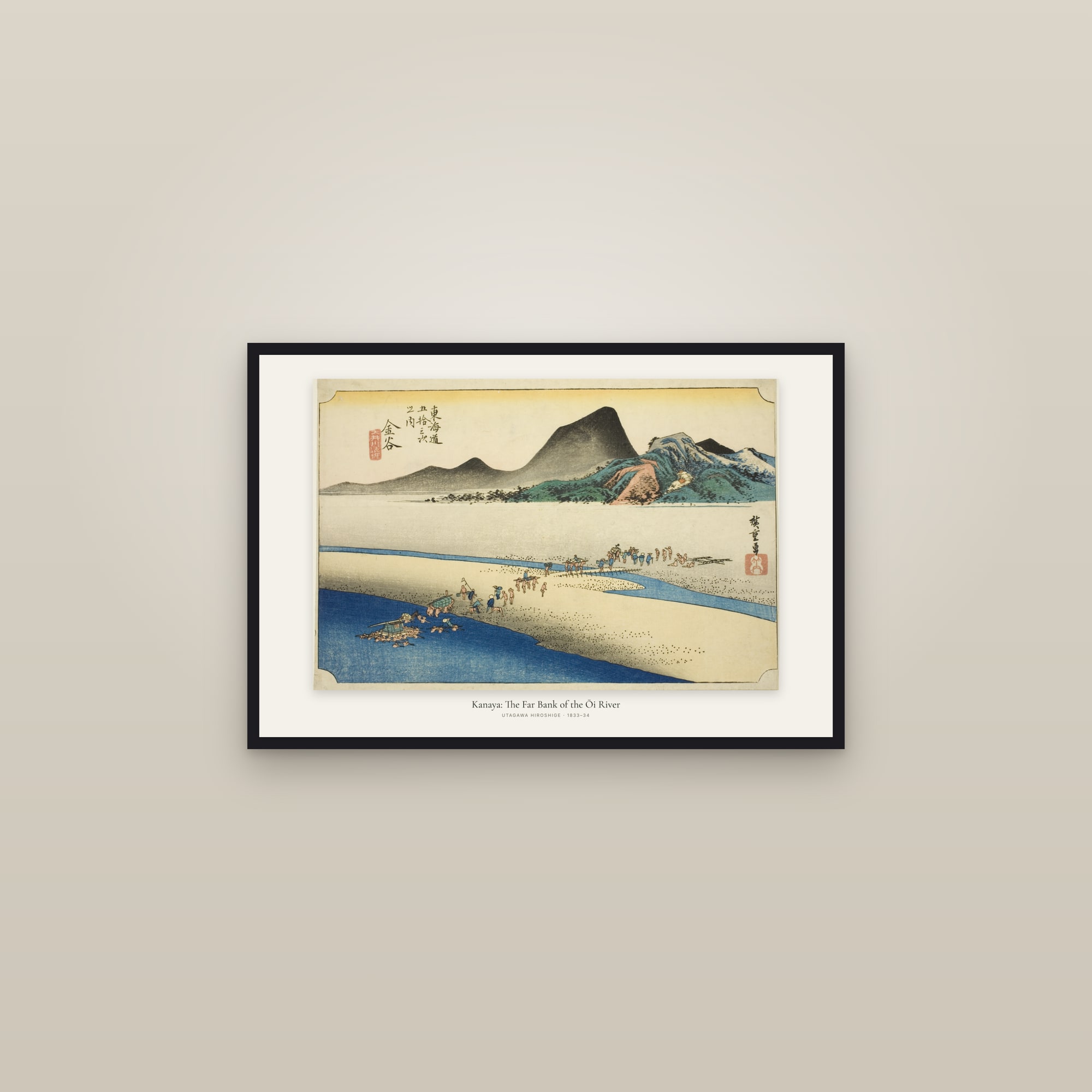
Most people walked. A traveller on foot covered 30 to 40 kilometres a day, and the whole road typically took 13 to 17 days. Some rivers had no bridge on purpose. On the Ōi River the government banned both bridges and ferries as a defence measure. Hiroshige's print of the crossing shows what that meant: travellers and baggage carried over the shallows by teams of porters.
Why are there 55 prints, not 53?
Because a road has two ends. Hiroshige drew one view for each of the 53 stations, then added the starting point and the finish. The MOA Museum of Art describes the series as a set of 55 large prints despite its title.
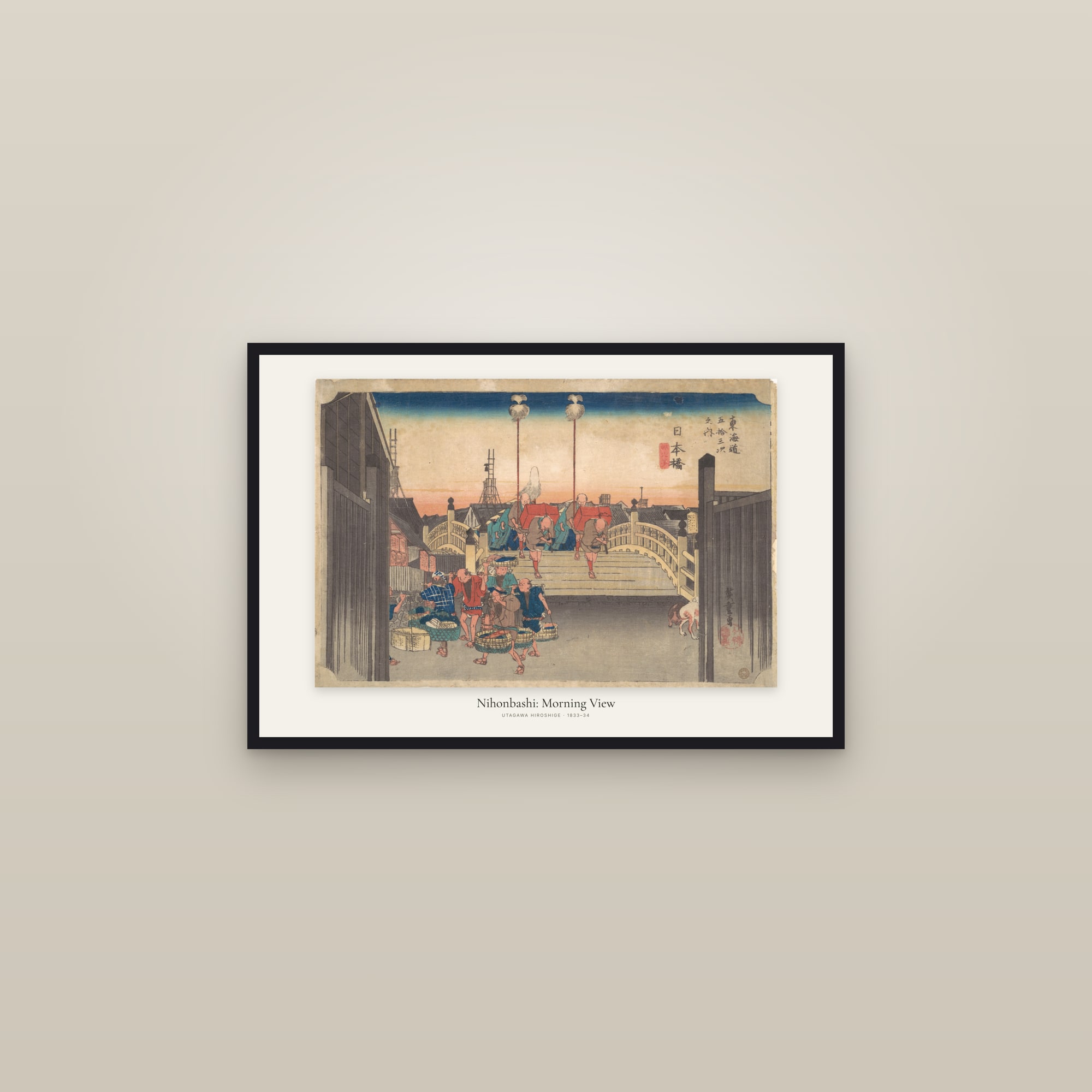
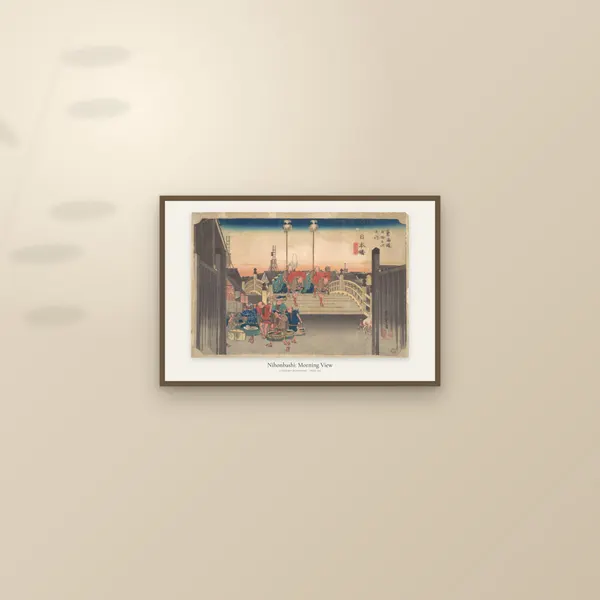
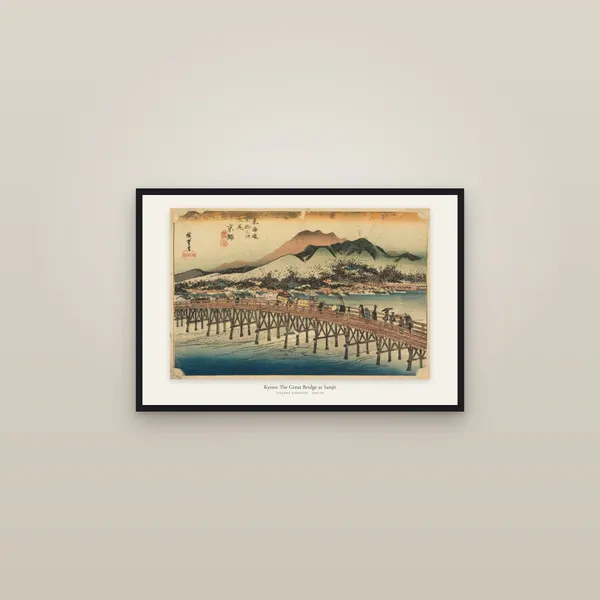
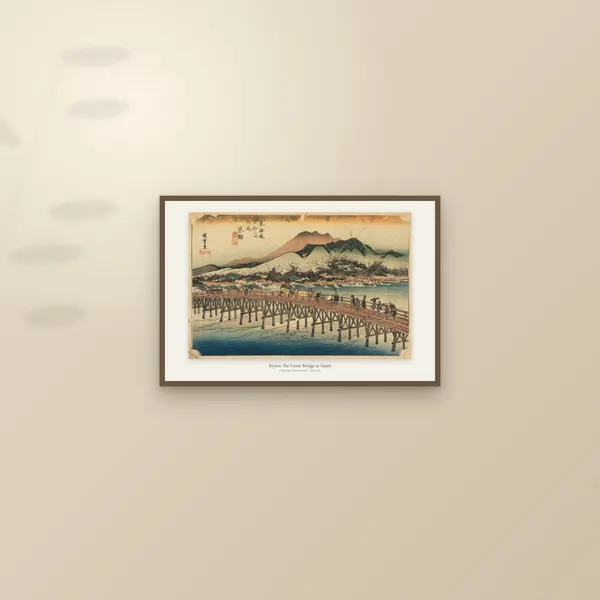
Print one is Nihonbashi at dawn. A lord's procession comes over the arch of the bridge behind two tall standards, while fishmongers with baskets clear out of its way in the foreground. Print 55 is Kyoto: a long wooden bridge on trestles, with travellers crossing towards the hills.
Who published it, and why did it sell?
The publisher was Takenouchi Magohachi, whose firm was called the Hōeidō. The MOA Museum says the series began as a joint publication with a second firm, the Senkakudō of Tsuruya Kiemon, and that the Hōeidō later took over the printing rights. That is why museums call this set the Hōeidō edition.
It was a gamble on both sides. A 2024 feature on the series, built on an interview with Inagaki Tomoko, a curator at the Okada Museum of Art in Hakone, describes the Hōeidō as "a fledgling newcomer" and Hiroshige as "virtually unknown" when the series appeared.
The road itself was already famous. Illustrated guides had been in print for years, and a comic novel about two idlers walking the Tōkaidō, known in English as Shank's Mare, was a huge bestseller. Hiroshige's prints gave that audience the journey in colour, with real weather. The same feature says the series "served as a guidebook," and calls this "probably a big reason" for its success. The MOA Museum puts the result plainly: the edition's success "brought Hiroshige the fame as a leading figure in landscape woodcut ukiyo-e."
The prints were made the way all such prints were, by a team. Hiroshige drew, a carver cut the blocks, and printers pulled each sheet by hand. Our piece on Japanese woodblock printing walks through the steps.
Did Hiroshige walk the road himself?
Nobody knows for certain. One of his followers later wrote that the shogunate ordered him to travel the Tōkaidō to Kyoto in 1832. The Okada Museum feature's verdict is that "the truth of this is not certain."
The prints offer a clue. For the views west of Shizuoka, it notes, Hiroshige more often based his pictures on a published guidebook, the Tōkaidō meisho zue. Researchers still debate whether he went beyond Hakone.
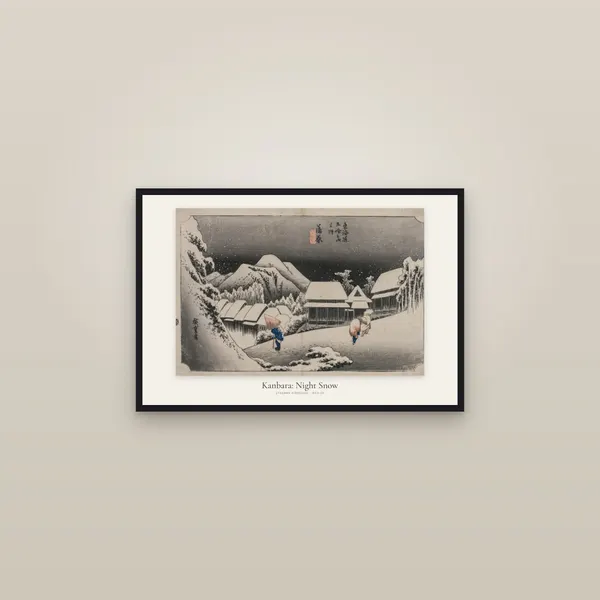
One famous print supports the doubt. The Cleveland Museum of Art points out that Kanbara, a coastal town, "rarely experiences snowfall." Hiroshige buried it in snow anyway. The series is a journey of the imagination as much as a record.
Which prints should you know?
Start with the weather. Three prints are reproduced more than any others, and each one turns a plain stop on the road into a mood.
| Station | What you see | Our sizes (inches) | |
|---|---|---|---|
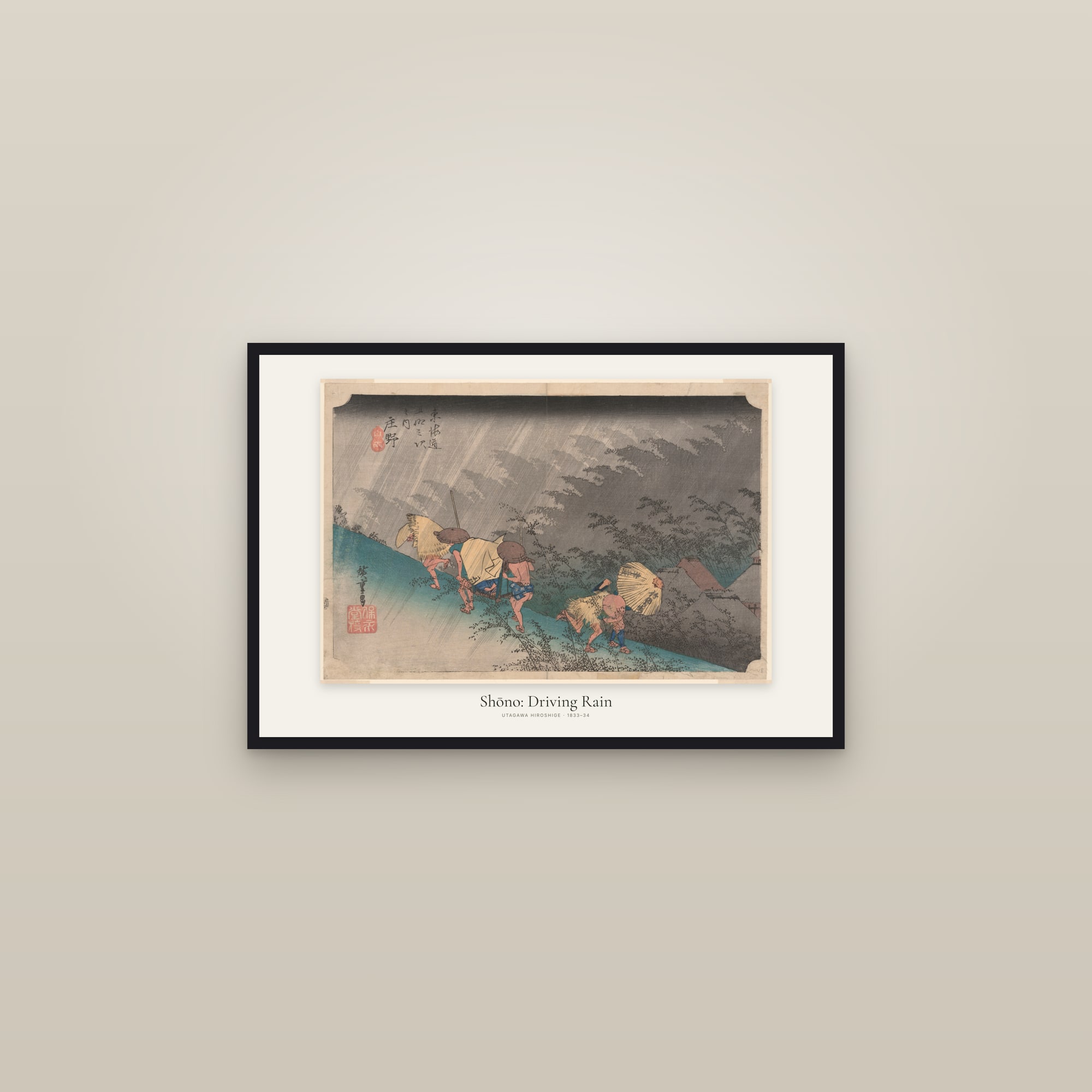
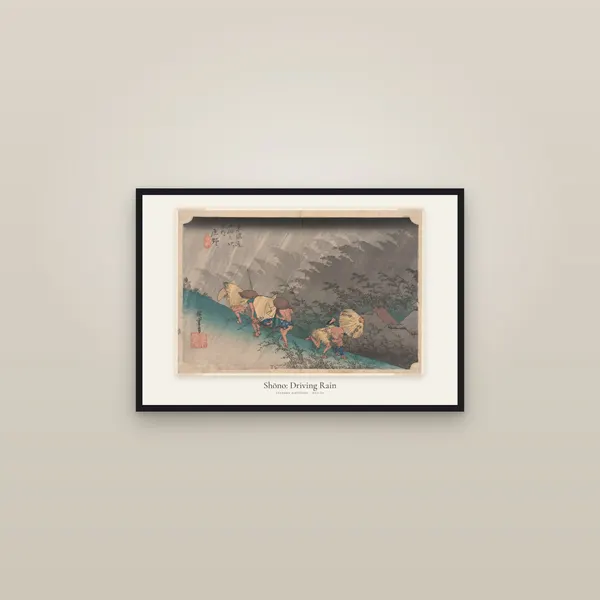
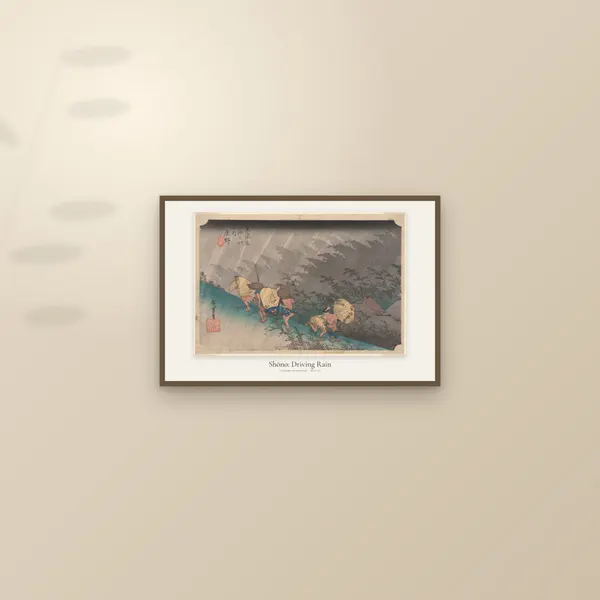
| Shōno: Driving Rain | 45 | Litter bearers and a man with an umbrella caught on a slope in a downpour | 18 × 12, 24 × 16, 36 × 24 |
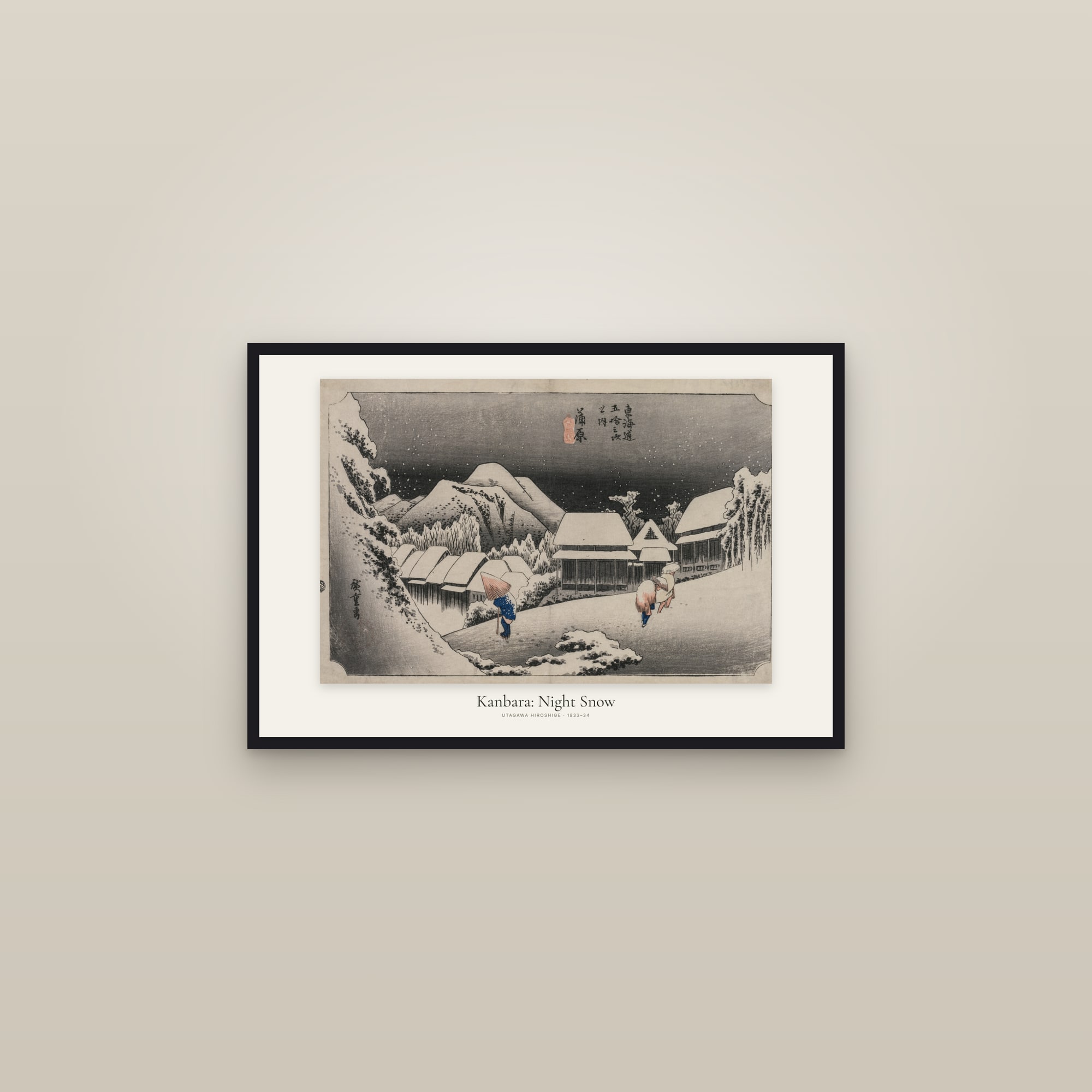
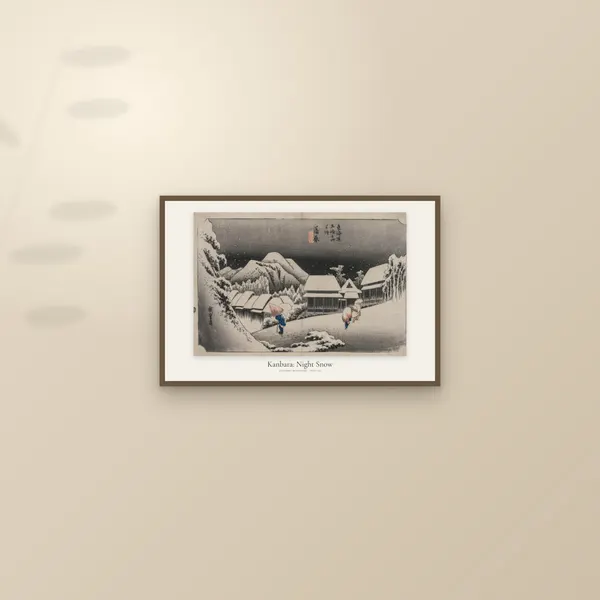
| Kanbara: Night Snow | 15 | Three walkers and a silent village under heavy snow | 18 × 12, 24 × 16, 36 × 24 |
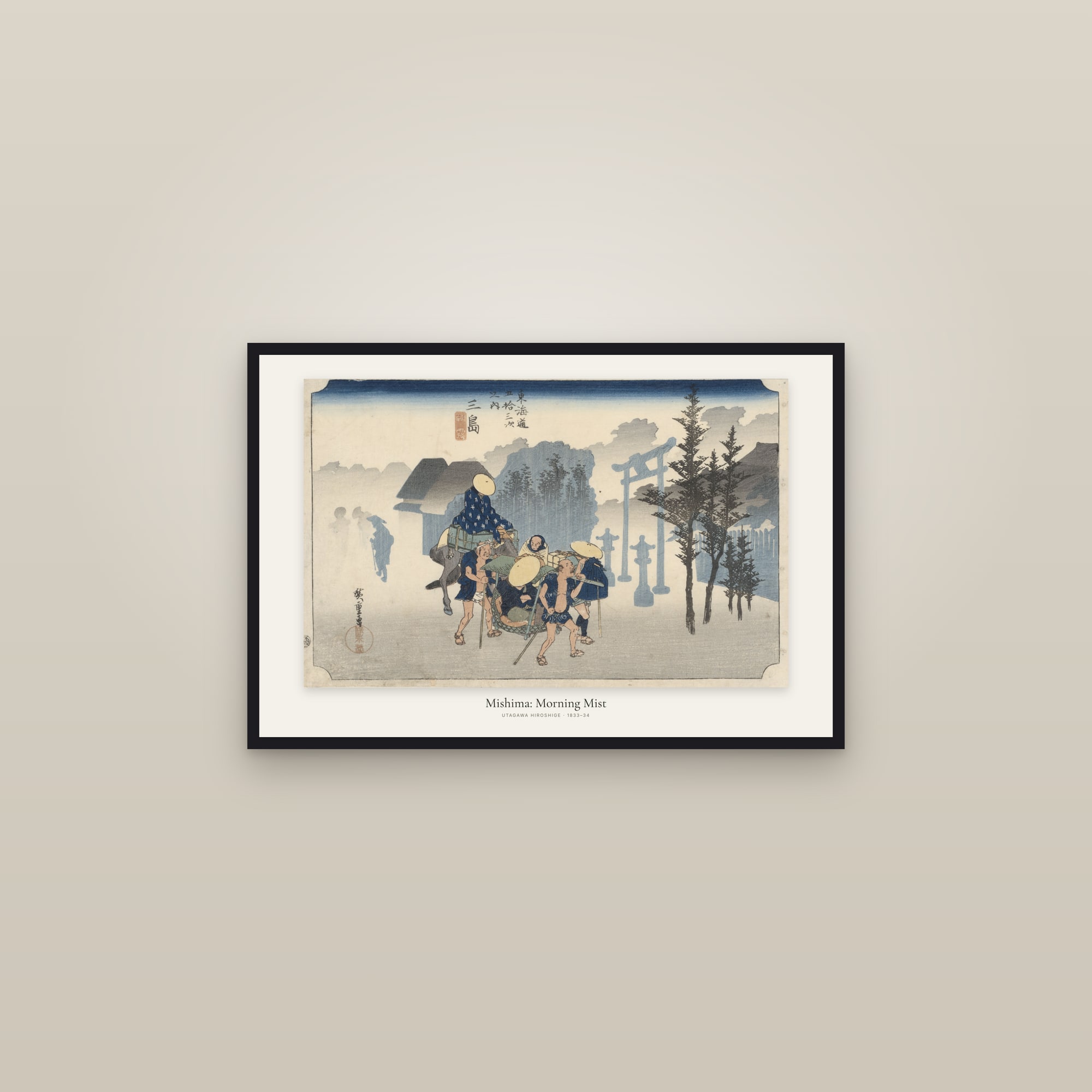
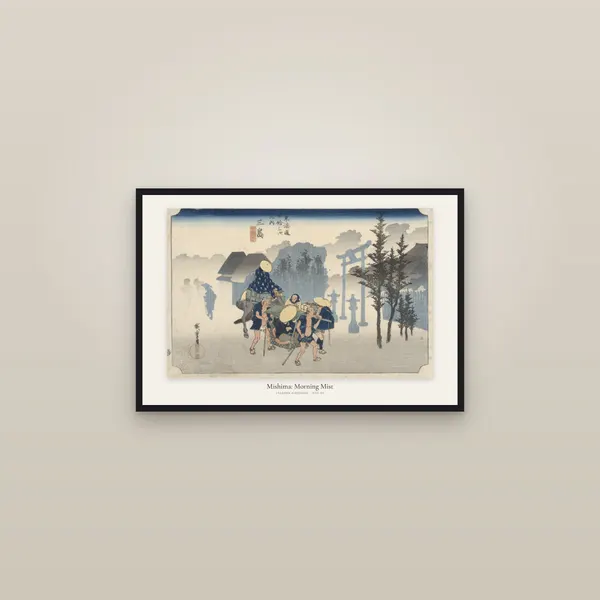
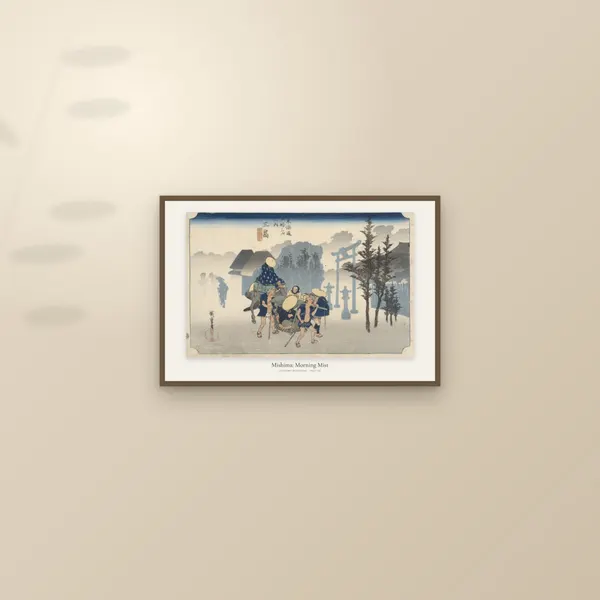
| Mishima: Morning Mist | 11 | Travellers in full colour, a shrine gate and trees as pale silhouettes | 18 × 12, 24 × 16, 36 × 24 |
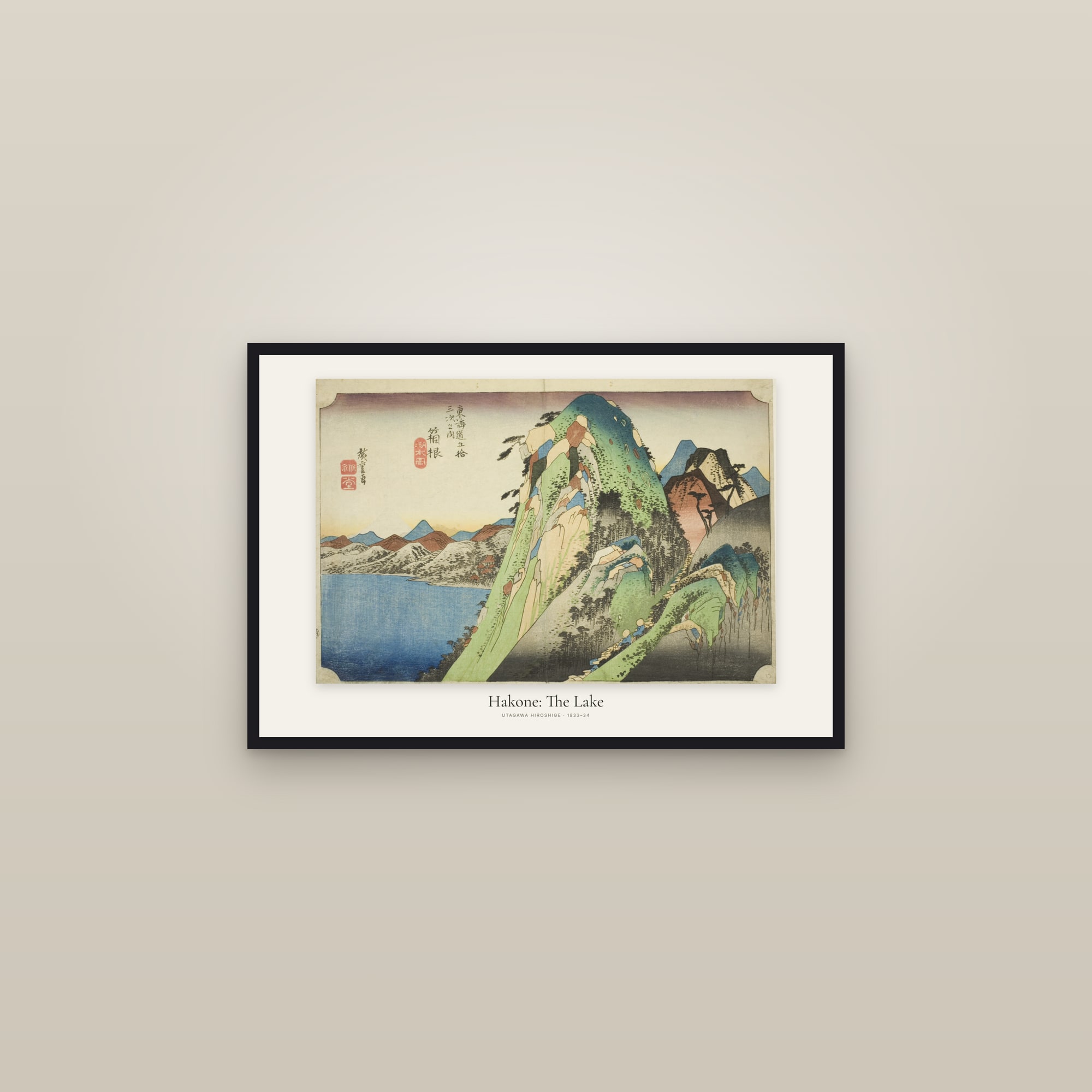
| Hakone: The Lake | 10 | A steep peak in patches of green, ochre and blue above a still lake | 18 × 12, 24 × 16 |
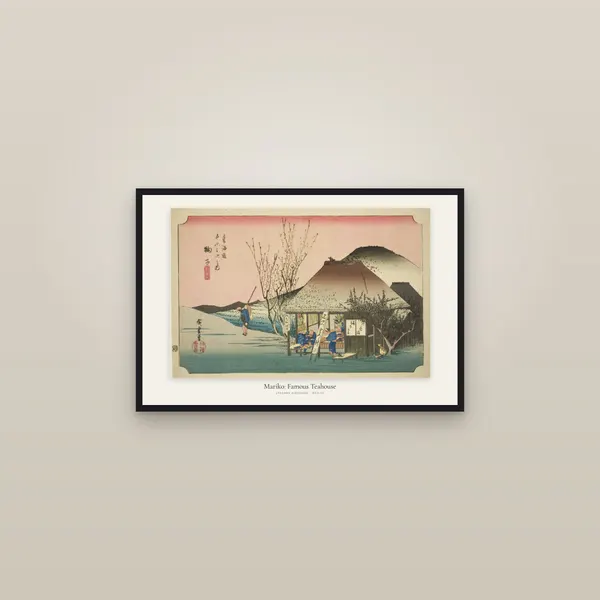
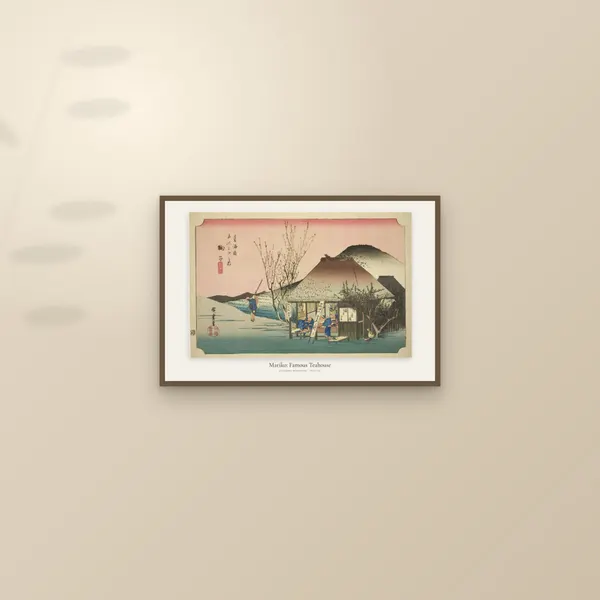
| Mariko: Famous Teahouse | 20 | Two customers eating at a thatched roadside teahouse under a pink sky | 18 × 12, 24 × 16 |
| Nihonbashi: Morning View | Start | A procession crossing the bridge at dawn | 18 × 12, 24 × 16 |
| Kyoto: The Great Bridge at Sanjō | End | The long trestle bridge and the hills of the capital | 18 × 12, 24 × 16 |
The station numbers count the post towns from Edo. Museums often number the prints instead, which adds one for Nihonbashi: Cleveland calls its Kanbara "number sixteen of the series."
Shōno is the one people remember. Nothing in it is still. The rain falls in slanted lines, the bamboo bends, and the two groups of travellers run in opposite directions. The trees are printed as flat grey shapes, each row paler than the last, which is how the picture gets its depth.
Kanbara is the quiet one. The Cleveland Museum explains the snow: the flakes "are created by carving their shapes out of the woodblock," so that when the block is inked the carved areas stay as unprinted white paper. The museum adds that this "may be the first by Hiroshige to depict falling snow."
Hakone is the boldest in colour. The Okada Museum feature praises its "patchwork of color." Look at the path low on the mountain: a lord's procession is winding down it, shown only by the tops of the travellers' hats.
Mariko has a joke in it. The teahouse sold grated yam soup, the town's speciality. The same feature suggests the two men eating it may be the comic heroes of Shank's Mare.
Is this the only Tōkaidō series?
No, and that matters when you shop. The first set sold so well that Hiroshige returned to the road again and again. The Okada Museum feature counts more than 20 later Tōkaidō series by him.
The later sets have different pictures. The Art Institute of Chicago, for example, holds a Hamamatsu from a set it dates to about 1837 to 1842 and calls "the Tokaido with Poem." Its sheet is about 17 by 23 cm, much smaller than a Hōeidō print. The same museum labels its Shōno from the first series as "also known as the Hoeido Tokaido."
The Hōeidō sheets are a standard size called ōban, printed wide. The Met's Nihonbashi measures 24.1 by 35.2 cm, and its Kyoto 24.4 by 35.7 cm. That is about 9½ by 14 inches, close to a sheet of office paper turned sideways.
Which version should you buy, and how should you hang it?
We print all 55 views, each from a single museum impression. The sources are the Metropolitan Museum of Art, the Rijksmuseum, the Art Institute of Chicago, the Cooper Hewitt, the Cleveland Museum of Art and the Library of Congress. Each view comes in up to three versions, all on 250 gsm archival paper, unframed or in a black or dark wood frame.
- Gallery print. The whole sheet, uncropped, on a pale ground with the title set beneath. Landscape. All 55 print at 18 × 12 and 24 × 16 inches, and the 20 sharpest scans also print at 36 × 24.
- Exhibition poster. The whole sheet with Hiroshige's name in large type below it. Portrait, from 12 × 18 up to 24 × 36 inches. Choose it for a tall, narrow wall.
- Edge to edge. The print fills the sheet, very slightly cropped. Offered for 41 of the views, on paper or canvas.
One print works well alone above a desk or a sideboard. The series was made to be seen in sequence, though, so it suits a row. The three weather prints, Shōno, Kanbara and Mishima, share a grey-blue palette and hang well side by side in matching black frames. For a pair, the two ends of the road make sense together: Nihonbashi on the left, Kyoto on the right. Our guide to print sizes and ratios explains the shapes.
Every view, in road order with its Japanese title and museum number, is listed in our Tōkaidō reference. If you like the series, two others follow naturally: the inland road in The Sixty-nine Stations of the Kisokaidō, and the city Hiroshige set out from in One Hundred Famous Views of Edo.

Questions people ask
What are the 53 Stations of the Tōkaidō?
They are the 53 post towns on the Tōkaidō, the main road between Edo (now Tokyo) and Kyoto in Edo-period Japan, where travellers ate, slept and changed horses and porters. The phrase is also the title of Utagawa Hiroshige's series of woodblock prints of the road, published around 1833 to 1834.
Why does the series have 55 prints when it is called Fifty-three Stations?
Because the road has two ends. Hiroshige drew one view for each of the 53 stations, then added the starting point, Nihonbashi bridge in Edo, and the finish, the great bridge at Sanjō in Kyoto.
What is the Hōeidō edition?
It is Hiroshige's first and most famous Tōkaidō series, named after its publisher's firm. The MOA Museum of Art says it began as a joint publication of the Hōeidō, owned by Takenouchi Magohachi, and the Senkakudō, owned by Tsuruya Kiemon, and that the Hōeidō later took over the rights. Hiroshige made many later Tōkaidō sets, so museums use the name to tell this one apart.
Did Hiroshige travel the Tōkaidō himself?
Nobody knows for certain. One of his followers wrote that the shogunate ordered him to travel the road to Kyoto in 1832, but a 2024 account of the series, made with a curator at the Okada Museum of Art, says the truth of this is not certain. For the views west of Shizuoka he often worked from an illustrated guidebook, the Tōkaidō meisho zue.
Which is the most famous print in the series?
Three weather scenes are the best known: Shōno: Driving Rain, Kanbara: Night Snow and Mishima: Morning Mist. The Cleveland Museum of Art says its Kanbara may be the first print in which Hiroshige showed falling snow.
How long did it take to travel the Tōkaidō?
About two weeks on foot. Travellers usually covered 30 to 40 kilometres a day, and the journey from Nihonbashi in Edo to Sanjō bridge in Kyoto typically took 13 to 17 days.
How big are the original prints?
Small. The Metropolitan Museum of Art's impression of the first print, Nihonbashi, measures 24.1 by 35.2 cm, about 9½ by 14 inches. Every size we print is larger than the original sheet.
Sources
- MOA Museum of Art, Atami: Hiroshige, the Fifty-three Stations on the Tōkaidō (the Hōeidō edition, c. 1833; joint publication with the Senkakudō; 55 prints; the success that made Hiroshige a leading figure in landscape prints)
- Nippon.com, 22 July 2024: The Fifty-Three Stations of the Tōkaidō, the art of the highway, with Inagaki Tomoko of the Okada Museum of Art (a newcomer publisher, the series as a guidebook, Shank's Mare, the 1832 journey, the Tōkaidō meisho zue, Hakone, Mariko, more than 20 later series)
- Nippon.com, 19 August 2024: The Tōkaidō, Japan's most famous road (Nihonbashi to Sanjō Ōhashi, 36 horses per station from 1601, 13 to 17 days on foot, alternate attendance, Shōno added in 1624, the Ōi River)
- The Cleveland Museum of Art: Evening Snow at Kambara, 1985.317 (1833; sheet 22.6 by 35.5 cm; snow carved out of the block; perhaps Hiroshige's first falling snow)
- The Metropolitan Museum of Art: Morning View of Nihonbashi, JP471 (ca. 1833–34; 24.1 by 35.2 cm; Rogers Fund, 1918)
- The Metropolitan Museum of Art: Kyoto, The Great Bridge at Sanjō, JP525 (ca. 1833–34; 24.4 by 35.7 cm)
- Art Institute of Chicago: Shōno, Driving Rain, 1964.1057c (c. 1833/34; colour woodblock print, ōban; 'also known as the Hoeido Tokaido')
- Art Institute of Chicago: Hamamatsu, from a later Fifty-three Stations series known as the Tōkaidō with Poem, 1930.60 (c. 1837/42; 17.1 by 22.9 cm)
Start hereA short history of the print, from woodblock to giclée